saint
St. Paisius Velichkovsky
Eighteenth-century elder of Mount Athos and abbot of Neamț in Moldavia who translated the Philokalia into Slavonic and sent his disciples back into Russia, where they gave rise to the revival of staretsy from Optina to Sarov. Through him the hesychast tradition was given back to the Slavic world.
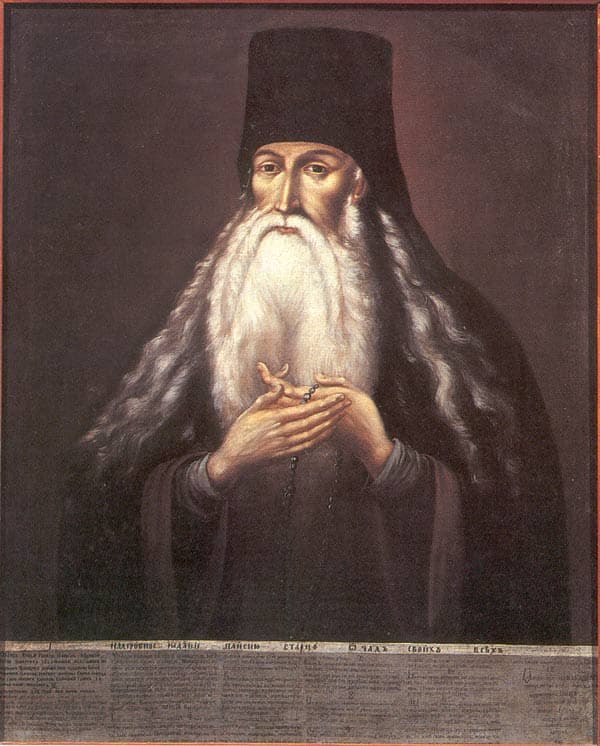
Paisius Velichkovsky — Public domain. Via Wikimedia Commons.
Life
Peter Velichkovsky was born on December 21, 1722, in the small Cossack town of Poltava (now in central Ukraine, then in the Russian-Polish borderlands), into the family of a married Ukrainian Orthodox priest. His father reposed when Peter was four, and his mother — a widow with several small children — gave the boy a particularly attentive Christian upbringing, sending him at thirteen to the famous Mogila Collegium at Kiev.
He found the Collegium too Western in its theology — its Latin-Polish-Scholastic orientation, inherited from Metropolitan Peter Mogila a century earlier, was uncongenial to a boy who was already drawn to the older traditions of the Greek Fathers and the desert ascetics. He left in 1740 at seventeen, made his way alone on foot to the small Liubech monastery on the Dnieper, and entered the monastic life. He was tonsured Plato at his rasophore tonsure; later, at the great schema, he would take the name Paisius (after the third-century desert father Paisius the Great).
He spent his first years (1740-1746) at a succession of small Ukrainian-Russian monasteries — Liubech, the Medvedovsky, the Polonsky — in a constant search for an authentic monastic life that matched what he had read in the Greek Fathers. He found the surviving Russian monastic tradition impoverished by long isolation from the broader Greek tradition. In 1746 he left Ukraine for Mount Athos.
He spent the next seventeen years (1746-1763) on Athos. The first three years were as a private hermit at a small skete near Pantokrator monastery, where he lived in deep poverty and intense study of the Greek patristic texts. From 1750 disciples began to gather. He moved to the Skete of the Prophet Elijah, then to the kellion of St. Constantine at the monastery of Pantokrator, and gradually built up a community of some sixty monks — Romanian and Slavic, with a few Greek converts — who lived together under his direction in a recovered version of the cenobitic discipline he had been searching for.
The decisive work of his Athonite years was the recovery of the Philokalia — the great Greek anthology of patristic texts on the prayer of the heart, compiled at Mount Athos in the 1770s by Nicodemus the Hagiorite and Macarius of Corinth. Paisius worked on Slavonic translations of the constituent texts in parallel with the Greek compilation, and his Slavonic Philokalia (published at Moscow in 1793 as "Dobrotolyubie") became the foundational text of the modern Russian spiritual revival — the work that gave Russian Christians of the nineteenth and twentieth centuries direct access to the desert fathers and Byzantine hesychasts in their own language.
In 1763, under pressure from the Ottoman authorities, the community moved off Mount Athos to Wallachia (modern Romania), then under Ottoman suzerainty but with substantial monastic freedom. They settled first at the Dragomirna Monastery (1763-1775), then — after the Russo-Turkish war of 1768-1774 transferred Bukovina to Austrian rule and Catholicized the local administration — at the Secul Monastery (1775-1779) and finally at the great Neamț Monastery (1779-1794), which Paisius transformed into the leading center of Orthodox monasticism in the Romanian lands.
By his repose, Neamț had over a thousand monks living under his direction — multilingual (Greek, Slavonic, Romanian, Latin all read in the daily refectory readings), strict in the older monastic disciplines, and deeply absorbed in the Philokalic tradition Paisius had recovered. The community sent disciples back into Russia from the 1780s onward; they founded or revived the monasteries that would shape the nineteenth-century Russian starets movement (Optina, Sarov, Valaam, Glinsk).
He reposed at Neamț on November 15, 1794, at seventy-one. He was buried in the Ascension Cathedral of Neamț, where his relics still rest. He was glorified by the Russian Orthodox Church in 1988 (the millennium of the baptism of Rus') and by the Romanian Orthodox Church in 1992. He is the patron of monastic communities that are recovering older traditions, of translators of sacred texts, and of the entire modern Orthodox spiritual revival. His feast is November 15.
Traditions
Feast day
November 15
Topics
Works in library