saint
St. Panteleimon the Great-martyr and Healer
A young physician of Nicomedia, converted by his teacher Hermolaus, who healed all who came to him without payment and was beheaded under Maximian — when his blood touched the ground, the olive tree to which he was bound burst into fruit. Patron of physicians and the unmercenary care of the sick.
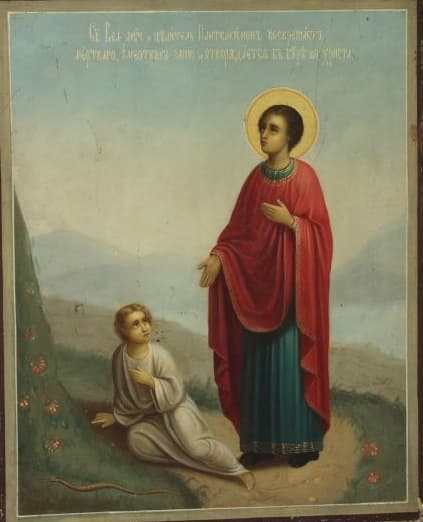
Saint Panteleimon the Healer — Public domain. Gavril Atanasov. Via Wikimedia Commons.
Life
Panteleimon was born around 275 in Nicomedia (today Izmit in Turkey), the imperial city of Diocletian's eastern court. His mother, Eubula, was a devout Christian who taught the boy the faith; his father, the wealthy pagan senator Eustorgius, had him christened in his pagan name Pantoleon ("the all-roaring lion") and entrusted him to the most celebrated physician of Nicomedia, Euphrosynos, to study the healing art. By his early twenties Pantoleon was so distinguished in medicine that the emperor Diocletian had taken notice and was preparing to appoint him personal physician to the court.
His turning came through the elderly Christian priest Hermolaus, who lived hidden near his house. Hermolaus had watched the brilliant young man come and go and at last greeted him one morning with the question: "Is it Asclepius you serve, or the Lord who made him?" Pantoleon, the loving son of a Christian mother who had died young, began to come to Hermolaus's hidden house for conversation. The decisive moment came one day when the young physician passed a dead child lying in the street, killed by a viper still entwined about its neck. He stopped, prayed in the name of Christ as Hermolaus had taught him, and the boy stood up — the viper itself dead at his feet. He went to Hermolaus the same day and asked for baptism.
His father Eustorgius, suspicious of his son's increasing absences from the imperial court, demanded an explanation. Pantoleon led him to the room where his mother had taught him as a child and made a confession of faith. The father, persuaded by his son's prayer over a blind man whose sight was restored at the saint's touch, was himself baptized in his old age. When Eustorgius died, Pantoleon — now using the Christian name Panteleimon ("the all-merciful") — sold the family estate and gave it away. He continued his practice but refused payment of any kind; he set the standard for what the East has called ever after the "unmercenary" physician.
Diocletian was at this time in the middle of the Great Persecution. When other physicians of Nicomedia, jealous of Panteleimon's healings, denounced him at court as a Christian, the emperor summoned him. He came openly, confessed Christ to the emperor's face, and was given over to one torment after another over a period of weeks: cast into a furnace (the fire would not touch him), tied to a stone and thrown into the sea (the stone floated), set before wild beasts (the beasts crouched at his feet), tied to a great wheel (the wheel broke), and at last set under the executioner's sword.
The first stroke broke against him. The soldiers cried out and fell at his feet; he prayed for them and forgave them; the executioner — at his command — finally took off his head. The olive tree against which he had been bound bore fruit when his blood ran down. He was about thirty. His feast is July 27.
He is the patron of all physicians, of hospitals and hospices, of the unmercenary tradition of medical care, and of any soul that suffers in the body. His head, with portions of his relics, rests at the Russikon (the Russian monastery of St. Panteleimon) on Mount Athos, from which countless ampules of holy oil have gone out to the sick of Russia and the world.
Traditions
Feast day
July 27
Topics
Works in library