saint
St. Great-martyr Paraskeva
A maiden of Iconium named for the day the Lord suffered, whose parents kept the Friday fast in her honor. Tortured and beheaded under Diocletian. Patroness of women's work, of marriage, and of those who turn to her with practical needs.
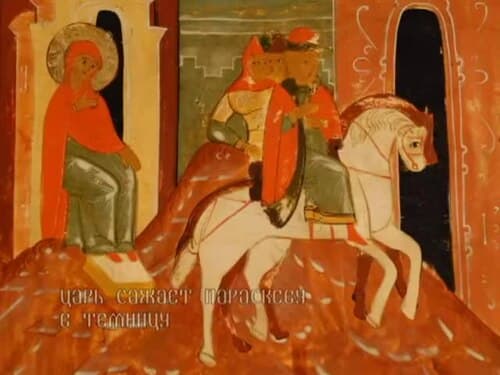
Paraskeva — CC BY 3.0. The Museum of Fine Arts of Karelian Republic. Via Wikimedia Commons.
Life
Paraskeva — her name comes from the Greek word for Friday, "Preparation" (since Friday was the day Jews prepared for the Sabbath, and in Christian use the day the Lord suffered) — was born around 200 in Iconium in Lycaonia (south-central Asia Minor), to wealthy and devoutly Christian parents. They had practiced a strict Friday fast in honor of the Passion of the Lord through long years of childlessness; when their daughter was born to them on a Friday, they named her for the day in thanksgiving.
She grew up in their large house outside the city, learning the faith from her mother and disposed from her earliest years to the contemplative life. When her parents died (she was about twenty), she sold the inheritance, distributed the proceeds among the poor of the city, and set out as an itinerant evangelist through the towns and villages of Anatolia. For a number of years she traveled — sometimes alone, sometimes with women disciples — preaching the gospel in market squares and pagan temple precincts, converting families to the faith, breaking down idols where she could.
She came at last to Rome itself, in the reign of the Emperor Antoninus Pius (138-161). She was arrested for her open preaching and brought before the Emperor in person. He found her remarkably beautiful and gentle, and tried for some time to dissuade her with promises and gifts; she answered him with the long defense of the faith of which a record survives. He ordered her hung up by her hair and beaten; she did not yield. He ordered an iron cauldron of pitch and tar boiled and Paraskeva thrown into it; she stood in the boiling pitch unharmed. He came himself to the foot of the cauldron to see whether she was actually in it — and at her gesture she splashed his face with the boiling tar. He was struck blind on the spot.
He cried out for her prayer. She prayed; his sight returned. He fell at her feet and confessed Christ. He gave the order to release all the Christian prisoners of the city, ordered his court baptized, and put up a public proclamation of toleration. She blessed him and left Rome.
She continued her preaching through the cities of the eastern empire and was finally arrested again at a small town near Therapia (in what is now European Turkey) under a local governor named Tarasius — a fanatical pagan unaffected by Rome's new mildness. He gave her over to a long series of tortures over many days, throughout which she continued to preach to the watching crowds. At last he had her beheaded. She was thirty.
She is one of the very widely honored saints across the Greek and Slavic worlds, but in a way unusual for early martyrs: she is the patroness of women's work — of weaving, sewing, spinning, of every kind of female craft and domestic skill — and of those who keep the Friday fast. In Slavic tradition no woman would spin on Friday in her honor. She is also invoked against headaches (from the boiling of the tar), for the recovery of lost property, and for protection in marriage. Her relics are at the monastery of Iași in Moldavia. Her feast is October 28.
Traditions
Feast day
October 28
Topics
Works in library