saint
St. Peter, Metropolitan of Moscow
First metropolitan to transfer the see of all Rus' from Vladimir to Moscow, the foundation of Moscow as the spiritual center of the Russian land. Friend of Prince Ivan Kalita and builder of the original Dormition Cathedral in the Kremlin.
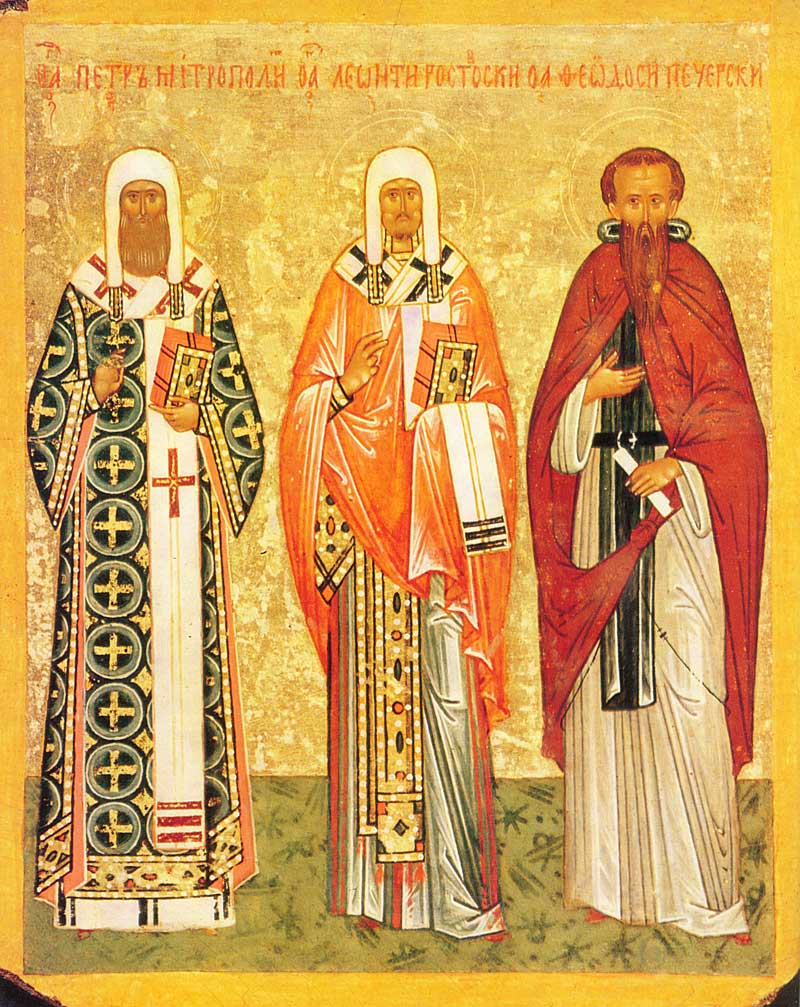
Peter, Metropolitan of Moscow — Public domain. Via Wikimedia Commons.
Life
Peter was born around 1260 in the western Russian principality of Volhynia (now western Ukraine), into a noble landholding family. He entered monastic life at twelve at the small monastery of Spas-na-Rate near his home, where he was given his elementary catechesis and his first training in icon-painting — a skill he would carry through his life. By twenty he had been ordained priest and was already known across the small Volhynian Church as both an iconographer and a thoughtful pastor.
He withdrew around 1290 to a small forest hermitage on the bank of the river Rata, where he lived alone in deep silence for some years before disciples began to gather. The hermitage grew into the small Ratsky Monastery, of which he served as abbot for the next fifteen years. In 1305 the Patriarch of Constantinople (the Russian Church being then under Greek jurisdiction) appointed him Metropolitan of all Rus' — the chief hierarch of the Russian Church, whose seat had since 1299 been at Vladimir on the Klyazma, north of Moscow.
Peter found the metropolitanate in difficulty. The princes of northern Rus' were divided into rival camps — Tver (the rising power in the Russian north under Prince Mikhail Yaroslavich) and Moscow (a smaller cadet principality under Prince Yuri Daniilovich, grandson of Alexander Nevsky). Tver had the older claim; Moscow had energy and ambition. Peter, after several years of diplomatic balancing, came to favor Moscow — partly because he recognized something in the young Prince Ivan I (Ivan Kalita, "Moneybag"), who would inherit the Moscow throne in 1325.
The decisive event of his episcopate was the gradual transfer of the metropolitanate from Vladimir to Moscow. Peter spent increasing time at Moscow from 1322 onward, in the household of Prince Ivan, and eventually settled there permanently. In 1326 he laid the foundation of the original Dormition Cathedral in the Moscow Kremlin — the first stone church of Moscow, intended as the new cathedral of the metropolitanate. He prophesied to Ivan: "If thou, my son, shalt obey me, build this church to honor the Most Holy Theotokos, and lay me to rest in it, thou shalt be glorified above all the princes of Russia, and thy sons and grandsons shalt be glorified, and this city above all cities of Russia."
He reposed on December 21, 1326, at sixty-six, before the cathedral was completed. He was buried at the still-unfinished site of the cathedral. Within a few years the prophecy began to be fulfilled: Moscow's primacy over Tver was established under Ivan Kalita; the metropolitanate was permanently transferred to Moscow in 1327; the Dormition Cathedral became and remained the principal church of the Russian Church through the next six centuries.
His relics rest at the Dormition Cathedral he had founded. He was glorified in 1339 by Patriarch John XIV of Constantinople — one of the very few Russian saints canonized within a generation of his death. He is the patron of Moscow and the founding hierarch of its primacy. His feast is December 21 (repose) and August 24 (translation of relics).
Traditions
Feast day
December 21
Topics
Works in library