saint
St. Philip the Confessor, Metropolitan of Moscow
Abbot of the Solovetsky monastery raised to the see of Moscow under Ivan the Terrible, whom he rebuked publicly for the bloodshed of the Oprichnina. Deposed, exiled, and finally smothered in his cell at Otroch monastery by Malyuta Skuratov.
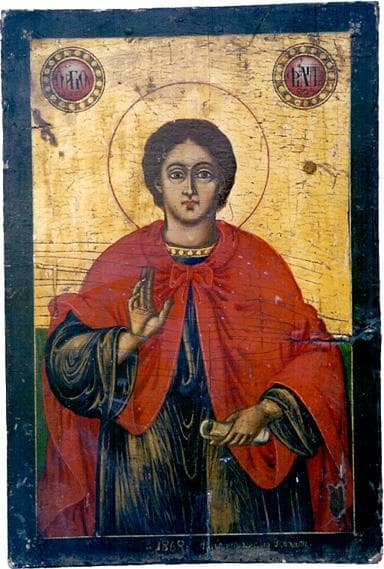
Philip the Confessor, Metropolitan of Moscow — Public domain. Via Wikimedia Commons.
Life
Theodore Stepanovich Kolychev was born on February 11, 1507, in Moscow, into the high boyar Kolychev family — substantial landholders with ancient service to the Moscow throne. He was educated at the family estate at Bezhetsk in the Novgorod hinterland; as a young man he served at the court of the young Grand Prince Ivan IV (the future Ivan the Terrible), then a boy of about five.
In 1537 Theodore's uncle and several other Kolychevs were involved in the failed boyar uprising of Andrei Staritsky against the regent Elena Glinskaya (Ivan IV's mother). Theodore was not personally implicated, but the family's standing at court was destroyed. He left Moscow and disappeared. He went north on foot, in the dress of a peasant, and arrived at the Solovetsky Monastery on the islands in the White Sea — the great northern monastic complex at the far edge of the Russian world — where he was received without anyone recognizing him.
He served at Solovetsky as a novice for eighteen months under unrelated obediences (he worked in the bakery and the cattle-shed), then took monastic vows with the name Philip. He spent the next twenty-eight years at Solovetsky (1537-1565), rising gradually to the offices of treasurer, ecclesiarch, and finally hegumen (abbot, from 1548). Under his abbacy Solovetsky was substantially rebuilt — new stone walls, new cells, the great Transfiguration Cathedral, the system of canals between the lakes that still drains the islands — turning the monastery from a small wooden hermitage into the most important monastic complex of the Russian north.
In 1565 Tsar Ivan IV (now in his terrifying middle period) created the Oprichnina — the personal security apparatus of his rule, with which he was systematically eliminating the high boyar families he believed were conspiring against him. The standing Metropolitan of Moscow, Athanasius, resigned in protest. Ivan looked for a replacement and recalled the well-regarded abbot of Solovetsky. Philip was offered the metropolitanate.
He refused it three times. He demanded as a condition of acceptance that Ivan abolish the Oprichnina. Ivan refused. Philip finally accepted on the condition that he would have the right to public moral counsel to the Tsar (the so-called "right of intercession," an old Russian episcopal prerogative). Ivan agreed. Philip was consecrated metropolitan on July 25, 1566. He was fifty-nine.
He served for about a year and eight months. The Oprichnina meanwhile intensified, with public executions becoming nearly daily in Moscow. Philip exercised his right of intercession constantly — petitioning Ivan privately, then more publicly. The decisive break came on March 22, 1568 (Palm Sunday). Ivan came up to the Dormition Cathedral for the Liturgy in the full uniform of the Oprichnina, with his guard around him; he came forward at the appropriate moment for the metropolitan's blessing. Philip refused to give it. Ivan demanded it three times. Philip said: "It is not the time for silence, lest by your inaction your soul perish."
Ivan was incandescent. He left the cathedral. Over the next several months he had a number of Philip's senior staff arrested and executed on fabricated charges. On November 4, 1568, Philip was deposed at a special synod (the surviving bishops did not dare oppose Ivan), placed in chains, and imprisoned at the Otroch Monastery in Tver. He was held there for over a year.
On December 23, 1569, as Ivan passed through Tver on his way to the destruction of Novgorod, he sent his chief Oprichnik Malyuta Skuratov to demand a blessing from the imprisoned metropolitan. Philip refused. Malyuta — by all the surviving accounts, both Orthodox and Soviet — smothered him with a pillow.
Philip was sixty-two. He was buried at the Otroch Monastery in an unmarked grave. His relics were uncovered in 1591 by the Solovetsky community and translated back to the Solovetsky Transfiguration Cathedral. In 1652 they were translated to Moscow at the order of Tsar Alexei Mikhailovich, in a ceremonial procession the Tsar accompanied on foot — a public Russian state penance for the murder of a saint. They rest at the Dormition Cathedral of the Kremlin in Moscow.
He was glorified in 1652 at the time of the second translation. He is the patron of all who exercise public moral conscience against unjust authority, and of those imprisoned for political reasons. His feasts are January 9 (martyrdom) and July 3 (translation of relics).
Traditions
Feast day
January 9 and July 3
Topics
Works in library