saint
St. Photini the Samaritan Woman, Equal-to-the-Apostles
The woman at Jacob's well who met the Lord at the sixth hour, ran to the city to bring her own people to Him, and was the first preacher of Christ to a Samaritan town. With her five sisters and two sons she preached at Carthage and finally was thrown into a well at Rome under Nero.
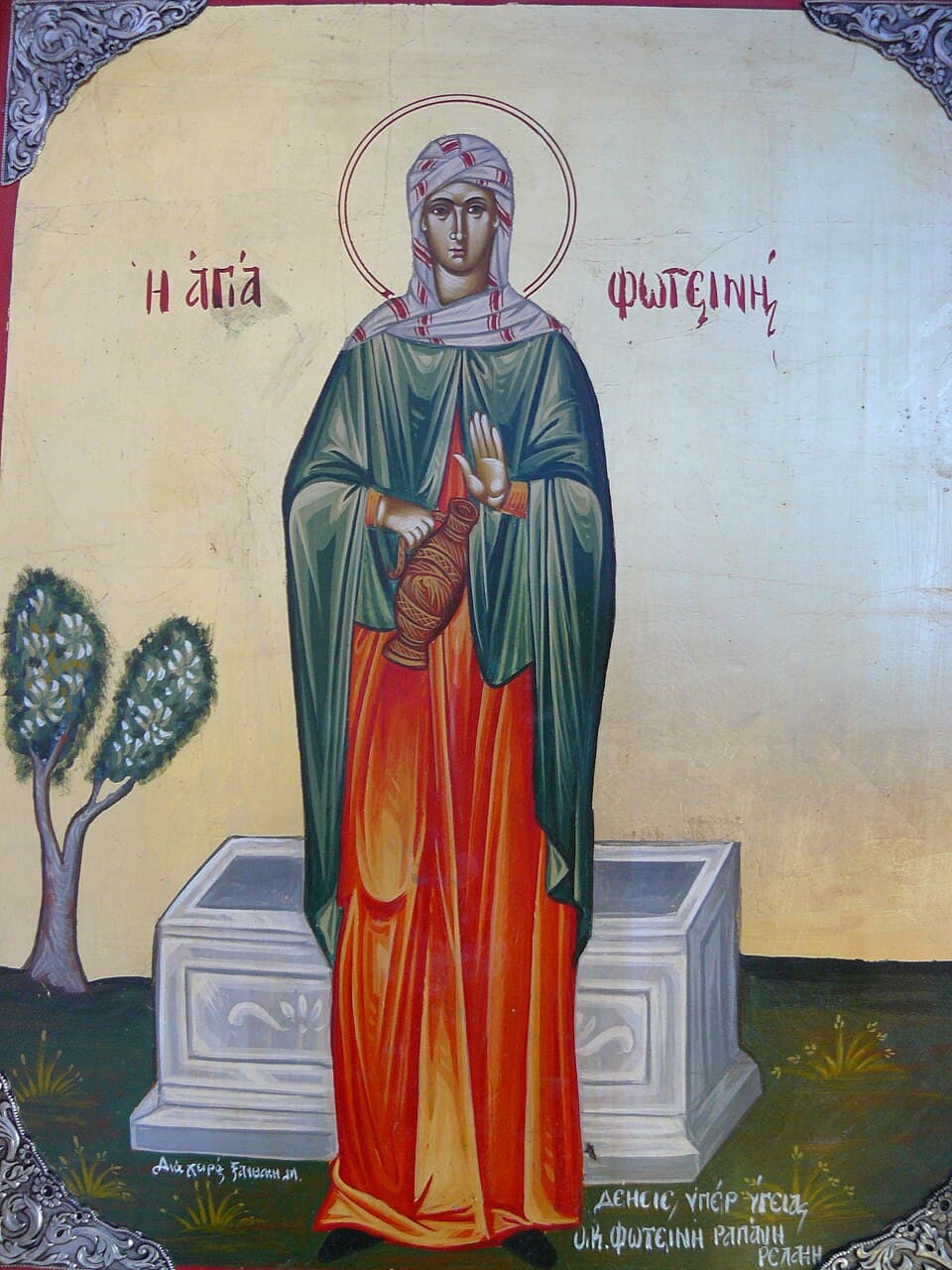
Saint Photini the Samaritan — CC BY-SA 3.0. Schuppi. Via Wikimedia Commons.
Life
The woman whom John 4 records as having met the Lord at Jacob's well outside the city of Sychar in Samaria has been venerated by the Eastern Christian tradition since the earliest centuries under the Greek name Photini ("luminous one") — the early baptismal name given her when she received the faith from the Lord that morning. The standard Eastern Christian biography of Photini, recorded in fully developed form in the sixth-century Synaxarion of Constantinople but with substantial earlier authentication, fills out what John tells us with what tradition has preserved.
She was born around the year 7 in Samaria, in or near the small city of Sychar (now Askar, just east of Nablus on the West Bank). Her family was of the established Samaritan community — religiously a minority that had broken with the Jews of Judah in the sixth century BC and held to a competing version of the Torah and a competing sacrificial center at Mount Gerizim. She had a sister, Anatoli, and several brothers. Her father gave her in marriage as a teenager to a man whose name the tradition has not preserved; the marriage failed, as did each of four subsequent marriages. By the time of her meeting with the Lord she was living with a sixth man without the formal status of marriage. She was about twenty-eight years old.
The encounter at the well took place around 28 — the Lord's first year of public ministry, on His way north from Judea to Galilee through Samaria. He sat down at Jacob's well at the sixth hour (noon) while His disciples went into the city to buy food. Photini came at that unusual hour to draw water — most women drew water in the cool of the morning or the evening; her noon visit was a way of avoiding the disapproving company of the village's other women. The Lord asked her for a drink, opening the conversation by violating two boundaries at once (a Jewish man speaking to a Samaritan woman and the Samaritan-Jewish religious wall). The dialogue that followed — preserved more fully in John 4 than in any other woman's dialogue with the Lord in the Gospels — moves rapidly from her assumption about water in jars to the Lord's offer of "living water," to her unhappy domestic situation (about which the Lord knows everything without being told), to the standing Samaritan-Jewish dispute about which mountain is the proper site of worship, to the Lord's own astonishing announcement: "I that speak unto thee am he" — the Christ. She had spoken with the Christ; she ran back to her city, leaving her water-jar at the well, and brought the citizens of Sychar back with her.
The Lord stayed in the city of Sychar with the new Samaritan converts for two days. He left Photini, her sister Anatoli, and her two sons (whom the Greek tradition names Photinus and Joseph; the Latin tradition names them Victor and Anatolius) as the nucleus of the first Christian community in Samaria. They were baptized at Pentecost in 30 — Photini herself, her sister, her sons, and several other members of the household had come up to Jerusalem for the festival and were among the three thousand whom Peter baptized on the day of Pentecost.
The Samaritan-Christian community that grew up at Sychar through the next decades took her as its center. She preached publicly, with the freedom that the early Pauline communities also gave to women. She was joined by her sons; together they pursued an active mission across Samaria and into the surrounding Roman provinces. She traveled to Carthage in North Africa some time in the late 50s — perhaps as part of the Christian community that fled the Pauline circle in the unrest that followed Paul's mission — and is recorded by an early African source as preaching at the agora of Carthage.
The decisive event of her life came in the persecution of Nero (64-68). She was at this point about sixty. She, her sons, and several other members of her household had come to Rome to plead for the cause of the Roman Christian community against the Neronian persecution. Tradition gives a long story of her appearance at Nero's court, of his attempts to win her over (including offering one of his daughters in marriage to her son Photinus), and of the household's eventual martyrdom in the imperial gardens. She was thrown alive into a deep well — a fittingly grim echo of the well at Sychar where she had first met the Lord — and was buried alive in it on March 20, 66.
Her relics were recovered by the early Roman Christian community after the death of Nero and were eventually translated to Constantinople in the sixth century, where they rest at the church of Hagia Photini built specifically for the purpose by the Emperor Justinian. Substantial portions are at the cathedral of Caltagirone in Sicily and at the modern Russian convent of St. Photini in Bethlehem.
She is honored by the Eastern Church under three titles: "Equal-to-the-Apostles" (since her preaching brought a whole Samaritan city to the faith on the day she met the Lord, and a whole African city to the faith years later), "Great-martyr" (for her death in the Neronian persecution), and "First-converted of the gospel" (since she is, after the Mother of God and the apostle John, the first explicit personal convert recorded by the Fourth Gospel). Her feast is February 26, and she is read in the Sunday Gospel of the Fifth Sunday after Pascha — the so-called Sunday of the Samaritan Woman — when the long encounter at the well is chanted in every Orthodox church.
Traditions
Feast day
February 26 and the fifth Sunday of Pascha
Topics
Works in library