father
St. Photios the Great, Patriarch of Constantinople
Patriarch of Constantinople of vast learning whose Mystagogy of the Holy Spirit decisively rejected the Filioque addition to the Creed, and whose Bibliotheca preserved fragments of much ancient literature otherwise lost. He sent the brothers Cyril and Methodius to the Slavs.
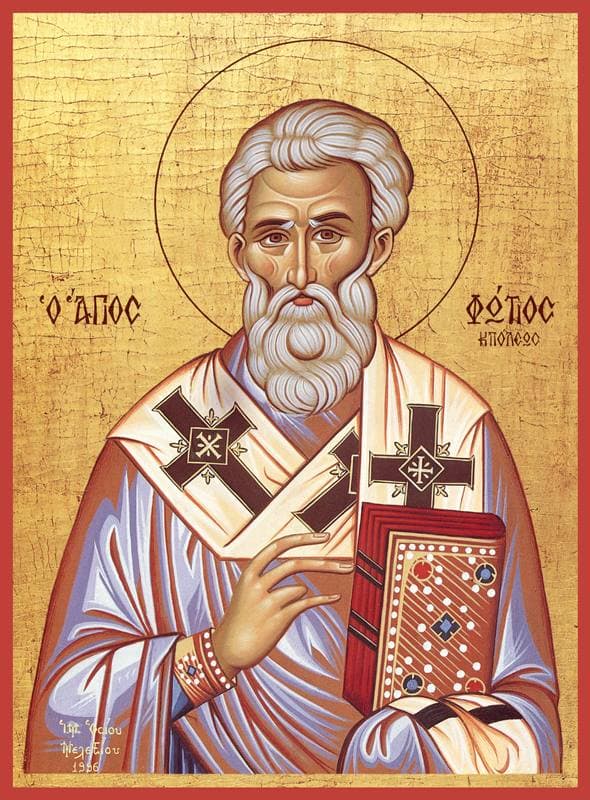
Saint Photios the Great — Hand-curated icon.
Life
Photios was born around 815 in Constantinople, into a senior aristocratic family of the imperial city. His father, Sergios, was a senior official of the imperial bureaucracy; his mother, Irene, was a niece of the future patriarch Tarasios who had presided over the Seventh Ecumenical Council (Nicaea II, 787, the council that restored the veneration of icons). Sergios and Irene were themselves exiled briefly during the second iconoclasm (815-843) for their open veneration of the icons; the boy Photios grew up in his family's banishment and absorbed in his earliest years the conviction that defending the icons was the central work of his time.
He was educated in Constantinople — first at the imperial palace school, then under various private teachers — and emerged as perhaps the most learned man of the Byzantine ninth century. His Bibliotheca, written when he was about thirty, is a collection of summaries and excerpts of two hundred eighty pagan and Christian books he had read (many of them now lost, surviving only in his summaries — a major source for our knowledge of late antique literature). His Lexicon, a Greek dictionary based on his lifelong reading, was the foundational reference work of Byzantine Greek scholarship through the next thousand years. He read widely in philosophy, theology, history, science, and political theory; he taught privately at his house in the city.
He held the senior bureaucratic post of imperial secretary (the protasekretis) until 858, when the imperial court found itself in a constitutional crisis. The Empress-mother Theodora — who had been regent during the boyhood of Emperor Michael III and who had restored the icons in 843 — was being pushed out of power by Michael's uncle Bardas. The reigning Patriarch Ignatios (a senior eunuch of imperial family, son of a former emperor) sided with Theodora and refused to give the empress the tonsure that would force her permanent retirement into a monastery. Ignatios was deposed by an imperial synod; the lay scholar Photios was rushed through all the clerical orders in five days (a clear canonical irregularity that would haunt his patriarchate ever after) and consecrated patriarch on Christmas Day 858.
He served as patriarch from 858 to 867 in his first patriarchate and again from 877 to 886 in his second. The two crises that defined his ecclesiastical career were both with the Western Church. The first was the dispute with Pope Nicholas I over the Bulgarian mission: Photios had sent Cyril and Methodius (the brothers from Thessalonica) to evangelize the Slavs of Moravia in 863, but the conversion of the Bulgarians the next year had been contested between the Eastern and Western Churches, and Pope Nicholas refused to recognize Photios's patriarchate. In retaliation Photios convened a synod at Constantinople in 867 that anathematized Nicholas — the first formal break between Rome and Constantinople, though it was patched up after the death of Michael III.
The second and more lasting crisis was the dispute over the Filioque. The West had since the fifth century been adding the phrase "and from the Son" (Filioque in Latin) to the description of the procession of the Holy Spirit in the Creed: "who proceeds from the Father and from the Son." The Eastern Church had never received the addition and rejected it both on dogmatic grounds (the Father is the sole principle of the Trinity in Eastern theology, and a Spirit "proceeding from the Son" makes the Son a second source of divinity alongside the Father) and on canonical grounds (the Creed had been settled by the Second Ecumenical Council and no local change to it was canonically permissible). Photios's Mystagogy of the Holy Spirit, written during his second patriarchate, is the systematic Eastern refutation of the Filioque and has remained the standard Orthodox argument against it ever since.
He returned to office in 877 after the death of his successor Ignatios, was deposed again in 886 by the new Emperor Leo VI (who wanted his own younger brother Stephen on the throne), and spent his last five years in honorable retirement at the monastery of the Armenians in the city. He continued to teach and write through the retirement and reposed there on February 6, 893, at the age of seventy-seven.
His relics, originally at the monastery of the Armenians, were dispersed after the Latin sack of Constantinople in 1204; portions are at the monastery of Iviron on Mount Athos and at the Patriarchal Cathedral of St. George in Istanbul. He was canonized by the Synod of Constantinople in 1872 — over a thousand years after his death — in the context of the modern Orthodox affirmation of his theological work against the Western errors that had widened in the intervening centuries. His feast is February 6.
Traditions
Feast day
February 6
Topics
Works in library