father
St. Polycarp of Smyrna
Disciple of the apostle John, bishop of Smyrna for sixty-five years, who under Marcus Aurelius answered the proconsul's demand to revile Christ: 'Eighty and six years have I served Him, and He has done me no wrong; how then can I blaspheme my King who saved me?' Burned at the stake, then pierced through.
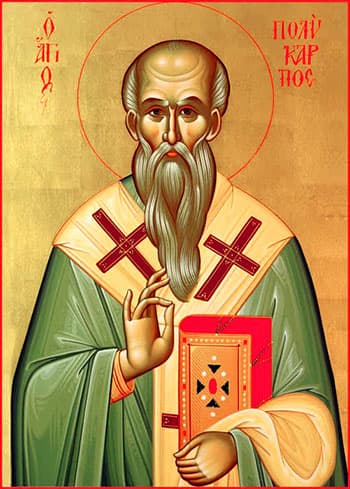
Polycarp of Smyrna — Hand-curated icon.
Life
Polycarp was born around 69 in Asia Minor, perhaps at Smyrna itself. As a young man he heard the apostle John in person — Polycarp's disciple Irenaeus of Lyons would still remember in old age sitting at his teacher's feet and hearing him recount what John had said about the Lord. John ordained him bishop of Smyrna, and he served his city for at least sixty years.
In about 110 his old friend Ignatius of Antioch, on the road to martyrdom at Rome, stopped at Smyrna. Polycarp sheltered him; Ignatius wrote one of his seven letters directly to Polycarp from Troas, urging the younger bishop to stand fast against the gnostic teachers and to attend to the widows and the poor of his city. Years later, when the Marcionite heretic Marcion met Polycarp in Rome and asked the old bishop "Do you not know me?", Polycarp answered "Yes, I know you — the first-born of Satan."
In 155, near the end of his life, a persecution broke out at Smyrna. Polycarp was an old man — eighty-six by his own reckoning — and the Christians of the city urged him to leave the town. He withdrew to a farmhouse outside the walls; the police found him there, and he ordered food and drink prepared for them while he stood at prayer for two hours before going with them quietly.
At the stadium the proconsul Statius Quadratus pressed him: "Swear by the genius of Caesar; revile Christ, and I will release you." Polycarp answered with the words by which he is forever remembered: "Eighty and six years have I served Him, and He has done me no wrong. How then can I blaspheme my King, who saved me?" The proconsul condemned him to burn. The fire would not consume him, the bystanders said — it arched around him like a sail — until at last an executioner ran him through with a dagger; the blood put out the flames, and a dove flew up from the wound.
The account of his martyrdom written by the Smyrna church to the church at Philomelium — preserved in full — is the earliest detailed martyrdom account in Christian literature outside the New Testament. The bones of Polycarp, the Smyrniots wrote, "are more precious than the jewels of kings." His feast is February 23.
Traditions
Feast day
February 23
Topics
Works in library
Readings and commentaries
Epistles
Martyrdom of Polycarp
Epistle to the Philippians
Polycarp's only surviving letter, sent to the church at Philippi shortly after the martyrdom of Ignatius of Antioch. The letter encloses copies of Ignatius's epistles — the textual tradition by which the Ignatian corpus reached the later Church.
The Martyrdom of Polycarp
A letter from the church at Smyrna recording the arrest, trial, and burning of their 86-year-old bishop Polycarp. The earliest extant detailed Christian martyrdom narrative, and the prototype of the genre — explicitly modeled on the Passion of Christ, with Polycarp's prayer at the stake and miraculous endurance of the flames.