saint
St. Porphyrios of Kavsokalyvia
Twentieth-century Greek elder of luminous gentleness, a clairvoyant healer who spent decades as chaplain of an Athens polyclinic and the last years of his life back on the Holy Mountain. Author of Wounded by Love.
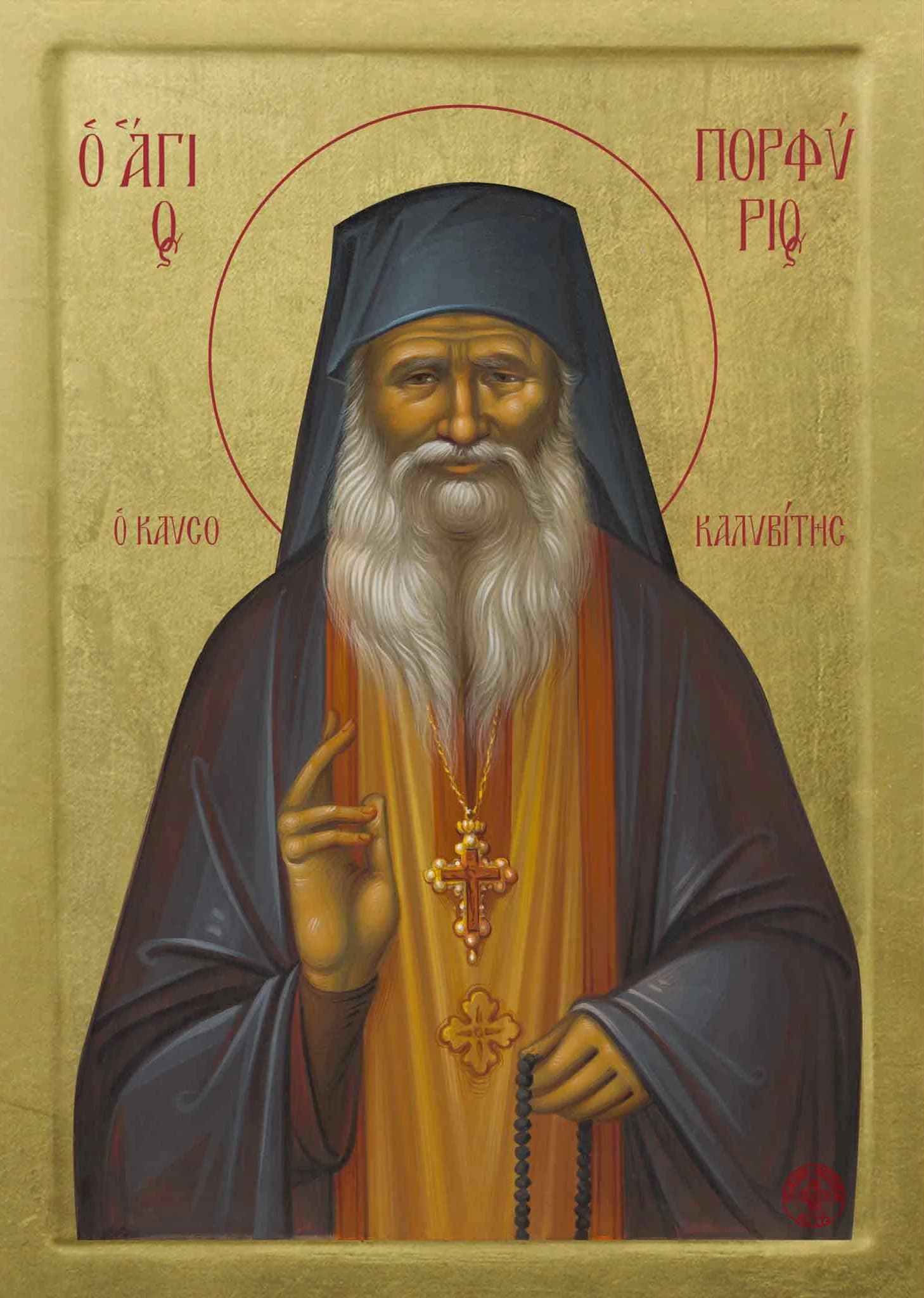
Saint Porphyrios of Kavsokalyvia — Hand-curated icon.
Life
Evangelos Bairaktaris was born on February 7, 1906, in the small village of Saint John on the Greek island of Evia, into a poor peasant family of seven children. His father, Leonidas, was a substantial-tenant farmer of pious habits — a kind of village deacon who chanted at the parish church on Sundays — and his mother, Eleni, was a quiet woman of deep piety. The family had to send Evangelos out to work at seven years old, since they could not afford his schooling beyond the second grade. He worked for several years as a shepherd in the high hills of Evia, then as a coal-miner's assistant in a small mining operation at the port of Halkida.
The decisive event of his life took place when he was about twelve. He had read a small life of Saint John the Theologian — perhaps the only book he had ever owned — and was so taken with the figure of the apostle that he ran away from home at twelve and made his way alone, on foot and by passing fishing boats, to Mount Athos. He arrived at the skite of Kavsokalyvia on the western side of the mountain after a journey of some weeks. He was received reluctantly (the elders did not normally accept boys so young, and he was unprepared), but the abbot of Kavsokalyvia, Father Pantelaimon, recognized something in the boy and gave him a small cell.
He spent his next fourteen years at Kavsokalyvia (1918-1932), under two successive elders: Pantelaimon and his disciple Ioannikios. Both were strict ascetics of the old Athonite school. Evangelos took the monastic name Nikitas as a novice; later he was given the name Porphyrios at his great schema tonsure. The two elders gave him an extraordinarily rigorous formation in the unceasing prayer of the heart — the Jesus Prayer, the hesychast technique, the controlled breathing, the long vigils. By the time he was twenty he was a recognized hesychast.
The decisive spiritual event of his Athonite years came at the chapel of Saint George on Mount Athos when he was about nineteen. He had been keeping the chapel for an aged hermit who lived nearby. One evening he heard the hermit praying alone in the chapel. The hermit was caught up in the vision of the divine Light; the chapel filled with an uncreated brightness that Porphyrios saw clearly. He understood for the first time, by direct experience, what the hesychast tradition had been teaching about the Taboric Light. He received the gift of clairvoyance (the gift of reading hearts) from that hour and kept it for the rest of his life.
In 1926, at twenty, he was ordained priest by an Athonite bishop. He served at Kavsokalyvia for several years more. In 1932, when he was twenty-six and in poor health from his ascetical labors, his Athonite elders sent him out of the mountain for treatment. He stayed at the small monastery of Saint Charalampos at Levkas on the Greek mainland for some time, then was sent — almost by accident — as chaplain to the polyclinic at the Athens cathedral. He served there for some thirty-three years.
The polyclinic chaplaincy was an unusual appointment for a man of his contemplative tradition, but it suited him exactly. He worked through the long Greek crisis of the 1940s (the German occupation, the Greek Civil War, the years of starvation and political collapse) as a parish priest in Athens — confessing the patients of the polyclinic, giving the last rites, teaching the children of the neighborhood, hearing confessions of military officers, government ministers, gypsies, and prostitutes alike. He kept up his hesychast practice through the chaos of the city; he became famous in Athens for his ability to read the hearts of those who came to him.
He retired from the polyclinic in 1971 at the age of sixty-five and went back to Mount Athos for some years (1979-1984), settling in a small hermitage near his old skite of Kavsokalyvia. The end of his life was marked by intensifying pilgrim traffic (the news of his return to the mountain spread, and thousands sought him out each year) and by failing health from a heart attack in 1980 and progressive cataracts. He was nearly blind by 1985.
He reposed at his hermitage at Kavsokalyvia on December 2, 1991, at the age of eighty-five. He had timed his return to the mountain so as to die there, near the place of his Athonite formation. His body was buried at Kavsokalyvia by his disciples. His written counsels — recorded by his spiritual daughters and disciples and published after his death as Wounded by Love and other volumes — have made him perhaps the most-read Greek elder of the modern Orthodox world.
He was canonized by the Ecumenical Patriarchate in November 2013. His feast is December 2.
Traditions
Feast day
December 2
Topics
Works in library