saint
Holy Daniel the Prophet and the Three Holy Youths
A young captive of Babylon who in the lions' den was kept by God, and the three companions — Ananias, Azarias, and Misael — who in the fiery furnace sang the hymn that the Church still chants in the eighth ode of every canon.
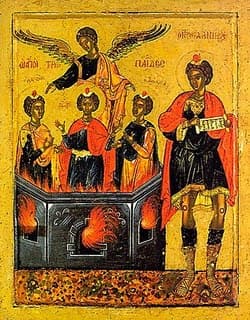
Daniel the Prophet and the Three Holy Youths — Public domain. Via Wikimedia Commons.
Life
Daniel was born around 620 BC in Judah, into a noble Judahite family — probably of the royal house of David through one of the cadet branches. He was a boy of perhaps fifteen or sixteen in 605 BC when Nebuchadnezzar of Babylon, victorious over Pharaoh Necho at Carchemish, marched south through Syria, took Jerusalem, exacted tribute from King Jehoiakim, and carried off to Babylon a portion of the Temple treasures together with a group of noble Judahite youths to be raised at the Babylonian court. Daniel was among them, along with his three companions Hananiah, Mishael, and Azariah.
The four were given Babylonian names — Daniel became Belteshazzar, Hananiah became Shadrach, Mishael became Meshach, Azariah became Abednego — and were enrolled in the three-year course of the Chaldean Magi: Babylonian language and literature, mathematics and astronomy, the interpretation of dreams, and what we today would call the law and political science of the Babylonian empire. They were also enrolled at the king's table, which presented a problem to the four since the food and wine of the king were a violation of the Mosaic law.
Daniel asked the eunuch in charge to give them only vegetables and water and to test them at the end of ten days. The test resulted in the four being healthier and more vigorous than their court-fed peers, and they were allowed to continue with their dietary preference. The Lord gave them surpassing wisdom in their studies, and Daniel in particular received the gift of dream-interpretation. At the end of three years they were brought before the king and were found to be ten times better than the Chaldean Magi of the court.
The first great moment of his prophetic service came when Nebuchadnezzar dreamed a disturbing dream that he then could not remember. He demanded that the Magi tell him both the dream and its interpretation, on pain of death; they could not. Daniel asked for time, prayed with his three companions through the night, and received in vision both the dream — the great image of gold, silver, bronze, iron, and clay, struck down by a stone cut without hands — and its interpretation: the successive empires that would rule the ancient Near East, and the everlasting kingdom of the Messiah that would supersede them all. Nebuchadnezzar made him chief of all the wise men of Babylon.
His three companions were thrown into the fiery furnace by Nebuchadnezzar for refusing to bow down to the great golden image he had set up — but the Lord sent his angel into the furnace with them, and the four (the three young men and a fourth figure "like the Son of God") walked unharmed in the midst of the fire. The fire-song they sang in the furnace — the Hymn of the Three Holy Children — is chanted as the seventh and eighth odes of every Orthodox canon to this day.
Daniel himself was thrown into the lions' den under Darius the Mede, for praying three times a day toward Jerusalem in defiance of the king's decree. The lions licked his feet. The king restored him, fed his accusers to the lions in his place, and proclaimed throughout the empire the God of Daniel. The visions of the seventy weeks (Daniel 9), of the Son of Man coming on the clouds of heaven to the Ancient of Days (Daniel 7), of the ram and the he-goat (Daniel 8), of the time of trouble and the resurrection of the just and the unjust (Daniel 12), all came to him in his old age.
He lived to a great age — perhaps over ninety — and reposed peacefully at the court of Cyrus the Persian around 530 BC, by then a respected adviser of three successive imperial dynasties (Babylonian, Median, Persian). His relics were buried at Susa, the Persian summer capital. They have been venerated as a Christian site since the Persian Christian community recognized them; a portion was translated to Constantinople in the early Byzantine period. The Tomb of Daniel at Susa (modern Shush in Iran) is still a recognized holy place.
His feast is December 17, kept jointly with his three companions Hananiah, Azariah, and Mishael. The four are also commemorated on the Sunday before the Nativity (the Sunday of the Holy Forefathers), as among the principal preparations of Christ's coming.
Traditions
Feast day
December 17
Topics
Works in library