saint
Holy David the King and Prophet
Shepherd boy of Bethlehem, anointed by Samuel, slayer of Goliath, king of Israel, author of the Psalter that has been the prayerbook of the Church through every age. Ancestor of the Christ according to the flesh.
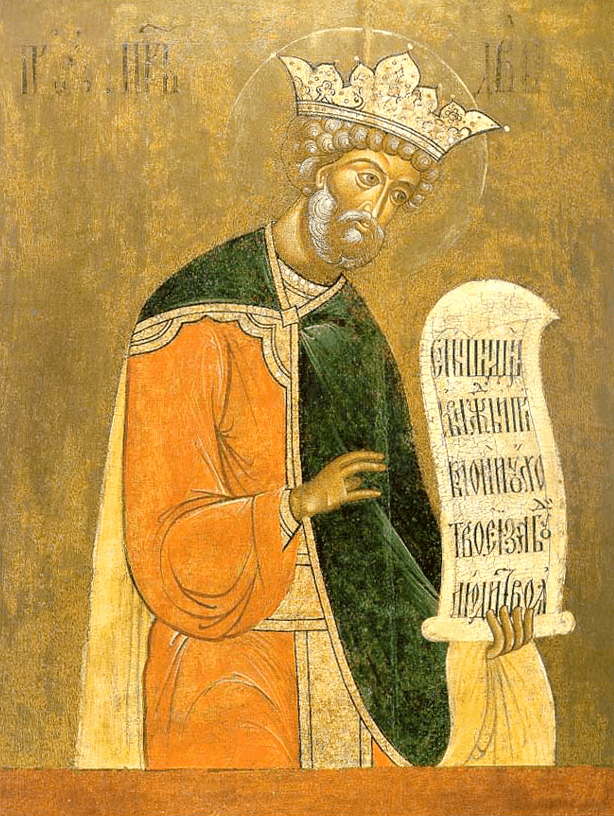
David the King and Prophet — CC BY-SA 4.0. http://www.obraz.org/. Via Wikimedia Commons.
Life
David was born around 1040 BC in the small Judahite village of Bethlehem, the youngest of the eight sons of Jesse — a sheep-farmer of moderate means whose ancestry went back through Boaz and Ruth to Judah, the son of the patriarch Jacob. He was perhaps fifteen or sixteen when the prophet Samuel came to Bethlehem at the Lord's direction to anoint the boy as the next king of Israel (in secret, since King Saul still reigned). The seven older brothers were paraded before Samuel and rejected; David was sent for from the fields, and Samuel anointed him as Saul stood in his prime in distant Gibeah.
He went up to Saul's court not yet as king but as a court harpist, soothing the king's troubled spirit with his music. His first public action — the duel with the Philistine giant Goliath in the valley of Elah, when David was perhaps seventeen — fixed his name in the memory of his people forever. He fought with sling and stones, refusing the king's armor, and brought down the giant with a single stone to the forehead. Saul made him a captain over the army.
The years that followed were a long ordeal of the king's growing jealousy and David's flight. He was driven from court, hunted through the wilderness of Judea and the Negev, sheltered for a time among the Philistines themselves, and finally — after Saul's death in the battle of Mount Gilboa — he was anointed publicly first king of Judah at Hebron, then seven years later king of all Israel at Jerusalem, the city he had taken from the Jebusites and made his capital.
He reigned over a united Israel for thirty-three years (about 1003-970 BC), extending the borders of the kingdom from the Sinai to the Euphrates and bringing the Ark of the Covenant in solemn procession into Jerusalem. He had planned to build a temple for the Ark but was forbidden by the prophet Nathan: as a man of war and bloodshed, he was not to build the Lord's house; the task was given to his son Solomon. He was given instead the foundational covenant of 2 Samuel 7 — that his throne would be established forever, and that one of his sons would build the Lord's house and rule over Israel without end. This is the covenant from which the messianic title "Son of David" comes, applied in the New Testament to the Lord.
The shadows of his reign were two great sins: his adultery with Bathsheba and his arranged murder of her husband Uriah the Hittite (one of his most loyal generals), and his uncharacteristic ordering of the census of Israel in his later years. Both sins were followed by deep public repentance — the second produced Psalm 51, the great penitential psalm read by every Orthodox at the third hour and through the entirety of the Great Lent. The Church reads David's repentance as the standard example of what a Christian penitence looks like: open confession, refusal to pass the guilt to another, and the acceptance of the consequence.
His authorship of the seventy-three Psalms attributed to him in the Hebrew Bible (and the larger number ascribed to him in the Septuagint and the Eastern tradition) made him "the Psalmist" — the principal Old Testament voice of the Christian liturgy. The Psalter is recited in its entirety twice a week throughout most of the year in the Orthodox monastic Office, and at least once weekly in the parochial Office. There is no Christian service that does not, somewhere, quote the words David wrote.
He reposed at Jerusalem at seventy, in 970 BC, having ruled forty years (seven at Hebron, thirty-three at Jerusalem). He was buried at the City of David — the old Jebusite citadel on the southern slope of the Temple Mount — in a tomb that was still pointed out in the time of the apostles (Peter mentions it in Acts 2). The Crusader-era basilica on Mount Zion now identified as the Tomb of David is a much later tradition.
His feast is the Sunday after the Nativity (December 26 or the following Sunday), kept jointly with Joseph the Betrothed and James the Brother of the Lord. He is the great Old Testament patron of repentance, of musicians, of the divinely-appointed sovereign, and of those who fall greatly and rise again.
Traditions
Feast day
December 26 (Sunday after Nativity)
Topics
Works in library