saint
Prophet Elijah the Tishbite
The fiery prophet who at Mount Carmel called down fire from heaven against the priests of Baal, was fed by ravens in the wilderness, and was taken up alive in a chariot of fire — the herald who is to return before the great Day of the Lord. Patron of the Carmelite tradition and of all who contend for the faith.
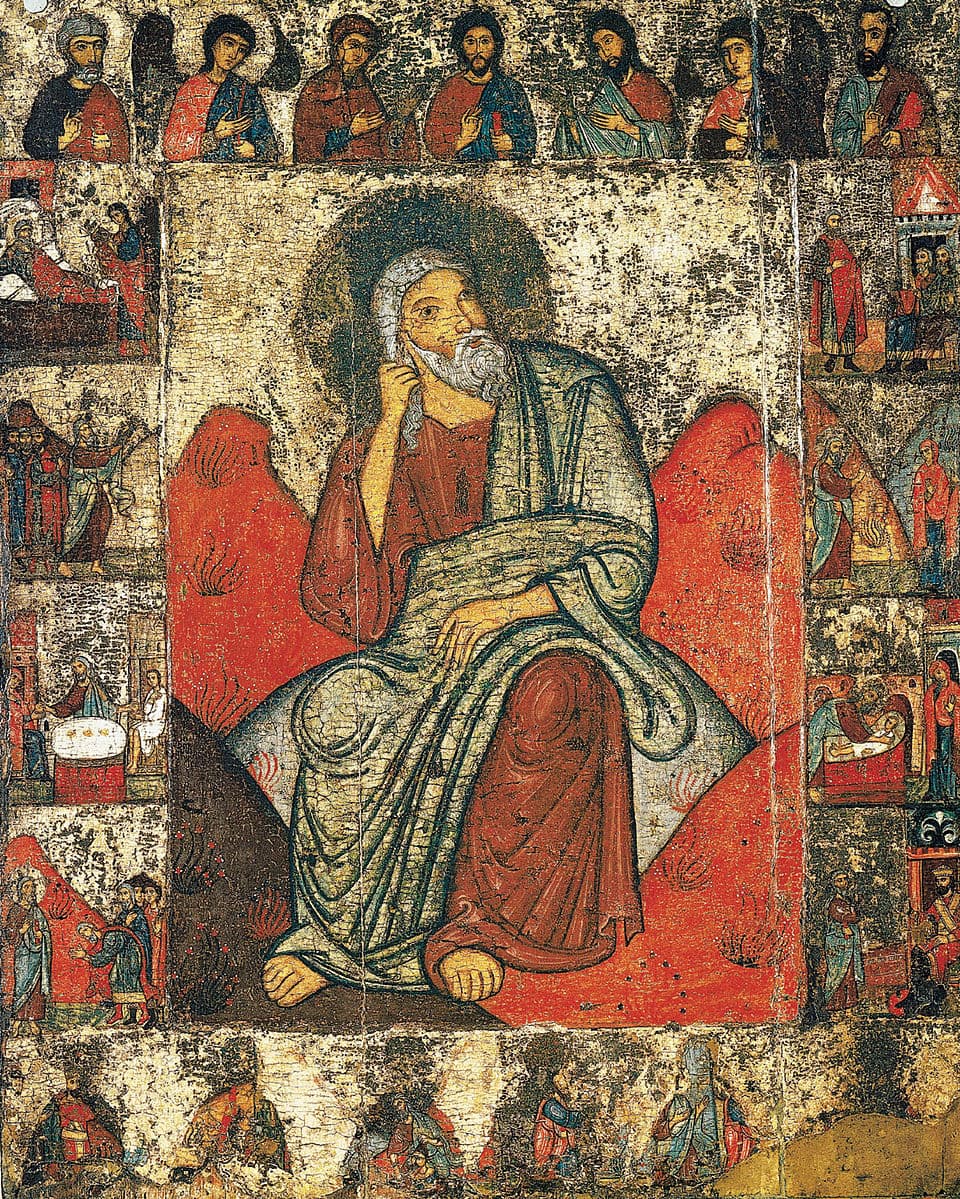
Elijah the Tishbite — Public domain. Via Wikimedia Commons.
Life
Elijah the Tishbite, of the inhabitants of Gilead, appears suddenly in the ninth century BC at the court of Ahab, king of the northern kingdom of Israel — without genealogy, without backstory, like a wind from the desert. He confronts the king with a single line: "As the Lord God of Israel liveth, before whom I stand, there shall not be dew nor rain these years, but according to my word." With that pronouncement he disappears.
The years of his ministry, recorded in 1 Kings 17-21 and 2 Kings 1-2, are a series of confrontations between the prophet of YHWH and the priesthood of Baal that Queen Jezebel had imported from her father's court at Sidon. God hides Elijah by the brook Cherith, where ravens bring him bread and meat morning and evening; sends him to a poor widow at Zarephath, whose handful of meal and jar of oil do not fail through three years of drought; raises her dead son through Elijah's prayer.
The high point is Mount Carmel. Elijah summons all Israel and the four hundred and fifty prophets of Baal to the mountain. Each side will prepare a bull on its altar and call on its god; the god who answers by fire is God. The prophets of Baal cry and slash themselves all morning to no effect. Elijah, when his turn comes, drenches his altar three times with water; he prays a single short prayer; the fire of the Lord falls and consumes the sacrifice, the wood, the stones, the dust, and the water in the trench. The people fall on their faces; the prophets of Baal are seized and slain at the brook Kishon.
After the victory, with Jezebel's death-threat at his back, he flees south. At Beersheba he prays to die; under a juniper tree an angel feeds him; in the strength of that meat he walks forty days to Mount Horeb (Sinai) where Moses had once stood. There the Lord passes him by — not in the wind, not in the earthquake, not in the fire, but in a still small voice. He receives the commission to anoint Hazael king of Syria, Jehu king of Israel, and Elisha as his prophetic successor.
His end is unique among the prophets. As he and Elisha walk together from Bethel toward Jericho, a chariot of fire with horses of fire suddenly separates them, and Elijah goes up by a whirlwind into heaven — never dying. His mantle falls upon Elisha, who picks it up and receives a double portion of his master's spirit.
The Old Testament closes (in Malachi 4:5) with the promise: "Behold, I will send you Elijah the prophet before the coming of the great and dreadful day of the Lord." The Forerunner John came in the spirit and power of Elijah; the Lord Himself confirms at the Transfiguration that Moses and Elijah, the two figures who alone met God on the holy mountain, are the great prophets of His coming. Orthodox tradition (rooted in 2 Esdras and other apocrypha) understands that Elijah and Enoch — the two who did not see death — will return at the end to confront the Antichrist before being slain themselves, completing the work begun.
He is the patron of the Carmelite order (formed at the cave on Mount Carmel where he had hidden during the famine), of military and naval forces, of foundries and engineers, and of all who contend for true worship against syncretism. His feast is July 20 — the day fixed by the desert tradition at his ascent in the fiery chariot. In Russia, where his cult is exceptionally strong, July 20 is the height of summer thunder and lightning; the saint who once called down fire from heaven is invoked over every Russian storm.
Traditions
Feast day
July 20
Topics
Works in library