saint
Prophet Elisha the Prophet
Disciple of Elijah, on whom the prophet's mantle fell when the chariot of fire took Elijah up. He worked sixteen recorded miracles — twice his master's — and his very bones raised a corpse to life. Worker of mercy who healed the waters of Jericho.
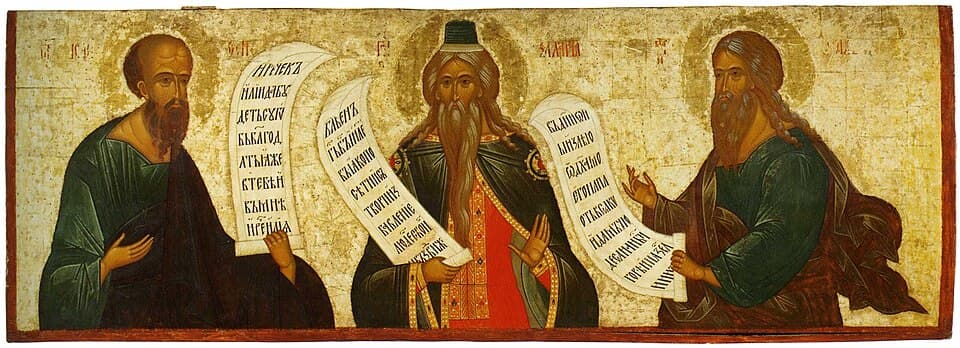
Elisha the Prophet — Public domain. Via Wikimedia Commons.
Life
Elisha was born around 910 BC at Abel-meholah in the Jordan valley, in the southern part of the tribal territory of Issachar (modern Beit-Yosef in northern Israel). His father, Shaphat, was a substantial-tenant farmer with twelve yoke of oxen — about as wealthy as a non-noble farmer of the period could be. The family appears to have been pious, since the boy Elisha was already known for his faithfulness when the prophet Elijah came to him.
He was perhaps twenty when the call came. Elijah, fleeing into the wilderness from Queen Jezebel's death sentence, had been instructed by the Lord at Horeb to anoint Elisha as his successor. He came down to Abel-meholah, found the young man plowing — Elisha was at the back of the line with the twelfth yoke of oxen — and as he passed walked over to him and threw his prophetic mantle on his shoulders. Elisha understood the gesture immediately. He left the plow, kissed his father and mother farewell, killed his oxen, made a feast for the local people from their meat (a renunciation of his old livelihood), and followed Elijah.
He served as Elijah's disciple for perhaps six years (around 870-864 BC). The two of them traveled the small prophetic circuit of northern Israel — Gilgal, Bethel, Jericho, the Jordan. On the day of Elijah's ascension, Elisha refused three times to leave his master's side: at Gilgal, at Bethel, at Jericho. They crossed the Jordan together (Elijah parted the waters with his mantle), and Elijah asked Elisha what he wanted as a parting gift. Elisha asked for a double portion of his master's spirit — the inheritance of the firstborn son under Mosaic law, an audacious request. Elijah told him that if he saw the ascent he would have it. The chariot of fire and the horsemen of fire came; Elijah was taken up; Elisha saw it, cried out "My father, my father, the chariot of Israel," tore his clothes, and picked up Elijah's mantle that had fallen.
He recrossed the Jordan with the mantle, parting the waters as Elijah had done — the first of his miracles, and the public sign that the prophetic spirit was now on him. He served as the principal prophet of northern Israel for the next fifty-five years (around 864-810 BC), through the reigns of Jehoram, Jehu, Jehoahaz, and the early years of Jehoash.
His miracles outnumber Elijah's. The Hebrew text records sixteen of them — double Elijah's eight, a fulfillment of the request for a double portion. The principal miracles: the healing of the bitter waters of Jericho with a handful of salt; the multiplication of the widow's oil; the resurrection of the Shunammite woman's son; the cleansing of the Syrian general Naaman from leprosy in the Jordan; the floating of the iron axe-head; the feeding of one hundred men with twenty barley loaves (a clear type of the Lord's later miracle of the loaves); the smiting of Gehazi with leprosy for greed.
Among his most striking acts were the political ones. He instigated the coup of Jehu against the house of Ahab, sending one of the young prophets of the schools to anoint Jehu as king with explicit instructions to "destroy the house of Ahab." Jehu carried out the coup; the wicked queen-mother Jezebel was thrown from her window by her own eunuchs; the seventy sons of Ahab were beheaded; the priests of Baal were exterminated. Elisha's prophecy was fulfilled.
He died in old age, around 810 BC, of an unspecified illness, in his sickbed at Samaria. King Jehoash visited him before the end and wept over him: "O my father, my father, the chariot of Israel, and the horsemen thereof" — the same cry Elisha had given at Elijah's ascension. He gave Jehoash one last prophecy about a Syrian war. He died and was buried in the prophet's tomb at Samaria.
The most striking miracle was performed after his death. A year later, as a funeral procession was passing his tomb, a Moabite raiding band attacked; the bearers, in haste, threw the corpse they were carrying into Elisha's tomb. The corpse touched Elisha's bones and immediately rose alive. The story is one of two scriptural examples (Acts 19:12 — Paul's handkerchiefs — is the other) of relics working miracles, and is the foundational Old Testament warrant for the Christian veneration of relics.
His relics were partly translated to Alexandria in the third century and from there to various Christian shrines; major portions are at the monastery of St. Macarius in Egypt and at several Coptic sites. The Mount Carmel monastery preserves a small portion. His feast is June 14.
Traditions
Feast day
June 14
Topics
Works in library