saint
Prophet Ezekiel the Prophet
Priest of Israel taken captive to Babylon, who beheld the wheel-within-wheel and the four-faced living creatures of the Lord's chariot, prophesied to the valley of dry bones, and foretold the temple of the world to come.
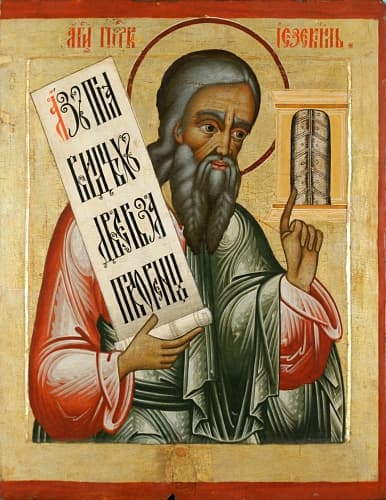
Ezekiel the Prophet — Public domain. 18 century icon painter. Via Wikimedia Commons.
Life
Ezekiel was born around 622 BC in Jerusalem, into a Jerusalem priestly family of the line of Zadok (the line that had served at the Temple from Solomon's time). His father Buzi was a serving Temple priest, and Ezekiel was raised from his earliest years in the great cycle of Temple worship that gives so much of his later prophecy its imagery. He was perhaps eighteen when King Jehoiakim of Judah began his rebellion against Babylon; he was perhaps twenty-five in 597 BC when Nebuchadnezzar took Jerusalem, deposed Jehoiakim's son Jehoiachin, and carried away the first major group of Judean nobles and craftsmen into Babylonian exile. Ezekiel and his wife were among them.
They were settled at the Jewish community of Tel-abib on the Chebar canal, a tributary of the Euphrates in southern Mesopotamia. Some five years after his arrival, in 593 BC, Ezekiel had his first prophetic vision — the great chariot-vision of the four living creatures (with the four faces of a man, a lion, an ox, and an eagle), the wheels within wheels, the throne of sapphire, and the figure of the Son of Man above the throne. The Christian tradition reads the four living creatures as the four evangelists — Matthew the man, Mark the lion, Luke the ox, John the eagle — the iconography of all four-Gospel images of the Christian East and West.
The vision marked Ezekiel's call. He was given the prophetic word that the city of Jerusalem would fall — not be spared as the false prophets of the exile claimed — and that the remnant in Babylon must turn to the Lord and live the covenant in the new land. He served as prophet to the Babylonian Jewish community for the next twenty-two years, until at least 571 BC (the date of the last prophecy precisely dated in his book).
He prophesied by sign-acts on a scale unusual even among the prophets. He lay on his left side for three hundred ninety days for the iniquity of the kingdom of Israel and on his right side for forty days for the iniquity of the kingdom of Judah. He ate bread baked over cow dung. He shaved off his hair and his beard with a sword, weighed it in a balance, and divided it among three uses to represent the three fates of the people of Jerusalem at the fall. He dug a hole through his city-wall house at night and carried a small pack through it, as a sign of the king's flight from Jerusalem. He sat in silent mourning when his wife died, refusing to grieve in the public manner, as a sign of how the people would receive the news of the fall of the city.
His prophecy was marked by extraordinary visions. The chariot-vision recurs at the beginning of chapter 10, when he saw the Lord depart from the Temple — perhaps the most theologically devastating image of his book. The great vision of the valley of dry bones (chapter 37) — the bones rising up clattering together, gaining sinews and flesh, and at last the four winds breathing into them the breath of life — was given him as a promise that the people of Israel, dead in their exile, would rise again. The Church reads it as the foundation Old Testament image of the General Resurrection and chants it at the Holy Saturday Liturgy.
The final great vision of his book (chapters 40-48) is the long description of the rebuilt Temple — measured carefully in cubits, with the river flowing from beneath the altar growing as it goes east and becoming a mighty stream that heals the Dead Sea and brings forth fruit on its banks. The Church reads this Temple as the image of the new heavens and new earth of Revelation, and the river as the river of the Spirit of the new covenant.
Ezekiel reposed in Babylon around 570 BC, at the age of perhaps fifty. He was killed by a Jewish prince of the exile — tradition gives him the name Joachim — for rebuking the man's idolatry. He was buried at Kefil, near the Babylonian Jewish community, in a tomb that has been continuously venerated since antiquity by Jews and Christians (the Jewish presence ceased only in the twentieth century with the destruction of the Iraqi Jewish community; the tomb is now nominally in the care of Iraqi Muslims). A portion of his relics is at the Cathedral of Saint Mark in Cairo and at the Sancta Sanctorum at the Lateran in Rome.
He is the patron of those in exile, of those who must wait many years for the fulfillment of a long-given promise, and of those whose prophetic vocation has been given in extraordinary visions. His feast is July 21.
Traditions
Feast day
July 21
Topics
Works in library