saint
Prophet Habakkuk the Prophet
Prophet whose dialogue with the Lord on the watchtower yielded the saying 'the just shall live by his faith,' and whose hymn — 'O Lord, I have heard thy report and was afraid' — is sung in the fourth ode of every canon.
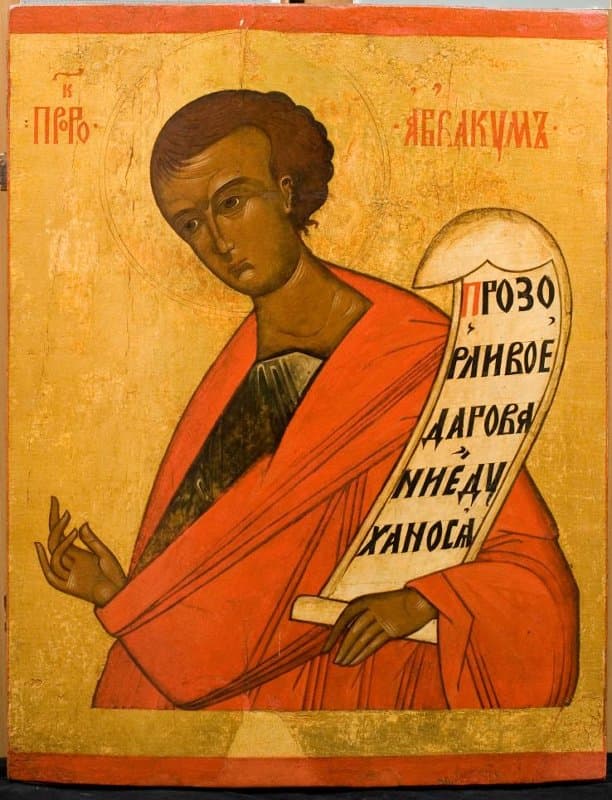
Prophet Habakkuk — Public domain. Via Wikimedia Commons.
Life
Habakkuk was born around 670 BC in the southern Kingdom of Judah, probably in the Levitical town of Beth-Zur (about ten miles south of Jerusalem in the Judahite hill country), into a Levitical priestly family. The name "Habakkuk" — the Hebrew form is "Habaqquq," from a root meaning "to embrace" — is unusual among Hebrew names and is taken by some commentators to be a foreign-derived form, possibly Assyrian. He was educated in the standard Levitical priestly tradition and probably served in some junior priestly capacity at the Jerusalem Temple before his prophetic call.
His call came in the late 600s BC — probably around 605 BC, in the early years of the Babylonian power that would shortly replace the Assyrian empire as the dominant force in the Near East. The Babylonian (Chaldean) army under Nebuchadnezzar had just defeated the Egyptian-Assyrian coalition at the Battle of Carchemish (605 BC) and was beginning its long advance south through Syria toward the Kingdom of Judah. Habakkuk was perhaps thirty-five when the call came.
The book that bears his name (one of the shortest of the Hebrew Bible at just three chapters and fifty-six verses) is a sustained dialogue with the Lord about the problem of national injustice. Habakkuk's first complaint (1:2-4) is a lament that the Judahite kingdom under King Jehoiakim has become so deeply unjust that the Lord seems indifferent to it: "How long shall I cry, and thou wilt not hear! even cry out unto thee of violence, and thou wilt not save!" The Lord answers (1:5-11) that He is raising up the Chaldean Babylonians as a divine instrument to punish Judah for its injustice. Habakkuk's second complaint (1:12-2:1) is that the Babylonians are themselves even more unjust than the Judahites and therefore unsuited to be the instruments of divine justice. The Lord answers (2:2-20) with the famous verse "Behold, his soul which is lifted up is not upright in him: but the just shall live by his faith" (Habakkuk 2:4) — a verse the apostle Paul will later cite three times in the New Testament (Romans 1:17, Galatians 3:11, Hebrews 10:38) as the foundation of his doctrine of justification by faith.
The third chapter of Habakkuk is the famous Habakkuk Hymn — the prophet's prayer-response to the divine answer. The Hymn is one of the oldest theophany-poems in the Hebrew Bible: "O Lord, I have heard thy speech, and was afraid: O Lord, revive thy work in the midst of the years, in the midst of the years make known; in wrath remember mercy." The Hymn is sung in the Christian Liturgical tradition as the fourth ode of every canon — the prophet's hymn placed in the standard nine-ode pattern of the Greek canon-cycle (with the Song of Moses at the Red Sea, the Prayer of Hannah, and the rest of the major prophetic-canonical hymns).
The personal records of his later life are scarce. The most distinctive tradition concerns his journey to Babylon. According to the Greek apocryphal addition known as "Bel and the Dragon" (the Greek expansion of the book of Daniel that the Eastern Church includes in its Old Testament canon), Habakkuk was at his home in Judah preparing a small meal — bread and stew — for the workers of his fields when an angel of the Lord seized him by the hair and transported him miraculously to Babylon, where he gave the food to the prophet Daniel in the lions' den. The story is the source of the iconographic image of Habakkuk being carried through the air with a basket of bread.
He reposed in Judah around 600 BC, before the Babylonian destruction of the kingdom — saved by his early repose from witnessing the fulfillment of his own prophecies. He was buried at his ancestral village of Beth-Zur. His tomb was venerated continuously through the second-Temple period and was identified by the early Christian community as the prophet's burial-site.
His relics — what remained of them after the long Old Testament centuries — were identified in 401 AD during the building program of the Empress Eudoxia at the Holy Land sites. The reliquaries were translated to Constantinople and rest at the church of Saint Habakkuk in Constantinople, with portions at the Cathedral of Saint Vito in Bari. He is the patron of those who pray for divine justice against systemic national injustice, of those who carry food to the hungry at miraculous distances, and of every Christian who has asked the Lord: "How long?" His feast is December 2.
Traditions
Feast day
December 2
Topics
Works in library