saint
Prophet Isaiah the Prophet
The evangelist among the prophets, called by the seraphim of the Lord at the great vision in the Temple, who foretold a Virgin shall conceive, the Suffering Servant who would bear our griefs, and the new heavens and new earth. Sawn asunder under King Manasseh.
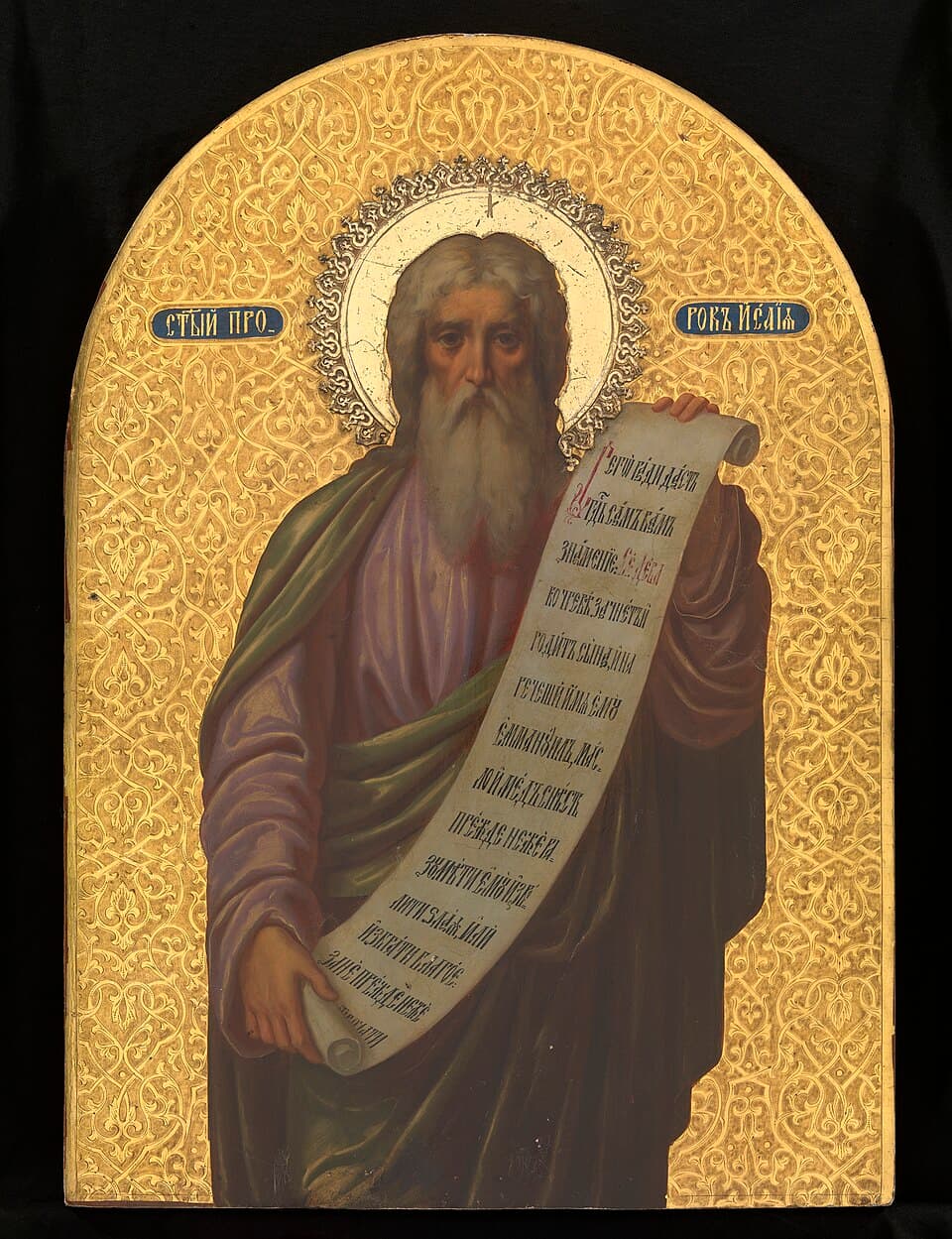
Isaiah the Prophet — Public domain. Via Wikimedia Commons.
Life
Isaiah was born around 765 BC in the city of Jerusalem, into a noble Judahite family with close connections to the royal court of the Davidic dynasty. His father, called Amoz in the prophetic books (not the Amos who is one of the twelve minor prophets), is said by Jewish tradition to have been the brother of King Amaziah of Judah — which would have made Isaiah a cousin of King Uzziah and a member of the inner royal family. He was educated at Jerusalem, married, and had two sons, both with prophetic names: Shear-jashub ("a remnant shall return") and Maher-shalal-hash-baz ("hasten the spoil, hurry the prey"). The names themselves were sign-acts, summaries of the message he was given to preach.
The decisive call of his life came in the year 740 BC — "the year that king Uzziah died," as the sixth chapter of his book famously begins. He was at the Temple in Jerusalem, in the great court near the altar, when his eyes were opened to see the Lord seated upon a throne high and lifted up; His train filled the Temple. Above the throne stood the seraphim, six-winged ones, who called to one another "Holy, holy, holy is the Lord of hosts: the whole earth is full of His glory" — the words the Church has chanted at every Eucharistic anaphora ever since.
Isaiah cried out that he was a man of unclean lips dwelling among a people of unclean lips. One of the seraphim took a live coal from the altar in tongs and touched his lips with it, saying "Thine iniquity is taken away, and thy sin purged." Then he heard the Lord ask "Whom shall I send?" and answered "Here am I; send me." The Lord gave him the message — that the people would not hear, that the cities would be made waste, but that a holy seed would remain. He was given fifty-five years of prophetic service.
His prophetic work spanned the reigns of four kings of Judah: Uzziah, Jotham, Ahaz, and Hezekiah. Under Ahaz he warned against the alliance with Assyria; he was given the great sign at Isaiah 7 — "Behold, a virgin shall conceive, and bear a son, and shall call his name Immanuel" — which the New Testament gospels read as the prophecy of the virgin conception of the Lord. Under Hezekiah he was the king's intimate counselor through the great crisis of Sennacherib's invasion in 701 BC; he prophesied that the Assyrian host would not enter the city, and the host was destroyed by a plague on the night of the prophecy. He prayed for Hezekiah's healing, and gave the king the extra fifteen years that are in the book of Kings.
His messianic prophecies are the most extensive of the Old Testament corpus. He foretold the coming of one upon whom the seven gifts of the Spirit would rest (Isaiah 11), the birth of the child whose name would be Wonderful, Counselor, the mighty God, the everlasting Father, the Prince of Peace (Isaiah 9), the Suffering Servant who would bear our griefs and carry our sorrows, be wounded for our transgressions and bruised for our iniquities (Isaiah 53), and the new heavens and new earth that would replace the old (Isaiah 65-66). The Christian tradition has read these prophecies as so detailed an account of the life of Christ that Isaiah has been called "the fifth evangelist."
He was martyred under King Manasseh of Judah, son of Hezekiah, around 681 BC. Manasseh was a deeply syncretist king who set up the abomination of desolation in the Temple and persecuted the prophets who rebuked him. Isaiah, who continued his preaching against the syncretism, fled to a hollow tree near the brook Cedron east of Jerusalem; the king's soldiers found him there and sawed him in two with a wooden saw — the manner of death that the writer of Hebrews remembers in his list of the witnesses of faith. He was eighty-four.
His relics — what could be recovered after the sawing — were buried at the place of his martyrdom. They were translated to the imperial city of Constantinople in 442 by Theodosius II and rest at the church of the prophet Isaiah on the Bosphorus. The Church remembers him on May 9.
Traditions
Feast day
May 9
Topics
Works in library