saint
Prophet Jeremiah the Prophet
The weeping prophet of Jerusalem, who foretold the captivity of his people and the new covenant written on the heart. Stoned by the exiles in Egypt for his witness against their idols.
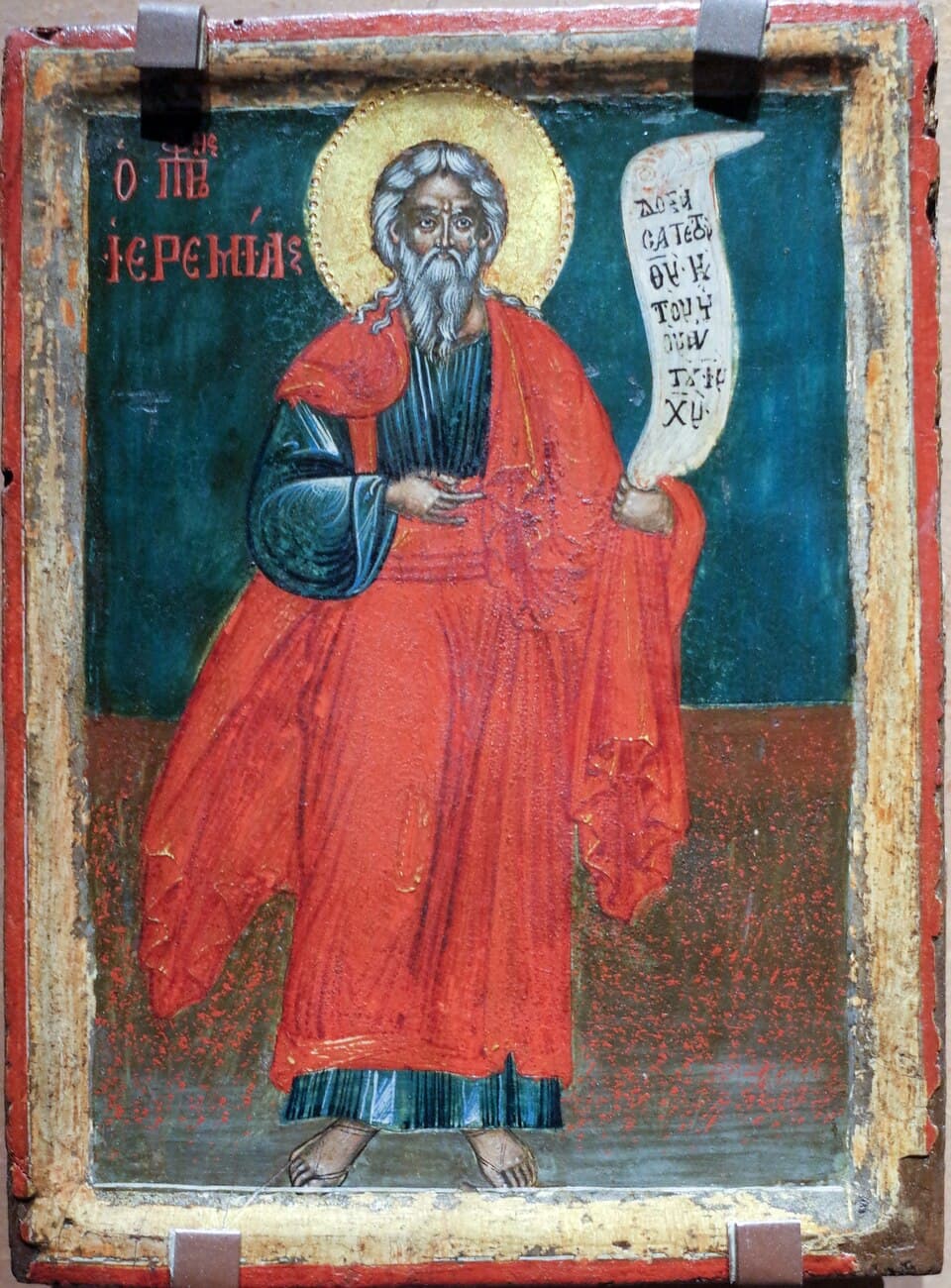
Jeremiah the Prophet — Public domain. Via Wikimedia Commons.
Life
Jeremiah was born around 645 BC in the priestly town of Anathoth, a few miles northeast of Jerusalem, into a priestly family of moderate standing. His father, Hilkiah (not the high priest of the same name who served under Josiah, though the names overlap), was a priest of the line of Abiathar — the line that David had favored and that Solomon, in his later years, had banished from Jerusalem to country priesthoods. Jeremiah grew up therefore in a family with a long memory of exclusion from the Temple service of the capital and with deep theological roots in the older Davidic-Mosaic tradition.
The Lord called him to prophesy in the thirteenth year of King Josiah of Judah — about 627 BC — when Jeremiah was perhaps eighteen. The call (recorded in Jeremiah 1) is one of the most famous of the Old Testament. The Lord said: "Before I formed thee in the belly I knew thee; and before thou camest forth out of the womb I sanctified thee, and I ordained thee a prophet unto the nations." Jeremiah objected: "Behold, I cannot speak: for I am a child." The Lord said: "Say not, I am a child: for thou shalt go to all that I shall send thee, and whatsoever I command thee thou shalt speak. Be not afraid of their faces: for I am with thee to deliver thee."
He prophesied for some forty years — through the reign of Josiah, the four months of Jehoahaz, the eleven years of Jehoiakim, the three months of Jehoiachin, and the eleven years of Zedekiah — covering the entire last generation of the Kingdom of Judah. His prophecy was, in its principal note, the warning of inevitable destruction: that the kingdom would fall, that Jerusalem would be burned, that the people would be carried away into Babylonian captivity. The judgment was not because of a few sins but because the people had broken the foundational covenant of Moses: they had become idolaters, they had broken the Sabbath, they had oppressed the poor, they had shed innocent blood. The judgment was not avoidable; only the response to it — submission and acceptance versus armed resistance and false hope — could mitigate its severity.
He was unrelentingly hated for the message. King Jehoiakim burned the first scroll Jeremiah dictated to his scribe Baruch (Jeremiah 36); the prophet dictated a second scroll, longer than the first. He was thrown into a pit of mud by court officials of Zedekiah (Jeremiah 38) and would have died there had not the Ethiopian eunuch Ebed-melech petitioned the king and pulled him out with old rags and ropes. He was beaten and put in stocks by the priest Pashur (Jeremiah 20). He went many times to the king and to the people in the markets and the city gates, prophesying their destruction; he was mocked and despised.
His sufferings made him the most personally revealing of the prophets — the prophet whose inner life is most visible in his own writing. He cried out to the Lord again and again in the bitterness of his calling: "O Lord, Thou hast deceived me, and I was deceived: Thou art stronger than I, and hast prevailed: I am in derision daily, every one mocketh me" (Jeremiah 20:7). He cursed the day of his birth (Jeremiah 20:14-18) in a passage that is one of the bleakest in the Old Testament. He stood weeping at the Temple gate. He wept over Jerusalem before the Lord wept over it. The Lamentations attributed to him — the long elegy on the fallen city, sung still in the Holy Saturday matins of the Eastern Church — set the tone of all later Christian lament.
He was the first to formulate the doctrine of the new covenant. In Jeremiah 31:31-34 he prophesied that the Lord would make a new covenant with His people, not according to the old covenant of the Exodus, but written on the heart by the Spirit of God — a covenant in which every man would know the Lord, from the least to the greatest. The writer to the Hebrews quotes the passage at length (Hebrews 8:8-12) as the explicit foretelling of the Christian dispensation.
He lived to see the city fall. The Babylonians took Jerusalem in 587 BC; the Temple was burned; King Zedekiah was blinded and led in chains to Babylon. Most of the population was carried away into the Babylonian exile. Nebuchadnezzar, knowing the prophecy Jeremiah had preached, gave him the choice of going to Babylon as an honored guest or remaining in Judea. Jeremiah chose to remain with the small remnant left behind under the Babylonian governor Gedaliah.
When Gedaliah was assassinated by a group of rebellious Jewish nobles, the remnant — fearing Babylonian reprisal — fled into Egypt, against Jeremiah's prophetic counsel. They took Jeremiah with them by force; he prophesied against the idolatry of the Egyptian Jewish community at Tahpanhes and was eventually stoned to death by his own people there, around 580 BC, at the age of about seventy. His body was buried at Tahpanhes; the relics were translated to Alexandria in the early Christian period and rest at the Coptic Cathedral of Saint Mark in Cairo.
He is the most-quoted Old Testament prophet in the Christian New Testament after Isaiah. He is the patron of every Christian who is given an unwelcome message to deliver, of those whose inner sufferings are deep and seemingly fruitless, and of every weeping voice that prays for a city's repentance. His feast is May 1.
Traditions
Feast day
May 1
Topics
Works in library