saint
Prophet Jonah the Prophet
Sent to preach repentance to Nineveh, he fled instead to Tarshish and was three days in the belly of the great fish — the type the Lord Himself appointed of His own three days in the heart of the earth. Through his preaching the great pagan city repented and was spared.
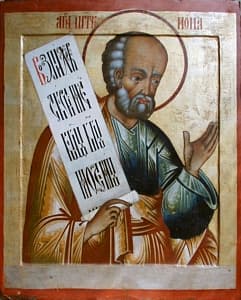
Prophet Jonah — Public domain. 18 century icon painter. Via Wikimedia Commons.
Life
Jonah, son of Amittai, was born around 815 BC at Gath-hepher in the territory of the tribe of Zebulun in Galilee — a small village about three miles northeast of Nazareth (the place where the Lord would later grow up). He was thus a Galilean prophet, one of the few of the Old Testament — most of the writing prophets of Israel came from Judah, but Jonah was a man of the northern kingdom under Jeroboam II. The Second Book of Kings (14:25) mentions him in passing as a prophet of the prosperity of Jeroboam's reign; his life-story is the substance of the short book that bears his name.
His call came around 760 BC. The word of the Lord came to him: "Arise, go to Nineveh, that great city, and cry against it; for their wickedness is come up before me." Nineveh was the capital of the Assyrian Empire — at the time the great rising power of the Near East and the chief enemy of Israel. To prophesy at Nineveh was to walk into the territory of a hostile foreign power and proclaim its destruction. Jonah refused.
He went down instead to the port of Joppa (modern Jaffa on the Israeli coast) and took ship for Tarshish — most likely the Phoenician trading colony of Tartessus in southern Spain, the most distant western point of the Mediterranean. He paid the fare and went below deck and slept. The Lord sent a great wind on the sea; the ship was in danger of breaking up. The pagan sailors cast lots to find the cause of the trouble; the lot fell on Jonah. He confessed his flight. They asked what they should do. He told them to throw him into the sea — and at his urging they did, with great reluctance.
The Lord prepared a great fish — the Hebrew text says simply a great fish, not specifically a whale — to swallow him up. He was three days and three nights in the belly of the fish. This is the type the Lord Himself would later appoint of His own three days and three nights in the heart of the earth between the Crucifixion and the Resurrection ("As Jonas was three days and three nights in the whale's belly; so shall the Son of man be three days and three nights in the heart of the earth," Matthew 12:40). Jonah's prayer from the belly of the fish — preserved as the second chapter of his book — is one of the great psalms of personal distress in the Hebrew Bible.
The fish vomited him up on the shore — tradition has variously identified the place; the most common is somewhere on the Phoenician coast. The Lord's word came to him a second time, with the same commission. This time he went. He walked through the streets of Nineveh proclaiming: "Yet forty days, and Nineveh shall be overthrown." The Ninevites — to Jonah's surprise — believed him. The king himself proclaimed a fast, came down from his throne, sat in sackcloth and ashes. The whole city repented. The Lord, seeing the repentance, repented Himself of the destruction He had threatened.
Jonah was furious. He had refused the mission in the first place precisely because he had suspected the Lord would do this — that He would spare the great pagan city if they repented, making Jonah's fierce judgment look hollow. He went out east of the city to a high place and sat down to see if the Lord would still destroy it. The Lord made a gourd grow over Jonah's head to shade him from the sun; Jonah was pleased with the gourd. The next morning the Lord sent a worm that killed the gourd. The hot east wind blew on Jonah; he was faint and asked to die. The Lord said: "Thou hast had pity on the gourd, for the which thou hast not laboured, neither madest it grow; which came up in a night, and perished in a night: and should not I spare Nineveh, that great city, wherein are more than sixscore thousand persons that cannot discern between their right hand and their left hand; and also much cattle?"
The book ends with the rhetorical question — the Lord's universal love for every pagan city, and the prophet's reluctant submission to it. The lesson is the great lesson of the Old Testament: the God of Israel is not the God of Israel only. He is the God of every people who turns to Him.
Jonah lived perhaps thirty more years and reposed in the territory of Zebulun around 730 BC. His tomb at Gath-hepher (modern Mash-had near Nazareth) was venerated by both Jews and Christians through the Byzantine period; a competing tomb at Mosul in Iraq (across the river from the ruins of Nineveh, where the prophet's repentance had taken place) was a major Christian and Muslim pilgrimage site until 2014, when the Islamic State destroyed it. The Lord refers to Jonah twice in the New Testament (Matthew 12:39-41 and Luke 11:29-30), making him the only minor prophet whom the Lord cites by name. His feast is September 22.
Traditions
Feast day
September 22
Topics
Works in library