saint
Holy Samuel the Prophet
The last of the judges and the first of the prophets in the regular line, dedicated by his mother Hannah from the womb, who anointed both Saul and David and judged Israel through long faithful years.
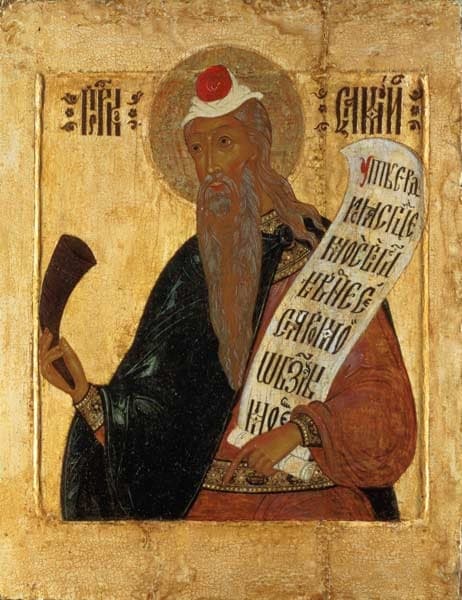
Samuel the Prophet — Public domain. Via Wikimedia Commons.
Life
Samuel was born around 1100 BC at Ramathaim-zophim, a small village in the hill country of Ephraim (modern Rama, about ten miles north of Jerusalem), to Elkanah and Hannah. The family was Levitical — Elkanah's genealogy in 1 Chronicles 6 places him in the line of Kohath, the priestly clan; Levitical priests sometimes lived outside the formal centers of priestly settlement when they served as country-priests of a tribal area. Elkanah had two wives: Hannah and Peninnah. Peninnah had children; Hannah was childless, and Peninnah taunted her for it through long years of the family's annual pilgrimages to the central sanctuary at Shiloh.
Hannah's prayer at Shiloh — when she went up alone to the Tabernacle one year and prayed silently with her lips moving — has become the model of Christian intercessory prayer. The high priest Eli, watching her, thought her drunk; she explained her grief; he blessed her in the Lord's name. She conceived within the year and bore Samuel — the name means "heard of God" or "asked of God." She nursed him until he was weaned (about three or four years old in the practice of the time) and then brought him to Shiloh and gave him to the high priest Eli for the lifelong service of the Tabernacle that she had vowed at his conception.
He grew up in the Tabernacle precinct at Shiloh, serving under Eli as a small temple servant. He slept near the Ark of the Covenant. The Word of the Lord had not come in vision in Israel for some generations; the boy did not yet know the Lord by direct encounter. One night the Lord called him: "Samuel." Samuel thought Eli had called him and ran to him. Eli sent him back to bed. The call came again, and a third time. Eli at last realized what was happening and told the boy that if the voice came again he should answer: "Speak, Lord; for thy servant heareth." The voice gave Samuel a prophecy of judgment on Eli's household for the sins of Eli's two sons Hophni and Phinehas, who had corrupted the priesthood. Samuel told Eli the prophecy the next morning. Eli accepted it: "It is the Lord: let him do what seemeth him good."
The prophecy was soon fulfilled. The Philistines defeated Israel at Aphek; Hophni and Phinehas were killed; the Ark of the Covenant was captured. Eli, hearing of the loss of the Ark, fell backward off his judgment seat and died of a broken neck. Phinehas's wife, in labor at the moment, bore a son she named Ichabod ("the glory is departed") and died. The Tabernacle at Shiloh was destroyed by the Philistines in the subsequent campaign.
Samuel emerged in the years that followed (around 1080 BC) as the last of the judges of Israel and the first of the prophets in the regular line. He led the people in repentance, secured the return of the Ark from the Philistines, traveled an annual circuit between his home at Ramah, Bethel, Gilgal, and Mizpah, judging the people. He served them in this way for some forty years.
In his old age the elders of Israel demanded a king "like all the nations." Samuel was reluctant — he understood the demand as a rejection of the Lord's kingship over Israel — but the Lord told him to grant it as a concession. He anointed Saul the son of Kish, of the tribe of Benjamin, as the first king of Israel. The choice did not go well. Saul disobeyed twice in significant matters (offering sacrifice without waiting for Samuel at Gilgal, and sparing King Agag of the Amalekites against the explicit Lord's command). After the second disobedience Samuel told Saul that the Lord had rejected him from being king.
Some years later the Lord sent Samuel to Bethlehem to anoint a new king. He came to the house of Jesse and reviewed the seven elder sons; the Lord rejected each. Samuel asked if there were any more; Jesse mentioned the youngest, David, who was out keeping the sheep. David was sent for and brought in; the Lord told Samuel to anoint him. He did, and the Spirit of the Lord came mightily upon David from that day forward. The act was kept secret from Saul, but the long succession of David's rise to the throne began from it.
Samuel reposed at Ramah around 1015 BC, at perhaps eighty-five years of age. He was the last public figure of Israel before the kingdom of David and the central transitional figure between the period of the judges and the period of the kings. He was buried at Ramah in the family tomb. The Witch of Endor — at Saul's request — raised his spirit one final time on the eve of Saul's defeat at Mount Gilboa; the spirit prophesied Saul's death the next day, and the prophecy was fulfilled.
His tomb at Ramah (modern Nebi Samwil northwest of Jerusalem) has been continuously venerated since antiquity. The Byzantine emperor Theodosius II translated portions of the relics to Constantinople in 406; they were dispersed at the Latin sack of 1204. He is the patron of those who pray for children in barrenness (in remembrance of his mother Hannah's prayer), of judges and prophets, and of all who must walk the line between the old order and the new in a time of political change. His feast is August 20.
Traditions
Feast day
August 20
Topics
Works in library