saint
Prophet Zechariah the Prophet (of the Twelve)
Prophet of the return from exile, who saw the visions of the man among the myrtle trees and of the King coming meek and riding upon an ass. His prophecy of the thirty pieces of silver and the pierced one shapes the reading of Holy Week.
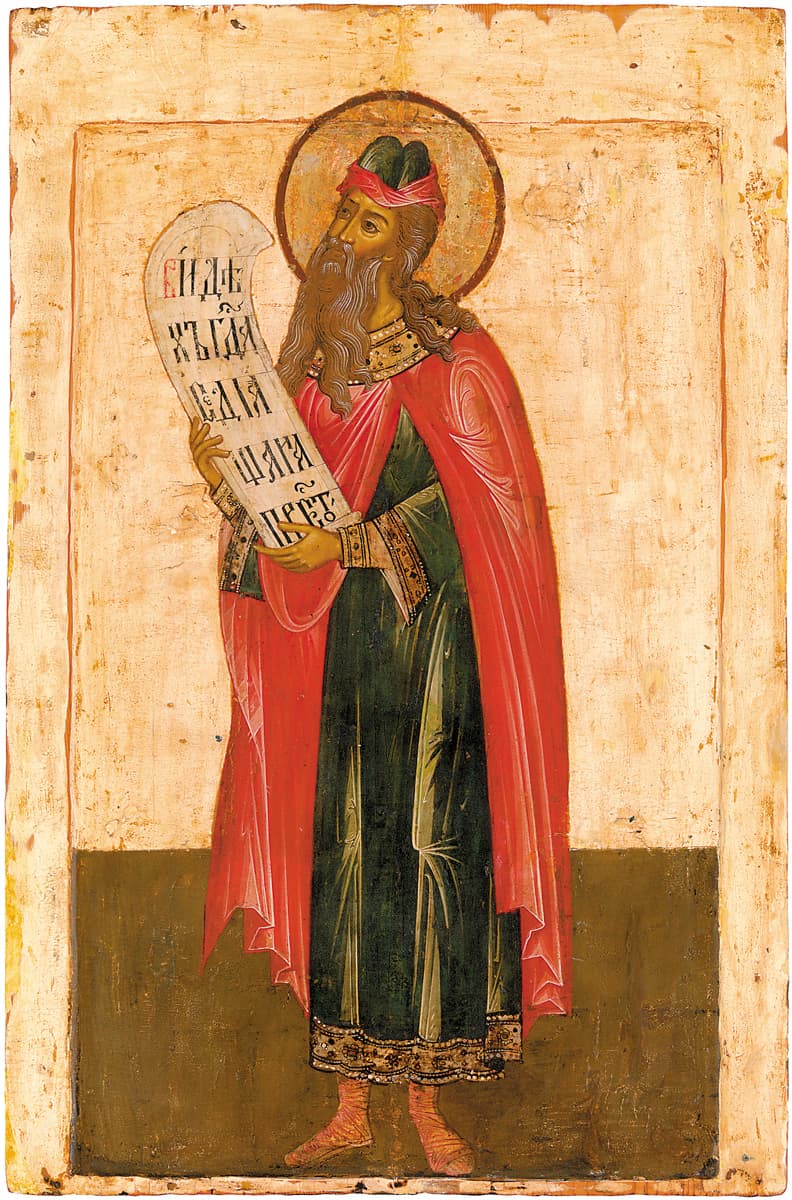
Prophet Zechariah of the Twelve — Public domain. Via Wikimedia Commons.
Life
Zechariah was born around 565 BC in Babylon, into a Judahite priestly family of the line of Iddo. His grandfather Iddo was one of the senior priests who had been carried into the Babylonian captivity in 587 BC at the destruction of Jerusalem and the first deportation. Zechariah and his father Berechiah lived their entire early lives in the Babylonian exile, at the substantial Jewish community on the Chebar canal in southern Mesopotamia (the same community to which Ezekiel had ministered a generation earlier).
He returned to Jerusalem with the first wave of returning Judahite exiles in 538 BC, under the leadership of Sheshbazzar — the Babylonian-appointed governor whom Cyrus the Persian Great had sent back to Judah with the imperial decree allowing the rebuilding of the Temple. Zechariah was about twenty-five at the return. He served as a junior priest in the small Jerusalem community for the next eighteen years, while the rebuilding of the Temple proceeded slowly under successive obstacles (political opposition from the Samaritans, the long indifference of the returned exiles themselves, the death of the senior priest Joshua's predecessors).
His prophetic call came in 520 BC — exactly contemporaneously with the call of the older prophet Haggai. Both prophets received the word of the Lord that the rebuilding of the Temple, then stalled for nearly two decades, must be resumed immediately. Haggai's preaching (recorded in the book of Haggai) gave the practical political case for the resumption; Zechariah's gave the long mystical vision of what the rebuilt Temple would mean.
The visions of Zechariah (the eight major visions of his book) are among the most striking apocalyptic imagery in the Hebrew Bible. The man among the myrtle trees (Zechariah 1) — a divine figure on a red horse, with three following horsemen of different colors, surveying the world for the Lord. The four horns and the four carpenters (Zechariah 1) — the powers that have scattered Israel and the new powers that will scatter the scatterers. The man with the measuring-line (Zechariah 2) — the rebuilt Jerusalem will spread without walls because of the multitude of inhabitants. The High Priest Joshua before the Angel (Zechariah 3) — Joshua's standing as the new high priest is established despite the accusations of Satan; the Lord clothes him with new clothes. The golden lampstand (Zechariah 4) — the seven-branched lampstand fed by two olive trees, representing the new Temple's priesthood and kingship.
The four chariots (Zechariah 6), the crowning of Joshua as priest-king (Zechariah 6 — the foreshadowing of the messianic priest-king who will combine the two offices), the messianic prophecies of Zechariah 9-14 (which include some of the most striking foreshadowings of the Lord's Passion in the Old Testament). Zechariah 9:9 — "Rejoice greatly, O daughter of Zion; shout, O daughter of Jerusalem: behold, thy King cometh unto thee: he is just, and having salvation; lowly, and riding upon an ass, and upon a colt the foal of an ass" — is the prophecy the Lord directly fulfilled at his triumphal entry on Palm Sunday. Zechariah 11:12-13 — the thirty pieces of silver thrown to the potter — is the prophecy Judas Iscariot's betrayal directly fulfilled. Zechariah 12:10 — "they shall look upon me whom they have pierced" — is the prophecy the soldier's spear-thrust on Good Friday directly fulfilled. Zechariah 13:7 — "smite the shepherd, and the sheep shall be scattered" — is quoted by the Lord at the Last Supper.
The rebuilt Temple — known as the Second Temple — was completed in 515 BC, about five years after Zechariah's call. Zechariah served as a senior priest of the new Temple for the next several decades. He produced the great messianic prophecies of Zechariah 9-14 in the latter half of his ministry, perhaps in his sixties.
He reposed at Jerusalem around 500 BC, at perhaps sixty-five. He was buried in the priestly tombs near the Temple. The tradition that places him in the genealogy of the Lord's family ("Zechariah the son of Berechiah, whom ye slew between the temple and the altar," Matthew 23:35 — that the Lord cites as the model of innocent prophetic blood shed in Israel) is sometimes thought to identify him with the slightly later Zechariah, son of Jehoiada, who was actually killed in the Temple in the time of King Joash; the rabbinic tradition makes both identifications.
His relics were uncovered in 415 AD during the Empress Eudoxia's building program, at a site identified by tradition as his tomb at the Wadi Joz valley near Jerusalem. They were translated to Constantinople and rest at the Patriarchal Cathedral; substantial portions remain at the Greek Orthodox monastery of Saint Zechariah in Jerusalem and at the Coptic Cathedral in Cairo. He is one of the principal Old Testament prophets whose prophecies are read at every Orthodox Holy Week service, and is the patron of those whose visions of the future are deeply detailed. His feast is February 8.
Traditions
Feast day
February 8
Topics
Works in library