saint
St. Romanos the Melodist
Deacon of Constantinople of Syrian origin, to whom the Mother of God appeared with a scroll he was bidden to eat — and from his mouth poured forth the kontakia, the great body of Byzantine sung sermon-poetry that includes the famous Kontakion of the Nativity 'Today the Virgin gives birth.'
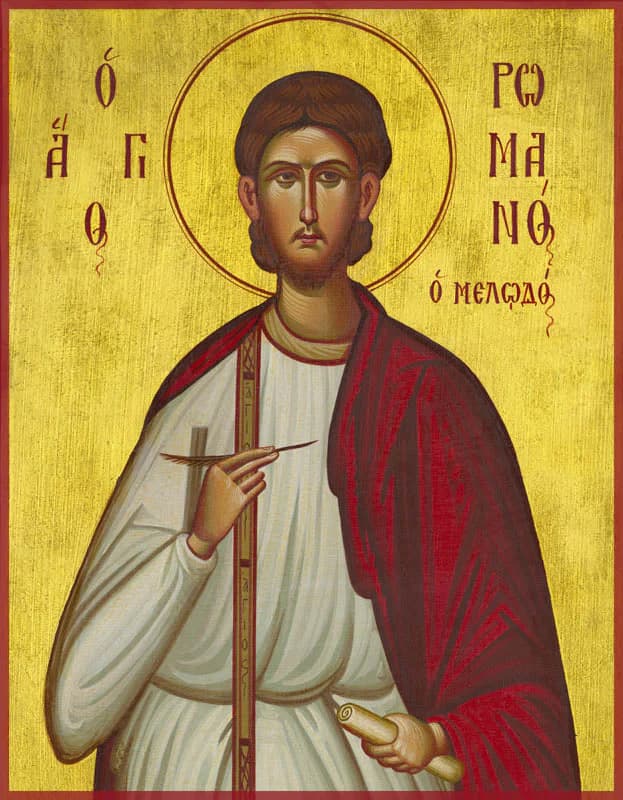
Saint Romanos the Melodist — Hand-curated icon.
Life
Romanos was born around 490 in the town of Emesa in Syria (modern Homs), to a Greek-speaking family of mixed Syrian-Greek background. He was probably a baptized Jew by family — the sources name his parents as Christian, but his Greek-Syrian middle-class culture in late fifth-century Syria was, demographically, very largely composed of recently baptized Jewish converts. He was educated locally; he was ordained a deacon at the church of the Resurrection in Beirut as a young man and served there for some years.
Around 515 he was transferred — by his ecclesiastical superior or by his own choice — to Constantinople, where he served as a deacon at the church of the Theotokos of the Kyros quarter (the Kyrou church, founded by a senator named Cyrus, an important Marian shrine of the capital). He was assigned to the Liturgy and to the all-night vigils kept at the great feasts of the year. He had no notable gift for singing or for poetry; the sources describe him as a man of devout intent but limited talent, mocked by the more accomplished cantors of the church.
The decisive event of his life took place on the eve of the Nativity of the Lord — December 24 — sometime around 518. He had been entrusted with chanting the great Kontakion (the festal hymn) at the all-night vigil and was deeply troubled by the prospect, since he sang badly and the other cantors had been openly contemptuous. He prayed before the icon of the Theotokos in his cell that evening. He fell asleep at prayer. The Mother of God appeared to him in his dream, gave him a scroll, and bade him eat it. He swallowed the scroll. He awoke at the hour of the vigil.
He went into the church, ascended the ambo, and chanted — entirely without preparation — the hymn that has been known ever since as the Kontakion of the Nativity: "Today the Virgin gives birth to Him who is transcendent in essence, and the earth offers a cave to Him who is unapproachable. Angels with shepherds give glory, and Magi journey with a star, for unto us is born a young child, the eternal God." The cantors of the church, the Patriarch, the Emperor Anastasius (who was present at the great Christmas vigil), and the whole congregation were utterly amazed. Romanos was the chief cantor of the church from that hour.
He spent the rest of his life writing similar hymns — long, structured poems of twenty to thirty stanzas each, on the feasts of the Lord, on the Theotokos, on the saints, and on the great events of the Old and New Testaments. The standard count of his works is over a thousand kontakia; about eighty survive in complete or substantial form. Each was set to a melody of his own composition; he sang and chanted them himself at the great vigils of the church year. The Kontakion of the Nativity that he sang from the scroll is still chanted on Christmas Eve in every Orthodox church.
He is also credited with the composition of the Akathist Hymn to the Theotokos — the longest and most famous of all Greek Marian hymns, sung in its complete form on the Saturday of the fifth week of Great Lent and in shorter portions throughout the year. The attribution is debated by modern scholars, but it has been the tradition of the Church since the eighth century.
He reposed at Constantinople around 555, having served some thirty-seven years as cantor of the Kyrou church. He was buried in the church itself. His relics were preserved at Constantinople until the Latin sack of 1204; their post-1204 fate is unclear, though a portion is believed to have been translated to Mount Athos. He is the patron of hymnographers, singers, and church musicians. With Symeon the New Theologian and John of Damascus he is one of the principal Orthodox hymnographers of the Greek tradition. His feast is October 1, kept jointly with the feast of the Protection of the Theotokos which his Akathist hymn established in the calendar.
Traditions
Feast day
October 1
Topics
Works in library