saint
Sts. Royal Martyrs of Russia
Tsar Nicholas II, Tsarina Alexandra, their four daughters Olga, Tatiana, Maria, and Anastasia, and the Tsarevich Alexei, murdered together in the basement of the Ipatiev House at Yekaterinburg on July 17, 1918. Glorified by the Russian Church Abroad in 1981 and the Moscow Patriarchate in 2000.
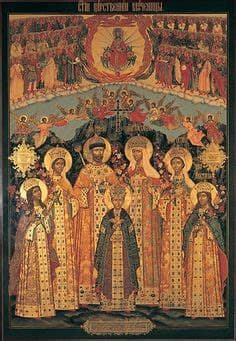
Royal Martyrs of Russia — CC BY-SA 4.0. Via Wikimedia Commons.
Life
Tsar Nicholas II Alexandrovich (born May 6, 1868), of the House of Romanov, succeeded his father Alexander III as Emperor of All Russia in October 1894. Within weeks of his accession he married the German princess Alix of Hesse-Darmstadt, who as his wife took the name Alexandra Feodorovna — a granddaughter of Queen Victoria and a convert to Orthodoxy of deep and serious devotion. Their four daughters — Olga (1895), Tatiana (1897), Maria (1899), and Anastasia (1901) — and their son Alexei (1904) made up the immediate family that would die with them at Yekaterinburg.
The reign was a hard one. The Russo-Japanese War of 1904-1905 ended in catastrophic naval defeat and the loss of Port Arthur; the revolutionary unrest of 1905, with the massacre of Bloody Sunday and the strikes that followed, forced the granting of a constitution and a duma the Emperor never quite accepted. The Tsarevich Alexei was diagnosed with hemophilia in his infancy — the price of the Tsarina's heritage from Queen Victoria — and the gradual encroachment of the Siberian wanderer Rasputin on the imperial household, on whose intercessions the boy's life seemed to depend, hollowed out the standing of the dynasty as the First World War broke over Russia.
In March 1917, with the front collapsing and bread short in Petrograd, the Tsar abdicated, first in his own name and then in his son's, in favor of his brother the Grand Duke Michael, who declined unless a constituent assembly should call him. The Romanovs were thereby without throne and without protection in revolutionary Russia. The Provisional Government held them under house arrest at Tsarskoye Selo and then at Tobolsk in Siberia, where they spent the eight months of the late 1917 winter. The Bolshevik coup of October 1917 made everything worse. In April 1918 the family was transferred to Yekaterinburg in the Urals, to the Ipatiev House, a merchant's residence requisitioned for the purpose and renamed the "House of Special Purpose."
They were held there for two and a half months, watched by Latvian and Russian guards who became progressively coarser as it became clear the new regime did not intend to release them. They prayed together every evening; the Tsarina kept a journal of the prayers and the deepening sense that they were being prepared for martyrdom. Through the spring and summer of 1918 the Whites advanced on Yekaterinburg, and the local Soviet — fearing the family might be liberated — applied to Lenin for permission to kill them.
In the early hours of July 17, 1918, the entire family was awakened and ordered to the basement of the house on the pretext of being moved for safety. They went down with their physician, Dr. Eugene Botkin, and three loyal household servants (the cook Ivan Kharitonov, the footman Aloysius Trupp, and the maid Anna Demidova) — eleven people in all. The execution detail, headed by Yakov Yurovsky, read a brief sentence from a paper, and the firing began at point-blank range. The Tsarina and the daughters had stitched diamonds into their corsets in the hope of preserving the family wealth, and the diamonds at first deflected the bullets — the executioners had to finish the work with bayonets. The bodies were taken into the woods, hacked, burned with acid, and buried.
The eleven were recanonized as the Russian Royal Martyrs by the Russian Orthodox Church Outside Russia in 1981 and by the Moscow Patriarchate as "passion-bearers" (a category for those killed for political reasons but who bore their death in a Christian spirit) on August 20, 2000. Their relics — uncovered in 1991 and 2007 in the woods at Porosenkov Log and identified by DNA — rest at the Cathedral of the Saints Peter and Paul in St. Petersburg. The Ipatiev House at Yekaterinburg was demolished by the Soviets in 1977 to prevent it becoming a pilgrimage site; on the spot now stands the Church on the Blood. Their feast is July 17 — the day of their slaying. The Tsarina is invoked by many in the prayers for purity of family life.
Traditions
Feast day
July 17
Topics
Works in library