saint
St. Sabbas the Sanctified
Father of Palestinian monasticism, founder of the Great Lavra in the Wadi Kidron between Jerusalem and the Dead Sea. The Typikon that still shapes the daily services of the Orthodox Church grew out of his community, and his lavra has been continuously inhabited by monks since his repose.
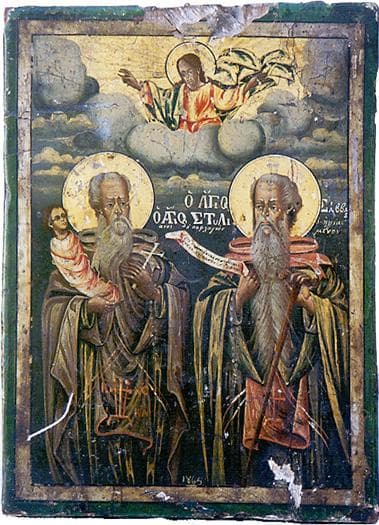
Sabbas the Sanctified — Public domain. Via Wikimedia Commons.
Life
Sabbas was born in 439 in the village of Mutalaska in Cappadocia, the only son of pious Christian parents. His father, an army officer, was posted to Alexandria when Sabbas was five; he left the boy in the care of an uncle, with whom Sabbas did not get on. The boy ran away to a small monastery in the village, was kept there, and at eight years old asked to take vows. The abbot allowed him.
At eighteen he made the long pilgrimage to the Holy Land, presented himself to the great elder Euthymius the Great in the wilderness east of Jerusalem, and asked to be received. Euthymius — saving the harder of the two paths for the more vigorous — sent him to the laura of Theoctistus a few miles to the north. There Sabbas lived ten years, did all the hardest manual work of the community, and so distinguished himself that Euthymius would come down at last and call him "the child-elder."
After Euthymius's death he withdrew at thirty into the deep wilderness, into a cliff-cave above the Kidron gorge halfway between Jerusalem and the Dead Sea — a desert of rock and sun where no monk had previously survived. He lived there five years alone. Disciples began to find him; he refused them for a long time, but at last accepted them, and the Great Lavra of Mar Saba — the monastery still inhabited today after fifteen hundred unbroken years — slowly rose around his cell.
He served as archimandrite of all the laura-monks of Palestine from 494. Through the long Christological controversies of the late fifth and early sixth centuries he was the great patriarch of Palestinian Chalcedonian orthodoxy — twice going up to Constantinople, in 511 and again in 530 (at age ninety-one), to plead with the emperor for the Holy Land against the monophysites.
He gave the Eastern Church the Typikon of the Lavra: the order of services, the rhythm of fast and feast, the structure of the liturgical day. With minor variations this Sabaite Typikon is the typikon of every Greek and Russian church today. He reposed on December 5, 532, at the age of ninety-three. His relics were taken by Crusaders to Venice in the twelfth century; in 1965 they were restored, with great ceremony, to the lavra at Mar Saba, where they remain.
Traditions
Feast day
December 5
Topics
Works in library