saint
St. Sava, First Archbishop of Serbia
Youngest son of the founder of the Nemanjic dynasty who left his father's court for Mount Athos, returning years later as a monk to give the Serbian Church autocephaly and Serbia her literary and liturgical tradition. The father of the Serbian people.
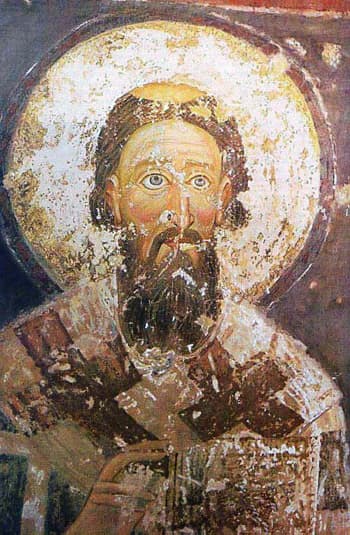
Sava, First Archbishop of Serbia — Public domain. Via Wikimedia Commons.
Life
Rastko Nemanjic was born in 1174, the youngest son of the great prince Stefan Nemanja — founder of the Nemanjic dynasty and unifier of medieval Serbia — and of his wife Anna. He was raised at his father's court at the modern town of Ras (then the Serbian capital), already, from an early age, conspicuous for his disinterest in court life. At sixteen he ran away to Mount Athos in 1191, having met a Russian monk of the mountain who was visiting the court at Ras. He was tonsured at the Russian monastery of St. Panteleimon and given the name Sava. His father, unable to retrieve him by force, finally accepted his vocation; he kept up correspondence with him through the rest of his own reign.
Stefan Nemanja himself abdicated his throne in 1196 in favor of his son Stefan and followed his youngest son to the Holy Mountain. Father and son together — under the joint monastic names Symeon and Sava — restored the abandoned monastery of Hilandar on the southwest of the mountain, which became and remains the great Serbian house of Athos. Symeon (formerly Stefan Nemanja) reposed at Hilandar in 1199; his son took up his work.
In 1207 Sava returned to Serbia to mediate the civil war between his brothers Stefan and Vukan, taking with him the relics of his father and consecrating them at the family monastery of Studenica. He stayed in Serbia for some years, founding monasteries (Studenica, Žiča, Mileševa), drafting a Typikon for the Serbian monastic life, and serving as the chief ecclesiastical adviser of his brother King Stefan. In 1219 he traveled to Nicaea (the seat of the Byzantine Patriarch in exile during the Latin occupation of Constantinople) and obtained from the Patriarch the autocephaly of the Serbian Church — a feat without precedent for a Slavic Church — and was consecrated by the Patriarch himself as the first Archbishop of Serbia.
He returned home and devoted the next fourteen years to building up the Serbian Church: organizing dioceses, translating the Greek liturgical books into Slavonic with refinements adapted to Serbian use, training a native episcopate. He crowned his brother Stefan as the first Serbian king (whence Stefan's epithet "the First-Crowned"), and shortly after, his nephew Radoslav. In 1234 he abdicated the archbishopric in favor of his disciple Arsenius and set out on a long second pilgrimage through the Holy Land — Jerusalem, the Sinai, the Egyptian monasteries — partly as a pilgrim and partly to gather relics and disciples for the Serbian Church.
He reposed at Tarnovo in Bulgaria on January 14, 1235, on his way back from this pilgrimage, the guest of the Bulgarian Tsar Asen II. His relics were translated to the monastery of Mileševa in Serbia, where they lay for nearly four centuries. In 1594 they were taken by the Ottoman general Sinan Pasha to the Vraćar plateau outside Belgrade and burned there in retaliation for the Serbian uprising in which Sava's name had been invoked. The Cathedral of Saint Sava — the great Serbian Orthodox church begun in 1935 and finally consecrated in 2004 — was built on the spot of his burning.
He is the founder of the Serbian literary tradition (his Life of his father Stefan Nemanja-Symeon is the first work of Serbian biography), the patron of Serbian schools (his feast is the day of the school festival in every Serbian land), and the type of the Christian prince who chose ascesis over crown. His feast is January 14.
Traditions
Feast day
January 14
Topics
Works in library