saint
St. Seraphim of Sarov
Russian wonderworker and hesychast of the Sarov forest who, after long years of silence, opened his cell to thousands of pilgrims with the greeting 'My joy, Christ is risen!' His conversation with Motovilov on the acquisition of the Holy Spirit is among the great spiritual texts of the modern Orthodox tradition.
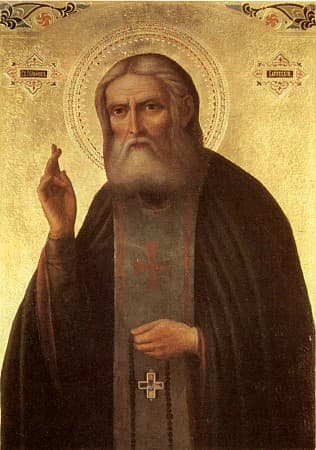
Saint Seraphim of Sarov — Public domain. Via Wikimedia Commons.
Life
Prokhor Moshnin was born on July 19, 1754, into a pious merchant family of Kursk in southern Russia. His father, who had taken the contract to build the great cathedral of Kursk, died when Prokhor was three; his mother Agafia raised him in the fear of God. A childhood incident in which he fell from the scaffolding of the unfinished cathedral and walked away unhurt was understood as the first sign upon him.
In his late teens he made a pilgrimage to the Kiev Caves and was directed by the elder Dositheus to the small monastery at Sarov in the forests east of Moscow. He entered there in 1778 at the age of nineteen, took monastic vows in 1786 with the name Seraphim, and was ordained deacon and then priest. Through these years he served the brotherhood, but his heart was drawn farther into the wilderness. From 1794 he was allowed to live as a solitary in a small log hut in the forest a few miles from the monastery, where he prayed, kept a garden, and was fed by the wild creatures — the great bear who came to take bread from his hand became part of the icon of the saint.
About this time he undertook the thousand-day pillar standing on a stone in the forest, repeating night and day the prayer of the publican: "O God, be merciful to me a sinner." During this period he was attacked by three brigands who, finding nothing in his hut to steal, beat him nearly to death with the handle of his own axe. He never resisted, and he refused later — when the men were found and tried — to press any charge against them.
In 1815 the Mother of God appeared to him for the seventh time in his life and bid him open his cell to the people. He came out of his thirty-year solitude and for the last sixteen years of his life received an endless flow of visitors — peasants, generals, students, princesses, his fellow monks, and the Russian intelligentsia. To each he gave the greeting that has become forever associated with him: "Christ is risen, my joy!" He spoke to many in vivid plain words about the goal of the Christian life, which (as he told his disciple Motovilov in a famous conversation on a snowy day in the forest) is "the acquisition of the Holy Spirit." During that conversation Motovilov saw his elder transfigured in uncreated light brighter than the sun.
He reposed at his cell on January 2, 1833, kneeling at his icon of the Theotokos with the Akathist on his lips. His relics were uncovered in 1903 in the presence of the Tsar Nicholas II and of crowds of pilgrims that filled the forests of Sarov for many miles. Driven into hiding during the Soviet years, the relics were rediscovered in 1991 in a storeroom of the Museum of the History of Religion in Leningrad and translated with great solemnity back to Diveyevo, the convent he had founded and loved. The Church keeps his feast on January 2 and on August 1, the day of the uncovering of his relics.
Traditions
Feast day
January 2 and August 1 (uncovering of relics)
Topics
Works in library