saint
St. Sergius of Radonezh
Russian father of cenobitic monasticism and builder of the Holy Trinity Lavra north of Moscow, beloved across the whole Russian Church for his gentleness and humility. His blessing of Prince Dmitry Donskoy before the battle of Kulikovo saw Russia begin to throw off Tatar rule.
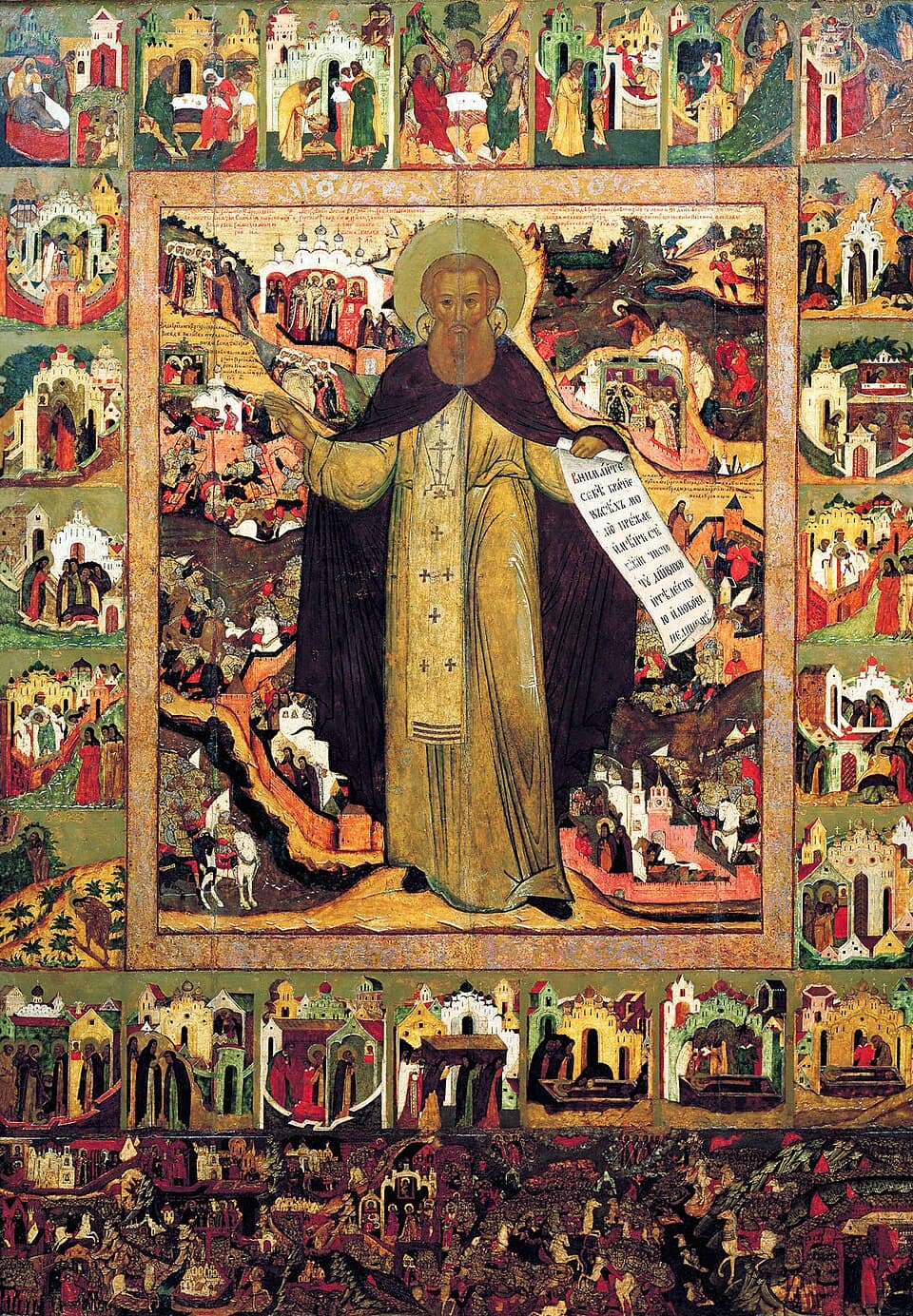
Saint Sergius of Radonezh — Public domain. Via Wikimedia Commons.
Life
Bartholomew, son of Cyril and Maria of Rostov, was born around 1314 into a noble boyar family that was driven by Tatar exactions to flee south to the small town of Radonezh near Moscow. As a child he struggled with letters; his brothers Stephen and Peter learned to read easily, but Bartholomew could not master the alphabet. One day, the well-loved story goes, he met an old monk under an oak tree, received a piece of blessed bread, and from that hour read fluently.
His parents took the monastic tonsure in their old age and reposed in peace at the small monastery near Radonezh. The two younger brothers Bartholomew and Stephen went into the deep northern forest above the Konchura River with axes, built a small log cell and a chapel dedicated to the Holy Trinity, and there began the silent life. Stephen left after a while for an established monastery in Moscow; Bartholomew remained alone — fasting, praying, splitting wood, ploughing his little garden, and (according to all his disciples) sharing his bread with a bear that came to him in winter.
In 1337 he received the monastic tonsure with the name Sergius. Other monks began to come; by 1340 there was a small cenobitic brotherhood, with the strict rule that no monk should own anything, beg, or accept payment from outside, but live by the work of his own hands. Sergius was the gentlest possible abbot — taking the worst portion at meals, carrying water for the sick, refusing for a long time to be ordained priest or to be made hegumen at all.
Russia in his lifetime was a tributary of the Tatar Khanate. In 1380 Grand Prince Dmitry Donskoy of Moscow came to Sergius's cell on the eve of his planned battle against the Tatar emir Mamai. Sergius blessed him for the campaign, gave him two monks (Peresvet and Oslyabya) to fight at the head of his army, and predicted victory. At Kulikovo Field the Russian army won the first great victory over the Horde — and the long undoing of Tatar rule began with that blessing.
Sergius reposed on September 25, 1392, having instructed his disciples not to bury him in the church but in the common cemetery of the brothers. The relics were uncovered intact on July 5, 1422. From his monastery — the Holy Trinity-Saint Sergius Lavra, still the spiritual heart of Russia — went out dozens of his disciples to found their own monasteries across the north: the Russian Thebaid. From his cell came also a way of life rooted in interior prayer, the cell, and the silent forest that would shape every Russian monastic since.
Traditions
Feast day
September 25 (repose) and July 5 (translation)
Topics
Works in library