saint
St. Silouan the Athonite
A Russian peasant who came to St. Panteleimon's on Mount Athos in his youth and lived there fifty years, given by the Lord the word 'Keep thy mind in hell, and despair not.' His writings, preserved by Archimandrite Sophrony, are among the great spiritual texts of the modern age.
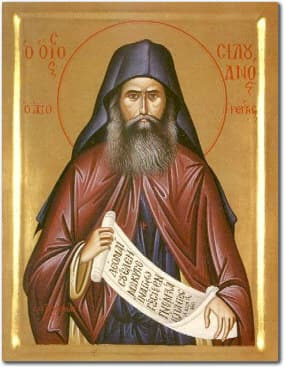
Silouan the Athonite — Public domain. Jack1956. Via Wikimedia Commons.
Life
Simeon Ivanovich Antonov was born in 1866 in the village of Shovskoye in the Russian province of Tambov, the fourth child of a Russian peasant family of deep piety and simple ways. His father, a quiet man whose example Silouan would remember all his life as the type of the Christian peasant, used to host a wandering bookseller every winter and listen to him read aloud through the long evenings. As a young man Simeon was strong, handsome, given to drink and to the rough pleasures of his village; he had a famous fight once in which he broke a man's ribs and stomach.
The grace came on him after a dream in his nineteenth year: he saw a serpent crawl down his throat, woke with disgust, and heard the voice of the Mother of God say, "You did not want to look at that serpent, and I will not be able to look at you." From that day he resolved to enter monastic life. He served his term in the imperial army, where he attracted the attention of his officers for his quiet bearing and the unobtrusive force of his discipline, and at twenty-six he set out for Mount Athos.
He arrived at the Russian Monastery of St. Panteleimon — the largest of the Athonite houses, with several thousand Russian monks at the time — in the autumn of 1892. He was tonsured Silouan, and almost from the beginning he was given the gift of unceasing prayer. But the gift was followed by a long, terrible darkness: for years he was assaulted by demons, by despair, by visions of his own damnation. In the worst of it, after some months of being unable to pray and unable to find any consolation in his soul, the Lord appeared to him at vespers in the chapel of the prophet Elijah and gave him the word that he would carry the rest of his life: "Keep thy mind in hell, and despair not."
The phrase, in his language, was a counsel to abide in the consciousness of one's own deserved hell — and yet to keep faith. By it he learned to hold together, without contradiction, the depths of penitence and the boundless love of God for every man, including the most damnable. From this point his spiritual life took on the steadiness for which his later writings are known: a quiet certitude of God's love that did not flinch from the cost of His salvation.
He served on the monastery's farm at Old Russia, then later as steward of the storehouses — manual work, all of it, throughout a long life of more than forty years on the mountain. He did not read widely; he wrote little. The records of his thought are the cahiers his disciple Archimandrite Sophrony Sakharov compiled and edited after his death. They include some of the most remarkable spiritual writing of the twentieth century — passages on the love of enemies, on prayer for the whole world, on the keeping of the mind, on the union of grace with the soul — and the famous saying "Pray for the unrepentant who burn in hell."
He reposed on September 24, 1938, at the age of seventy-two. He was canonized by the Ecumenical Patriarchate in 1987. His writings, edited by Sophrony and translated into a dozen languages, have made him one of the most influential Orthodox voices of the modern world. His feast is September 24.
Traditions
Feast day
September 24
Topics
Works in library