saint
Holy Simeon the God-Receiver
The aged elder of Jerusalem to whom it had been revealed that he would not taste death before he beheld the Lord's Christ. He took the Child in his arms in the Temple and sang the Nunc Dimittis — 'Lord, now let thy servant depart in peace' — that the Church chants every vespers.
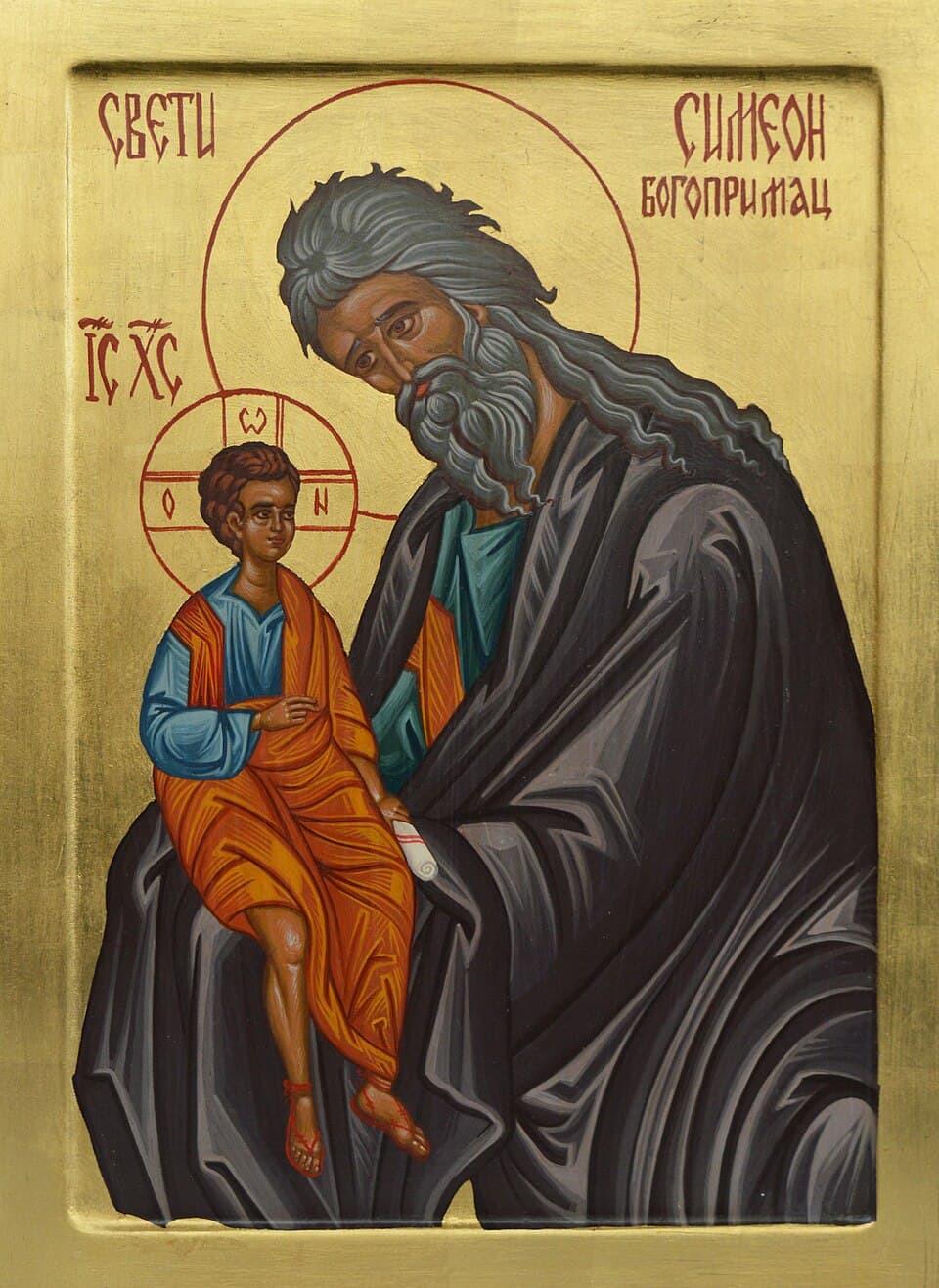
Simeon the God-Receiver — CC BY-SA 4.0. Danilo Vuković. Via Wikimedia Commons.
Life
Simeon was born around the year 270 BC at Alexandria, into a Jewish scholarly family of the diaspora. Tradition identifies him as one of the seventy-two scholars assembled at Alexandria by King Ptolemy II Philadelphus around 250 BC to translate the Hebrew Scriptures into Greek — the great translation that became the Septuagint and that has been the principal Old Testament of the Greek Orthodox Church ever since. He was probably one of the younger of the seventy-two and was given the prophet Isaiah to translate.
When he came to the passage at Isaiah 7:14 — "Behold, a virgin shall conceive, and bear a son, and shall call his name Immanuel" — he hesitated. The Hebrew text used the word ʿalmâ, "a young woman," which in the ordinary Hebrew of the time meant simply a marriageable young woman, not specifically a virgin. Simeon began to write "young woman" in the Greek, but it seemed to him that the prophecy was being weakened by the rendering, and he started to write "virgin" (Greek parthenos) instead. He stopped, wondering whether the marvel of a virgin-conception would seem an absurdity to the Greek readers of the translation. While he debated with himself, the angel of the Lord appeared to him and announced that he would not see death until he should see the Lord's Christ, born of a virgin, with his own eyes.
He returned to Jerusalem and lived there, the years stretching into decades and the decades into centuries. The early Christian tradition is unanimous that he lived nearly three hundred years, kept alive by the angel's promise, an unmistakable sign in himself of the long delay of the messianic age. He served in some capacity at the Temple — as a doctor of the Law, or as one of the elders of the priestly community — and is described in the Gospel as a "just and devout" man "waiting for the consolation of Israel," the standard messianic title of the period.
The decisive day of his life came on the fortieth day after the Lord's nativity — the day of the Lord's presentation in the Temple, the celebration of which the Church keeps on February 2. By an inward prompting of the Holy Spirit he went down to the Temple at the hour at which Joseph and Mary brought the infant Christ for the ritual of presentation prescribed for first-born sons in the Mosaic Law. He met them in the outer court of the Temple, in the place where the women came to make the offering of the doves prescribed for those who could not afford a lamb. He took the forty-day-old Child in his arms.
The hymn that he sang at that moment — the Nunc Dimittis — is the great evening prayer of the Christian Church. "Lord, now lettest Thou Thy servant depart in peace, according to Thy word; for mine eyes have seen Thy salvation, which Thou hast prepared before the face of all peoples; a light to lighten the Gentiles, and the glory of Thy people Israel." It is sung at every Orthodox Vespers, at every Catholic Compline, at every Anglican Evensong. The phrase "the candle in the wind of my old age" of the modern poet has its source in this.
He spoke also to the Theotokos — alone, after the public hymn — of the further mystery: "Behold, this child is set for the fall and rising again of many in Israel; and for a sign which shall be spoken against; (yea, a sword shall pierce through thy own soul also), that the thoughts of many hearts may be revealed." The Marian prophecy of the seven sorrows of the Theotokos has its source here.
He reposed shortly after the encounter, at the age of approximately three hundred sixty years (the tradition is firm on the great number, less precise on the exact figure). He was buried at Jerusalem; tradition gives him the same tomb-cave area in the Hinnom valley south of the Temple Mount where many of the righteous of the second-Temple period were buried. His relics were translated to Constantinople in the early sixth century and rest at the church of St. James the Brother of the Lord on the Marmara coast.
He is the patron of long expectation, of the elderly, of those who wait for some particular consolation that has not yet come. He is the patron also of those who hold infants — every Orthodox priest, when he holds the newborn at the rite of churching, prays in Simeon's words. His feast is February 3 (jointly with Anna the Prophetess) and at the Feast of the Meeting of the Lord on February 2.
Traditions
Feast day
February 3 and at the Meeting of the Lord, February 2
Topics
Works in library