saint
Sts. Sophia and her Daughters Faith, Hope, and Love
A Roman widow whose three small daughters — twelve, ten, and nine years old, bearing the names of the great theological virtues — were tortured to death one after another before her eyes under Hadrian. The mother died at their grave three days later. The icon of motherhood that gives its children to God.
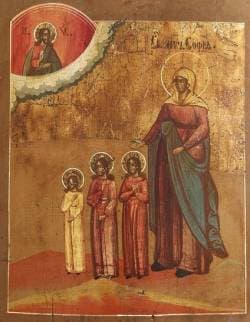
Sophia and her Daughters Faith, Hope, and Love — Public domain. Via Wikimedia Commons.
Life
Sophia (the Greek word for Wisdom) was a Christian widow of Italian birth living at Rome in the early second century — the reign of the Emperor Hadrian (117-138). She had been brought up in a Christian family of some means and was widowed young; the church of Rome was at this period growing rapidly under the catechesis of bishops Telesphorus and Hyginus, and Sophia's house in the city was one of the meeting-places of the still-clandestine community.
She had three daughters whom she gave the names of the three theological virtues of St. Paul's letter — Pistis (Faith), Elpis (Hope), and Agape (Love), preserved in Slavic Christian tradition as Vera, Nadezhda, and Lyubov. The girls were twelve, ten, and nine years old at the time of the events that gave them their place in the Church's calendar.
About the year 137 Hadrian's persecution of the Roman Christians intensified. Sophia's family, well known in the city, was denounced by neighbors; they were arrested and brought before the Emperor in person. Hadrian, evidently moved by the youth of the daughters and by Sophia's bearing, attempted to win them over with promises and gifts — adopted daughters of the Emperor, marriages into the highest Roman families. Sophia refused for all four of them. They were given over to the prefect Antiochus for examination.
Antiochus had each of the daughters tortured separately, in ascending order of age and severity, in their mother's presence. Faith was scourged, had her breasts cut off with shears, was placed on a hot iron grill, and was at last beheaded. Hope was thrown into a furnace, miraculously preserved unburned, and at last beheaded with the sword. Love was stretched on the rack, beaten with rods, and finally hung up by the hands and slowly burned with torches before being beheaded.
Throughout the long ordeal Sophia stood by, holding herself upright by the Lord's grace, encouraging each daughter in turn to be steadfast. After their death the bodies were given over to her. She buried them outside the gates of the city on the road to Tibur and remained at the grave for three days in unceasing prayer, neither eating nor drinking, until her own soul was loosed and she joined them. The four bodies were left at the same place.
Their relics were translated to Alsace in the eighth century, to the convent of Esche near the modern town of Eschau, where they remained until the upheavals of the Protestant Reformation. The major portion was destroyed in the iconoclastic riots of the 1520s; fragments were saved and are venerated to this day at several Orthodox and Roman Catholic sites. The largest surviving relics rest at the Church of the Holy Sepulcher at Alsace's modern Eschau.
Sophia and her daughters are honored across the whole Orthodox world as the icon of motherhood that gives its children to God. The Slavic forms of their names — Vera, Nadezhda, Lyubov, and Sofiya — are among the most-loved girls' names in Russia. Their feast is September 17.
Traditions
Feast day
September 17
Topics
Works in library