saint
St. Spyridon the Wonderworker
A shepherd-bishop of Trimythous on Cyprus whose simple faith at the Council of Nicaea is said to have confounded a philosopher by the parable of the brick — fire, water, and clay from one tile, as the Trinity from the one God. His incorrupt relics rest on Corfu.
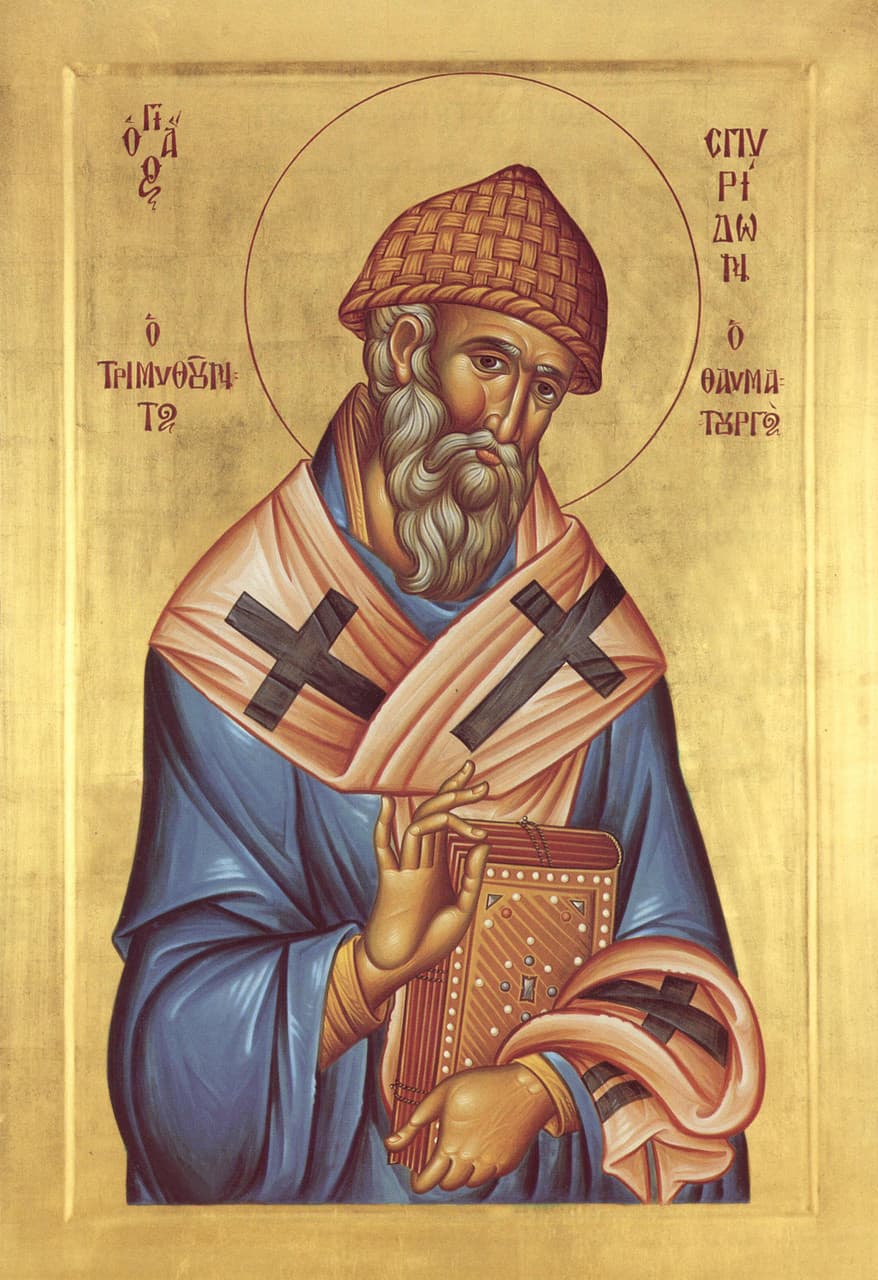
Spyridon the Wonderworker — Hand-curated icon.
Life
Spyridon was born around 270 on the island of Cyprus to a peasant family of shepherds. He kept his father's flocks himself and married young; when his wife died after a few years of marriage he did not remarry but turned the whole of his time to the Church and the poor. The bishopric of Trimythous fell vacant during the persecution of Diocletian; the people chose him for it, and he served his small mountain town as bishop without ever ceasing to be a shepherd — he is shown in icons in a wicker shepherd's cap, the universal mark of his image.
He came up to Nicaea in 325 to the First Ecumenical Council, an old man already, dressed in his shepherd's clothes. There the famous incident of the brick is told: when a learned pagan philosopher was demolishing the Christian arguments one after another, Spyridon stood up and said, "Listen now to one ignorant fisherman." He held up a clay brick and pressed it; from it came at once water (downward) and fire (upward), and only the dry clay remained in his hand — fire, water, and earth, three elements but one tile, as the Father, Son, and Spirit are three persons but one God. The philosopher fell at his feet and confessed Christ on the spot.
His miracles are among the most charming in the synaxaria. When a poor farmer came to him to borrow seed, he wrapped a stone in cloth and told the man to plant it — the stone became gold in the buyer's hand at market and was paid back as a stone again the next season. When a merchant tried to cheat him over a goat, he set the goat free; the goat returned to the saint at the church door. When a flood threatened the village he held up his cross and the river divided. His daughter Irene, who had taken a deposit from a fellow Christian and died without telling her father where she had hidden it, was raised by his prayer to answer his question and then laid back to rest.
He reposed around 348 and was buried at Trimythous. In the seventh century his relics were translated to Constantinople; after the fall of the city in 1453 they were taken to Corfu, where they remain to this day, incorrupt and warm — pilgrims who venerate them have for centuries reported finding the saint's slippers worn through, as if he had walked through the night to help the suffering. His feast is December 12.
Traditions
Feast day
December 12
Topics
Works in library