father
St. Symeon the New Theologian
Abbot of St. Mamas in Constantinople and author of the Hymns of Divine Love, who insisted that mystical experience of the Divine Light is given even now to those who seek the Lord with all their heart. Only the third Father given the title 'the Theologian.'
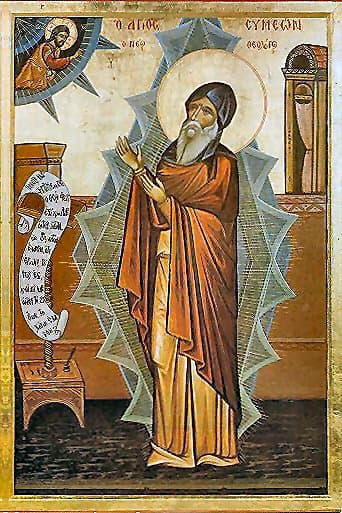
Symeon the New Theologian — Public domain. Via Wikimedia Commons.
Life
Symeon was born in 949 in the village of Galatae in Paphlagonia (on the southern Black Sea coast of what is now Turkey), into a provincial Byzantine noble family. He was sent at twelve to Constantinople for education at the court of his uncle, a senior official of the imperial palace; by fourteen he was being groomed for a court career and was already a junior office-holder by his late teens. He grew up in the world of the upper aristocracy of mid-Byzantine Constantinople — privileged, classically educated, well-connected, expected to make a career as a magistrate or a courtier.
Around his fifteenth year — perhaps fourteen — he came under the spiritual direction of Symeon the Studite (called "Eulabes," "the Pious"), an elder of the great Studion Monastery in the capital. Under the elder's guidance he began the practice of unceasing prayer and the systematic reading of the Greek Fathers. One evening, while he stood in his apartment at his uncle's house reciting the Trisagion, he was caught up in an overwhelming experience of the divine Light — the light he would describe again and again in his later writings as the immediate vision of God Himself. The experience left him changed in a way that could not be undone.
He did not enter the monastic life immediately. He continued at court for several years, but the experiences continued; finally he could no longer bear the dissonance of his daily life with the gift he had received. He left the court at twenty-seven and entered the Studion Monastery as a novice. Within a few months he had so excited the jealousy of his fellow novices by his rigor and the obvious favor in which he was held by the elder Symeon the Studite that the abbot transferred him for his own safety to the smaller monastery of St. Mamas in the same city.
At thirty-one he was made abbot of St. Mamas — a small house with about a dozen monks in dilapidated buildings. He served as abbot for the next twenty-five years and transformed the monastery into one of the most spiritually serious houses in the capital, drawing dozens of young monks from the noble families of the city. His teaching there was systematic, demanding, and — even for the Studite tradition that had formed him — radical. He insisted that every monk should aim for the actual conscious experience of grace, the direct vision of the divine Light, in this life. He held that an unconfessed sin remained a barrier to all spiritual progress and that one should never receive Holy Communion until one had made a thorough confession to a trusted spiritual father.
These positions, joined to Symeon's increasingly forceful insistence on the necessity of direct spiritual experience as the criterion of true faith, brought him into conflict with the official hierarchy of the patriarchate of Constantinople. The first attack came from Stephen, the syncellus (chief assistant) of the Patriarch — a learned ecclesiastic who held that an experiential mysticism of the kind Symeon taught was either a delusion of the past (the age of the apostles) or a delusion of an unsound mind in the present. The dispute went on for years and ended in 1009 with Symeon's deposition as abbot and his exile from the capital.
He spent his last twelve years at a small abandoned chapel of St. Marina on the Asian side of the Bosphorus near Chrysopolis. There, with a handful of disciples who had followed him out of the city, he wrote the works that have made him one of the giants of Greek Christian spirituality. The principal works are the Hymns of Divine Love (fifty-eight long mystical poems written in iambic meter, full of fire and tears), the three categories of Catechetical Discourses (instructional sermons to his monks), the Practical and Theological Chapters (aphoristic counsels), and his Letters. They have been a major source of Orthodox spirituality ever since.
He was given by his community the title "the New Theologian" — the third of the three Greek Christian figures so titled, after the apostle John and Gregory of Nazianzus. The title means "the new one who speaks of God from direct experience," in distinction from those who speak of God on hearsay. He reposed at his hermitage on March 12, 1022, at the age of seventy-three, and was canonized at his old Studion monastery shortly after.
His relics were translated to Constantinople in 1052 and rest at the Studion (now in ruins under Istanbul); the head and some other relics survive at the monastery of Vatopedi on Mount Athos. He has been particularly recovered as a teacher in the modern Orthodox world by Vladimir Lossky, Archimandrite Sophrony, and others. His feasts are March 12 (repose) and October 12 (translation of relics).
Traditions
Feast day
March 12 and October 12
Topics
Works in library
Readings and commentaries
Discourses
The Practical and Theological Chapters
Untitled commentary
Practical and Theological Texts: One Hundred and Fifty-Three Texts
St. Symeon the New Theologian · Practical and Theological Texts: One Hundred and Fifty-Three Texts — as included in the Philokalia.
The Three Methods of Prayer
St. Symeon the New Theologian · The Three Methods of Prayer — as included in the Philokalia.
St. Symeon the New Theologian — Introductory Note (Philokalia)
Editorial introduction to the Philokalic selections of St. Symeon the New Theologian.
On the Mystical Life — Ethical Discourses Vol. 1: The Church and the Last Things
The first volume of Symeon's Ethical Discourses in English — containing the first three discourses and parts of the tenth and fourteenth. Topics range from creation and the Incarnation, the saints' union with Christ, the foreknowledge and predestination of those who are united to Christ in baptism, the fearful day of the Lord and the future judgment, and the proper celebration of the feasts. Translated from the Greek and introduced by Alexander Golitzin.
On the Mystical Life — Ethical Discourses Vol. 2: On Virtue and Christian Life
The second volume of Symeon's Ethical Discourses in English — focused on virtue and the Christian life: the spiritual struggle, the passions, dispassion, the love of God, and the encounter with God in the heart. Translated from the Greek and introduced by Alexander Golitzin (SVS Press, 1996; Popular Patristics Series 15).
On the Mystical Life — Ethical Discourses Vol. 3: Life, Times, and Theology
The third volume in the SVS Press On the Mystical Life series — Alexander Golitzin's editorial study of St. Symeon the New Theologian's life, the controversies of his last decades, his theology of the personal vision of God, and the larger Byzantine and patristic tradition in which he stands. The companion volume to the two-volume translation of the Ethical Discourses.