saint
St. Symeon the Stylite
A Syrian ascetic who lived thirty-seven years on a pillar at Telanissos near Antioch, drawing the whole world up to Christ from on high. He commemorated the indictal feast of the ecclesiastical new year, September 1.
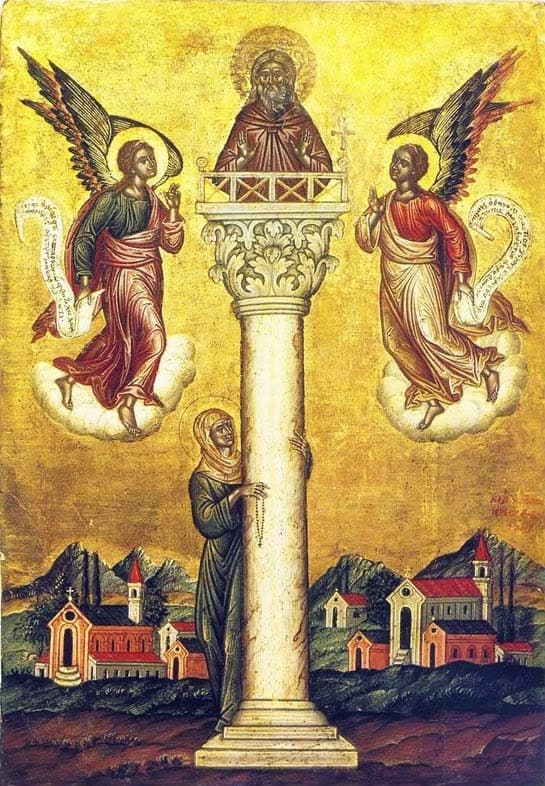
Saint Symeon the Stylite — Public domain. Via Wikimedia Commons.
Life
Symeon was born around 388 in the small village of Sisan, on the border between the Roman Empire and the Persian — a shepherd's son in the foothills of the mountains south of Antioch. As a boy of thirteen he heard the Beatitudes read in a church one Sunday and was so struck by them that he asked an old monk standing nearby what they meant. The old man taught him; from that day Symeon went home determined to give his life to the Lord.
He entered the monastery of Eusebius at Teleda, eighty miles south of Antioch, at sixteen. His austerities horrified the brothers — he tied a rope of palm fibres around his bare waist until his skin grew over it, was discovered, and had to be cut free with a knife by the doctor. The abbot finally asked him to leave; he was too extreme for the community. He went on alone, settling in a tomb-cell at the foot of the great hill called Telanissos.
At about thirty he made his decision. Pilgrims and the curious were coming to him in such numbers that he could neither pray nor rest; he had a small platform built on top of a pillar four cubits high, and from then on lived only there. He went up; he did not come down. Over the years the platform was rebuilt successively taller — six cubits, then twelve, then twenty, finally thirty-six cubits (about fifty feet). For thirty-seven years he stood, slept standing, ate (once a week, on Sundays only after Communion), and prayed in the open air above the Syrian plain.
The crowds went on coming. Bedouins came up from the desert and converted on the spot; envoys came from the Persian shah; the Emperor Theodosius II wrote to him for advice; bishops climbed the iron ladder to consult him on doctrine. He never came down — not even when the bishops of the patriarchate ordered him to, to test his obedience — until the Antiochene patriarch himself sent up word that the test was passed and he could remain.
He reposed at the top of his pillar on September 1, 459. The Antiochene patriarch, accompanied by the Roman army, came up the hill to remove the body; six thousand monks of Syria and a hundred thousand pilgrims came with him. The body was carried to Antioch, then to Constantinople. The shrine of Qal'at Sim'an (Symeon's Castle) rose around his pillar in the years following — a great cruciform basilica, the largest church in the East before Hagia Sophia, the ruined stub of his pillar still at the center.
From him came a long line of Syrian and Byzantine stylites — Daniel, Alypius, Symeon the Wonderful — who imitated his way of life. The Church remembers him on September 1, the day his repose marked the beginning of the indictal year.
Traditions
Feast day
September 1
Topics
Works in library