saint
St. Tatiana of Rome
A noble deaconess of third-century Rome under Severus who endured the breaking of her teeth, the rending of her flesh, and the spectacle of the arena — the very lions licked her feet before she was beheaded. Patron of students (especially of Moscow State University).
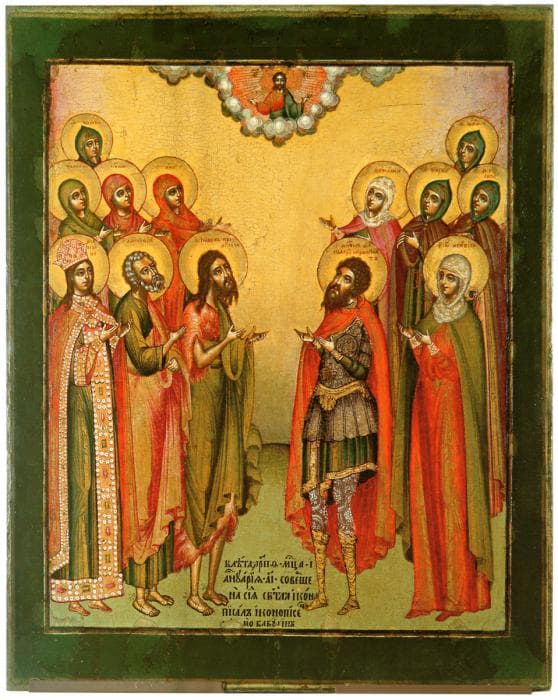
Tatiana of Rome — Public domain. Бабухин Кузьма Яковлев. Via Wikimedia Commons.
Life
Tatiana was born around 200 in Rome, the only daughter of a wealthy and senatorial Christian family. Her father was a Roman consul who had been baptized in secret in his youth and had brought up his daughter in the faith without making it public. Tatiana grew up at the family villa on the Palatine and was, from her early teens, devoted to acts of mercy — she had a steady habit of going out to visit the prisoners in the city's many gaols.
In the year 222 the young Emperor Alexander Severus came to the throne. Severus himself was tolerant of Christianity (his mother Julia Mamaea had Christian sympathies and had received Origen at her court), but his praetorian prefect Ulpian — the great Roman jurist — was a hard-line traditionalist. Ulpian launched a quiet but vicious campaign against the Roman Christian community, working through informants and using the public games as the venue for executions.
Tatiana, by then a consecrated deaconess of the Roman church (the diaconate of women, distinct from the diaconate of men, served the women of the community in baptism and visitation), was about twenty-two when she was denounced. She was brought before Ulpian's tribunal at the temple of Apollo on the Palatine and ordered to sacrifice. As the procession entered the temple, she prayed; the temple shook and the great statue of Apollo fell from its pedestal and shattered on the marble floor. The pagan attendants fled in terror.
The torments that followed are recorded with the unusual detail typical of the Roman acts of the martyrs. Ulpian had her hung up by her hair and beaten with iron rods; the rods broke and the soldiers found her wounds healed in the morning. He had her thrown to the lions at the Coliseum; the lions came up to her, licked her feet, and lay down at her side. He had her cast into the great fire at the temple of Diana; the fire opened around her into a corridor of cool air and she walked out untouched. He had her teeth broken out one by one with iron pliers; she continued to speak the gospel through the bleeding. At each ordeal more of his soldiers and torturers fell at her feet and confessed Christ — eight of them, by the account, were martyred along with her.
At last he had her beheaded with her father — who had been arrested at home and brought to the same square — both struck down with a single sword. She was twenty-three; the year was about 226.
Her relics were translated to a basilica on the Caelian hill that bore her name through late antiquity. She is the patroness of students (since the eighteenth century, of Moscow University in particular, which was founded on her feast day in 1755 and named her its heavenly patroness ever since), of female teachers, of the women of imperial households, and of any soul that asks for the courage to confess Christ openly. Her feast is January 12.
Traditions
Feast day
January 12
Topics
Works in library