saint
St. Thekla the Protomartyr and Equal-to-the-Apostles
A noblewoman of Iconium converted by the apostle Paul whose witness she followed through fire, beasts, and exile. The first woman martyr, she labored as an evangelist for many years and reposed in old age in a cave at Seleucia. Patroness of women teachers and apostolic women.
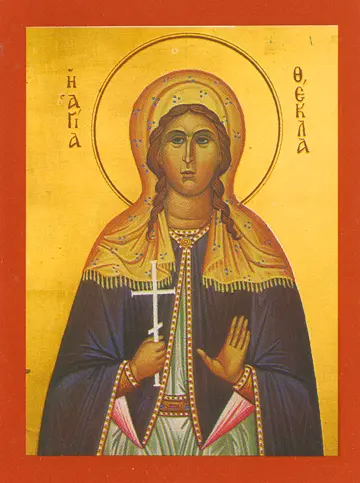
Saint Thekla of Iconium — Hand-curated icon.
Life
Thekla was born around the year 30 in the city of Iconium in Lycaonia (modern Konya in central Turkey), into a wealthy noble family of the Greek-speaking aristocracy. She was the only daughter of a widow named Theocleia and had been raised in considerable comfort. By the age of seventeen, in the year 47 — when the apostle Paul came to Iconium on his first missionary journey with Barnabas — she was already betrothed to a young nobleman named Thamyris.
She heard Paul preaching from her bedroom window, which looked across the street to the courtyard of the house of one Onesiphorus where Paul was lodging. The apostle was teaching from the door of the house; Thekla listened day and night for three full days without taking food or moving from her place. She was particularly struck by his teaching on virginity and the kingdom of God, which Paul was already developing as the great theme of his Asian preaching.
Her mother, alarmed, summoned Thamyris, and the two of them went to the apostle to plead with him to give up his preaching. Thamyris went further — he denounced Paul to the Roman authorities, who threw the apostle into prison. Thekla bribed her way into the prison that night, sat at Paul's feet through the dark hours, and was instructed in detail in the new faith.
The next morning her absence was discovered; her mother and her betrothed had her dragged before the Roman proconsul. Paul was sentenced to a beating and exile from the city; Thekla, for refusing to renounce her new faith and her broken betrothal, was sentenced to be burned at the stake. The fire was kindled. As Thekla stood in the midst of it praying, a great rainstorm came up unexpectedly and put out the flames. She was unharmed.
Released, she went after Paul. She found him at Daphne, near Antioch, hiding from his enemies. They traveled together for some time. At Antioch a Roman official named Alexander tried to seize her in the street, in the presence of Paul; she resisted, tore his cloak, and pulled the crown of office from his head. He was so humiliated that he denounced her also to the local proconsul, who sentenced her to be torn apart by wild beasts in the local amphitheater.
The proconsul allowed her to be lodged in the house of one Queen Tryphena — a noble Christian woman of the city who had received Thekla's mother as a guest. Tryphena's daughter had recently died, and Thekla prayed for the daughter, who appeared to her in vision and asked her to pray that she be passed into eternal life. Tryphena was so consoled that she begged the proconsul to release Thekla; he refused, but allowed her to be sent into the arena without the customary stripping for the spectacle — out of regard for Tryphena's connections.
In the arena a lioness was let out at Thekla. The lioness lay down at her feet and would not touch her. Other beasts followed: bears, leopards, more lions; none would touch her. A pit of vipers was opened beneath her — Thekla baptized herself in the pit, declaring "In the name of Jesus Christ I baptize myself for the last day." Bulls with lighted torches tied to their horns were driven against her; the ropes broke and the bulls turned aside. Finally the proconsul, recognizing that no Roman execution could be carried out against her, released her.
She went to Seleucia in Isauria (on the southern coast of Asia Minor) and lived there for the rest of her long life as an evangelist of the apostolic tradition. She lived as a virgin and as a teacher of women, baptizing many and bringing them into the faith. She was sometimes called by the title of "Equal-to-the-Apostles" already in the early Greek sources, since her preaching had effects comparable to those of the Twelve. The pagans of Seleucia eventually moved against her in her old age — she was perhaps ninety — and pursued her into the wilderness. The earth opened and received her, leaving only the hem of her veil for her tormentors to take.
Her relics — what could be recovered, since the body itself was taken — are at her church at Maaloula in Syria, one of the very ancient Christian shrine sites, and at the Cathedral of Tarragona in Catalonia, to which a portion of her arm was translated in the Middle Ages. She is one of the very widely venerated saints across the entire Christian world; in the East she is the first woman martyr (the protomartyr among women, paralleling the protomartyr Stephen), and in the West she is one of the patrons of Seville and of teachers of women. Her feast is September 24.
Traditions
Feast day
September 24
Topics
Works in library