saint
St. Theodore the General (Stratelates)
An officer of Heraclea on the Black Sea under Licinius who openly broke the city's idols, was crucified, pierced through with arrows, and beheaded. With Theodore the Tyro, one of the two great soldier-saints of the East.
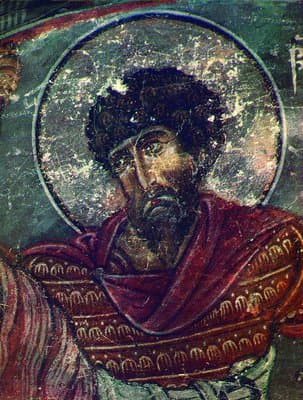
Theodore the General (Stratelates) — Public domain. Teodore. Via Wikimedia Commons.
Life
Theodore the General — known by the Greek surname Stratelates — was born around 281 in Euchaita, a small city in Pontus (northern Asia Minor), into a Christian family. Distinct from his older companion Theodore the Tyro (the Recruit), with whom he is often associated, Theodore the General rose by his military talent under the Emperor Licinius to be governor of Heraclea (also called Heraclea Pontica) on the south coast of the Black Sea — a city of considerable strategic importance.
He was a young man — twenty-five or twenty-six — and unusually beautiful and brave; Licinius (who had renewed the persecution of Christians in his eastern territories around 320) seems to have hoped to keep him in his service and so promoted him quickly. But when the Emperor came to Heraclea around 319 and demanded that Theodore offer a public sacrifice to the gods, Theodore — having debated the matter inwardly for some time — answered with the great gesture of his life. He asked for the imperial idols to be brought to his house, that he might offer his sacrifice privately and properly. The Emperor, pleased, gave him the gold and silver idols from the city's temples.
Theodore took them home, broke them into pieces, and distributed the pieces to the poor of the city. When the Emperor heard of it he came in fury. Theodore openly confessed Christ before him, gave a long defense of the faith, and the Emperor ordered him put to the torture. He was scourged, his sides torn with iron hooks, his eyes pierced with reeds, dragged behind horses for several stadia. Finally he was crucified — fastened upright to a cross set in the public square of the city.
While he hung on the cross many of the soldiers of his command, having watched what was done to him, came to him in turn and confessed Christ themselves. Two angels appeared in the sky and broke the spikes from his hands and feet; he stood whole again before the astonished crowd. He prayed in the morning before sunrise, then voluntarily presented himself to Licinius and was beheaded — a free martyrdom, unforced. The crowd of converts at his execution was so great that the city of Heraclea was confirmed in Christianity by his blood. His feast is February 8, with a commemoration of the translation of his relics on June 8.
He is, with Theodore the Tyro, the great patron of the military in the Eastern tradition — particularly of officers and of cavalry. He is shown in icons in full Roman officer's uniform, often killing a serpent or dragon with a spear from his saddle (in some traditions he is the original of the dragon-slaying icon later attached to St. George, whom he closely resembles in attributes). His relics rest at Brindisi in southern Italy, where they were translated by sailors after the fall of his city to the Turks.
Traditions
Feast day
February 8 and June 8
Topics
Works in library