saint
St. Theodore the Tyro (the Recruit)
A young recruit of the Roman army at Amasea under Maximian who burned down the temple of the Mother of the Gods and was burned alive himself. Also remembered for appearing in a dream to Patriarch Eudoxius to save the faithful from polluted food during the first week of Lent — the origin of the koliva blessing on the first Saturday.
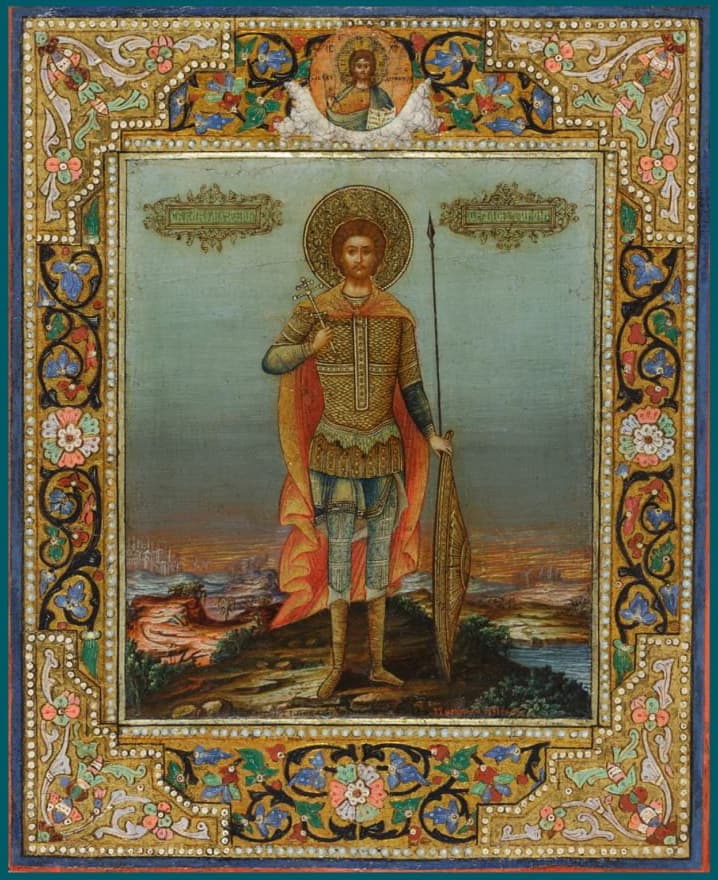
Saint Theodore the Tyro — Public domain. Osip Semenovich Chirikov. Via Wikimedia Commons.
Life
Theodore was born around 281 in the eastern Roman province of Pontus, near the city of Amasea (modern Amasya in north-central Turkey), into a moderately prosperous Christian family of the Greek-speaking provincial gentry. He was given the standard education of his class — Greek rhetoric and the basics of Latin — and was conscripted into the imperial Roman army at twenty in 301, at the height of the Diocletianic persecution.
He was assigned to the "Cohors Tyronum" — the recruit cohort, the second-line auxiliary infantry unit where new soldiers spent their first year of service, learning Roman discipline before being assigned to a regular legion. From this cohort he took his epithet "Tyro" (Greek "Tyron"), "the Recruit." His military career began at a fort near Amasea, where he served under the centurion Brincas during the persecution that swept the eastern empire in 303-305.
The imperial edict of 303 required all soldiers to offer incense to the Roman gods on pain of dismissal and execution. Theodore was already known in his unit as a Christian — he had been baptized as a child and had continued the practice openly. He refused the order. He was given some time — he was useful as a young soldier — and was sent home on temporary leave while his commanders considered what to do.
During this leave he committed the act that fixed his name in Christian memory. There was at Amasea a great temple of Cybele the Mother of the Gods — one of the principal pagan shrines of the province, of considerable wealth and political importance. Theodore went to it at night, set it on fire, and burned it to the ground. The act was not a private gesture of personal piety but a calculated public statement against the persecuting state: the Roman regime depended on the legitimacy of its public cult, and the burning of a major temple was a public denunciation of that cult.
He was arrested at once. The local Roman governor Publius brought him to trial at Amasea. The court records (recovered in part by the early Christian community of Pontus and preserved in the later Greek hagiography) show a long examination in which Theodore answered the standard questions about his faith, refused the standard concessions (a token offering, a few words of polite acknowledgment of the imperial gods), and was sentenced to be tortured to extract a recantation. He was placed on a heated iron grate and beaten with leaded rods; the metal of the grate so burned his flesh that the smell filled the courtyard. He did not recant. He was finally burned alive in a furnace on February 17, 306, at the age of about twenty-five.
His body was recovered by the local Christian community and buried at the village of Euchaita, twenty miles north of Amasea. A church was built over his tomb in the late fourth century; the village became a major Christian pilgrimage site and was renamed Theodoropolis ("Theodore's-town") in the sixth century. The cult of the saint spread rapidly across the Eastern Roman Empire — by the fifth century he was one of the principal soldier-saints venerated by the army.
The second major event in his cult is the famous Saturday-of-Lent miracle of the koliva. About fifty years after Theodore's death — during the brief reign of the apostate Emperor Julian (361-363) — Julian, knowing the Christians' habit of intensified fasting through Great Lent, ordered that the meat in the public markets of Constantinople be sprinkled with the blood of pagan sacrifices, in order to defile the Christians whose Lenten diet would force them to buy from the markets. The Christians could not avoid the defilement except by going without market food entirely.
Theodore the Tyro appeared in a dream to the Patriarch Eudoxius of Constantinople on the Friday night of the first week of Lent. He told the patriarch to instruct the Christians of the city to eat nothing from the markets the next day but to prepare instead a dish of boiled wheat with honey and nuts — what the Greeks call koliva. The patriarch did as he was told; the Christians of the city ate koliva on the first Saturday of Lent. The market defilement was thus avoided.
The Eastern Church has kept the koliva blessing on the First Saturday of Great Lent ever since, as a memorial of the saint's intervention. The Saturday is liturgically the saint's "second feast" — alongside his proper commemoration on February 17.
Theodore's relics were translated to Constantinople in the early fifth century and rest at the church of Hagia Sophia. Substantial portions are at the cathedral of Brindisi in southern Italy (a tenth-century Norman translation) and at several other Western shrines. He is the principal patron of recruits, of soldiers in their first years of service, of those who are tempted to compromise out of fear of authority, and of those who suffer for refusing to sprinkle the pagan blood on their daily bread. His feasts are February 17 and the First Saturday of Great Lent.
Traditions
Feast day
February 17 and the First Saturday of Great Lent
Topics
Works in library