saint
St. Theodosius of the Caves of Kiev
Disciple of Anthony of the Caves and first abbot to give the Russian monasteries the cenobitic rule of Theodore the Studite. With Anthony he is called the father of Russian monasticism.
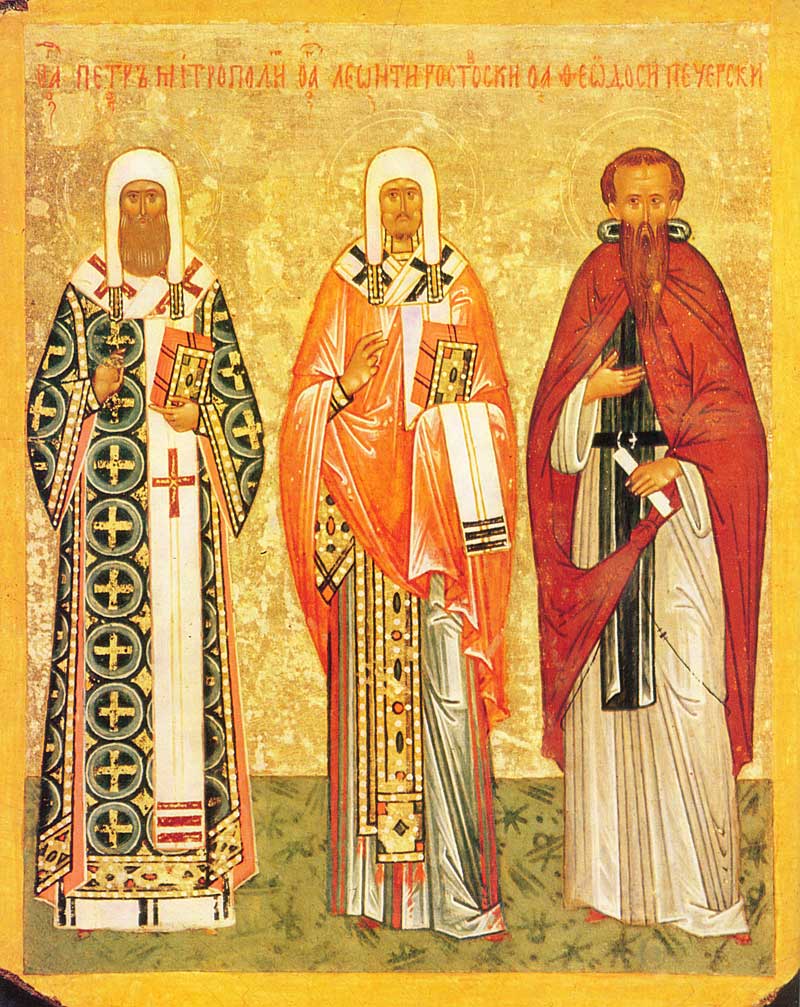
Theodosius of the Caves of Kiev — Public domain. Via Wikimedia Commons.
Life
Theodosius was born around 1009 in the town of Vasilkov (modern Vasylkiv, Ukraine) south of Kiev, the son of moderately prosperous boyar parents. His father, an official of the local prince, died when Theodosius was thirteen, leaving his mother to raise him and his sisters alone. She was a hard, determined woman, of fierce piety but also of fierce attachment to her son; the sources speak with respect of her physical strength (she had a man's voice and could hold off a horse with one hand) and of her difficulty in releasing the boy to the inner calling that drew him from childhood.
He insisted on baking the prosphora for the village church with his own hands as a boy — work normally done by older women — and on wearing rough cloth and chains. His mother beat him repeatedly for this self-chosen poverty (the family was, after all, of the local nobility), and twice when he ran away to join groups of pilgrims setting out for Jerusalem she had him brought back and chained to a beam. Eventually, in his early twenties, he managed to slip away unobserved to Kiev and found his way to the small community of caves that had begun to grow up around the elder Anthony on the south bank of the Dnieper.
Anthony received him reluctantly — Theodosius was too well-born, too obviously not adapted to the rigor of cave life — but his mother had finally exhausted her resources of recall. She came to Kiev with a small band of armed retainers and demanded he be released, but seeing him and the community at last broke down before his unyielding determination and allowed him to remain. She herself eventually entered a women's monastic community in Kiev and died there.
Theodosius lived at the caves for some thirteen years before Anthony, the founder, withdrew from the abbacy and named him hegumen in 1062. He took the community out of the caves themselves (which Anthony preferred but which had become too small) and built the first wooden monastic buildings on the hillside above. He introduced the rule of the great Constantinople monastery of the Studion — the cenobitic rule of common life, common meals, common prayer, fixed obediences — which became the basis of the entire Russian monastic tradition. By his repose the community numbered some seventy monks; within a century after him it numbered several hundred.
He was known for two things in particular: extraordinary personal poverty (he wore the same rough cassock summer and winter, ate the same bread the youngest novice ate, did the manual labor of the youngest monk, often unloaded the carts that came from the city with grain) and equally extraordinary frankness with the powerful. He was the spiritual father of Prince Iziaslav of Kiev, who came up the river to confess at the monastery weekly; Theodosius rebuked him to his face for the murder of his rival Vseslav and was for some time exiled by the prince for the rebuke. He was reconciled to Iziaslav at the prince's deathbed.
He wrote a number of works of pastoral instruction and Christian polemic — letters of advice to princes, exhortations to his own monks, several treatises against the Latin Christians who had begun to enter Russia in trade. He composed a small body of liturgical material, including some of the earliest known Slavic hagiography. His most famous saying — recorded by Nestor the Chronicler — is the one he gave on his deathbed when asked to choose a successor: "Whom you wish, brother, that the Lord may give you."
He reposed on May 3, 1074, at the age of about sixty-five. His relics were uncovered in 1091 by the Chronicler Nestor (himself a monk of the Lavra), found incorrupt, and translated to the Lavra cathedral. They were taken to the lower caves during the Mongol sack of Kiev in 1240 and have remained there since. His feasts are May 3 (repose) and August 14 (translation and the Synaxis of the Saints of the Kiev Caves). With Anthony he is the joint father of Russian monasticism.
Traditions
Feast day
May 3 and August 14
Topics
Works in library