saint
St. Theodosius the Cenobiarch
Cappadocian founder of the great cenobitic monastery between Jerusalem and Bethlehem, named cenobiarch — head of the cenobia of the Holy Land — by the patriarch of Jerusalem. Defender of Chalcedon during the Monophysite crisis.
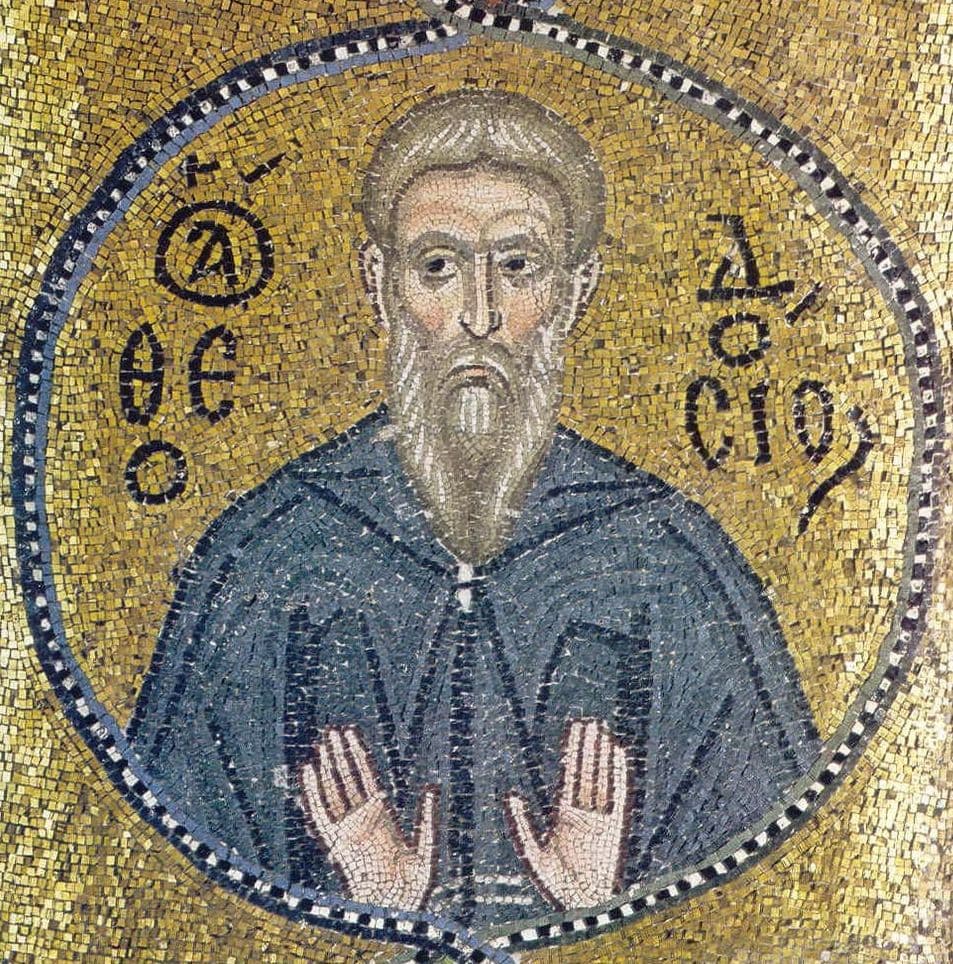
Theodosius the Cenobiarch — Public domain. Via Wikimedia Commons.
Life
Theodosius was born around 423 in the small Cappadocian village of Mogariassos (in the modern province of Kayseri in central Turkey), into a moderately prosperous Greek Cappadocian Christian family. His parents — both faithful Orthodox of the post-Chalcedonian generation — gave him careful catechesis from boyhood; he served as a small reader at the village church. He set out alone at perhaps eighteen, around 441, on foot from Cappadocia to the holy places of Palestine — the standard pilgrim journey of the period, taken by serious young Christian seekers from across the empire.
He stopped first at Antioch in northern Syria to receive the blessing of the elder Simeon the Stylite, who was still standing on his column near the city. Simeon prophesied to the young pilgrim that he would become "a great cenobiarch" — the head of many monastic communities. Theodosius continued his journey south through Syria into Palestine, arriving at Jerusalem at perhaps twenty.
He went straight to the great elder of Palestinian monasticism — Euthymius the Great, who at this point (around 443) had been at his lavra in the Wadi Mukallik east of Jerusalem for over thirty years. Euthymius received the young Cappadocian and assigned him to the small Cathisma monastery beside the road from Jerusalem to Bethlehem (the monastery at the spot where the Theotokos had rested on her way to Bethlehem before the Lord's birth, by the old Christian tradition). Theodosius lived at the Cathisma for several years as a disciple of the cenobitic monastic life — the communal monastic discipline as distinct from the more solitary lavra-style.
In 455, at about thirty-two, he withdrew to a deeper solitude. He found a small cave high in the cliffs east of Bethlehem (where Saint Helena had once stopped on her pilgrimage), and lived there alone for the next twenty years as a strict anchorite. The cave-hermitage gradually attracted disciples; by 475 he had perhaps fifty monks living in a loose lavra around the original cave.
Around 476 the elder of the Cathisma monastery (his original community) reposed; the community at the Cathisma — without a successor and concerned about its future — sent a delegation to Theodosius asking him to come back and assume the abbacy. He refused but offered instead to expand his own community into a fully cenobitic monastery along the lines the Cathisma had practiced. He built a new monastic complex around his cave-hermitage on the standard cenobitic model — large communal building, central cathedral church, refectory, common dormitories, separate cells for the senior monks — and from 477 onward led the community as a strict cenobitic abbot.
The "Theodosius Monastery" (modern Deir Dosi, about ten miles east of Bethlehem on the West Bank) grew rapidly under his abbacy. By 490 it housed about four hundred monks; by 510 it housed about seven hundred. The community was strictly multilingual — Greek, Syriac, Armenian, Latin, Bessian (the language of the Roman Balkan provinces), Cappadocian Greek, Persian — with separate chapels and liturgical traditions for each language group, all meeting together in the central Greek-language Liturgy for the principal services of the week.
The community's distinctive feature was the systematic combination of cenobitic discipline with extensive charitable work. The monastery operated four hospital-wings (one for monks, one for clergy from outside the community, one for laymen, one for women); a substantial almoner's office that distributed food and clothing to the poor of the surrounding Judean desert villages; a school for orphaned boys; a guesthouse that could accommodate fifty pilgrims at any given time. The monastic income from agricultural work and lay donations was constantly being recycled into these various works.
The Patriarch of Jerusalem in 494 — Salustius — formally designated Theodosius as "cenobiarch," the title of senior coordinator of all the cenobitic monasteries of Palestine (as Sabbas the Sanctified was designated "archimandrite of the lavras"). Theodosius held the cenobiarchic title for the next thirty-five years. He served effectively as the chief administrator of the Palestinian cenobitic system, with about a hundred monasteries under his nominal supervision by the time of his death.
The major theological-political controversy of his lifetime was the Monophysite question. The Emperor Anastasius (491-518) was sympathetic to the Monophysite position; he had attempted to enforce the heretical version of the Henotikon on the Eastern hierarchy. Theodosius — together with Sabbas the Sanctified — was the principal Palestinian monastic voice for the strict reception of Chalcedon (451) and against the imperial Monophysite policy. The two of them traveled together to Constantinople in 511 to confront the Emperor directly; they refused his offer of compromise; they led the resistance to his attempts to impose Monophysite clergy on Palestine. The eventual Chalcedonian victory under Justin I in 518 was substantially their work.
He reposed at his monastery on January 11, 529 — at the great age of a hundred and five (he was about a hundred and five and had been at his community at the cave for fifty-three years). The funeral was attended by Sabbas the Sanctified (then ninety-one), by Patriarch Peter of Jerusalem, and by senior monks of the entire Palestinian system. He was buried in the cave that had been the original hermitage, where his relics still rest.
The Theodosius Monastery has been continuously occupied since his death — through the Persian-Arab conquests of the seventh century, through the Crusader period, through the Ottoman centuries, through the British Mandate and the modern Israeli-Palestinian conflict. It is one of the very few continuously-occupied early Christian monasteries in the world today. His body is in the cave-shrine at the monastery, with portions of his relics translated to the Greek Orthodox monastery of Saint Theodosius at Mount Athos.
He is the patron of cenobitic monasteries, of Christians who organize the institutional combinations of contemplation and active charity, of those who refuse the imperial-political pressure to compromise on doctrine, and of every monastic abbot who has had to administer a multilingual community. His feast is January 11.
Traditions
Feast day
January 11
Topics
Works in library