father
St. Theophan the Recluse
Bishop of Tambov and Vladimir who at fifty-one withdrew into perfect seclusion at Vyshensk Hermitage, where over twenty-eight years he wrote some of the great spiritual letters of modern Orthodoxy, translated The Philokalia into Russian, and quietly guided thousands by post.
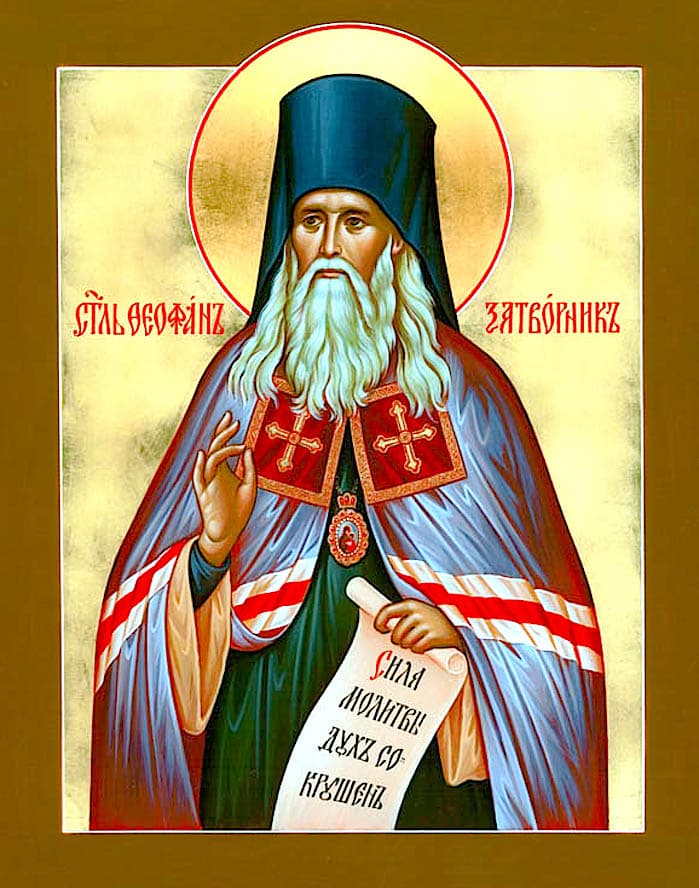
Theophan the Recluse — CC BY-SA 4.0. Via Wikimedia Commons.
Life
George Vasilievich Govorov was born on January 10, 1815, in the village of Chernavsk in the Oryol province of central Russia, into a married priestly family of modest means. His father was the parish priest of the village; his mother was a clergy daughter. He was the seventh of seven children. He was educated first at the local diocesan elementary school, then at the Liven theological school, then at the Oryol seminary, where he distinguished himself in patristic Greek and in the natural sciences.
He took his examinations at the Kiev Theological Academy in 1841 — the highest of the four Russian theological academies — and was tonsured during his last year of study, taking the name Theophan after the eighth-century Theophan the Confessor. He was ordained priest immediately on his graduation in 1841. He served the next dozen years in a succession of academic and administrative posts: instructor at the Kiev-Sofia theological school, instructor at the Novgorod seminary, assistant inspector at the St. Petersburg Academy, member of the Russian mission to Jerusalem (1847-1854), rector of the St. Petersburg Theological Seminary, and in 1857-1859 rector of the St. Petersburg Theological Academy.
He was consecrated Bishop of Tambov in 1859 at the age of forty-four. He served three years at Tambov (1859-1863), then four years at Vladimir-on-the-Klyazma (1863-1866) — the principal Russian metropolitanate before the rise of Moscow. Both bishoprics were demanding administrative posts; he handled them well, but increasingly he felt the conflict between the administrative and the contemplative life. In 1866, at fifty-one, he requested and received the Emperor's permission to retire to the small Vyshensk Hermitage in the Tambov province for the rest of his life.
He spent twenty-eight years in seclusion at Vyshensk (1866-1894). The standard pattern of his life was: monastic offices in his small cell-chapel for the first six years (1866-1872); after 1872, his cell-chapel was sealed off from the rest of the hermitage and he served the Liturgy entirely alone, taking communion to himself, receiving the prepared elements through a small window. He saw no one except his manservant Eumemerius. He did not appear at the monastery's common services. He did not preach. He wrote constantly.
The writings of his seclusion are voluminous — over a hundred and fifty volumes of letters, treatises, sermons (composed for distribution, never preached), translations, and devotional manuals. The principal works are: The Path to Salvation (his most-read systematic treatment of the Christian spiritual life, written for educated lay seekers); What is the Spiritual Life and How to Attune Oneself to It (his most-read shorter work, written as a series of pastoral letters to a young woman); The Inner Life (the systematic exposition of the Eastern Orthodox understanding of prayer); the Russian translation of the Philokalia, completed in 1890 — the work that gave the Russian-speaking world its first complete access to the great Greek anthology that Paisius Velichkovsky had translated into Slavonic a century earlier.
His distinctive emphasis — the one that has made him perhaps the most-read Russian spiritual author of the modern period — is on the integration of the warm feelings of the heart into the practice of prayer. Where Ignatius Brianchaninov had emphasized the dangers of spiritual delusion and the need for ascetic restraint, Theophan emphasized that genuine prayer must engage the heart's affections — must be felt, must move the soul, must result in the gradual warming of the inner life. The two positions are not entirely incompatible (both writers had read the Philokalic tradition deeply), but the difference of emphasis is real, and Theophan's approach has been more popular with lay readers.
He reposed at Vyshensk on January 6, 1894, at seventy-nine — on the very feast of Theophany ("the showing of God"), the feast for which his monastic name was chosen. He was found dead at his prie-dieu, the morning Liturgy on the small cell-altar before him just at the moment of communion. His relics were uncovered in 1988 by the Russian Orthodox Church on the millennium of the baptism of Rus' — he was glorified that year — and rest at the Vyshensk Hermitage. He is the patron of theological writers, of translators, of recluses, and of all who labor at long systematic spiritual instruction. His feast is January 10 (his name day) and January 6 (his repose).
Traditions
Feast day
January 10
Topics
Works in library
Readings and commentaries
On Saving Your Soul
A short pastoral compendium drawn from St. Theophan's letters — a numbered programme of repentance, abiding in God, guarding the heart, patience, and humble offering of self to God's will, with attention to the encounter with God in prayer and the safeguards against spiritual deception.
The Path to Salvation: A Manual of Spiritual Transformation
St. Theophan's most systematic pastoral treatise — a three-part manual on the entrance of Christ's life into the soul (through Baptism and the labors of Christian upbringing), the turning of the sinner toward God in repentance, and the long ascent of the perfected Christian life. Originally written as a series of articles in the Russian journal Domashnaya Beseda (1868-69). The defining nineteenth-century Russian guide to the inward life for both monastic and lay Christians.
The Spiritual Life and How to Be Attuned to It
A series of pastoral letters written by St. Theophan from his cell at Vyshensky Hermitage to a young Russian noblewoman of the imperial circle on the inner shape of the spiritual life — from the awakening of faith and the first steps in repentance through the work of prayer and the long discipline of the heart.