theologian
Blessed Theophylact of Ohrid
A lucid commentator whose Gospel exegesis distills earlier Fathers into accessible interpretation.
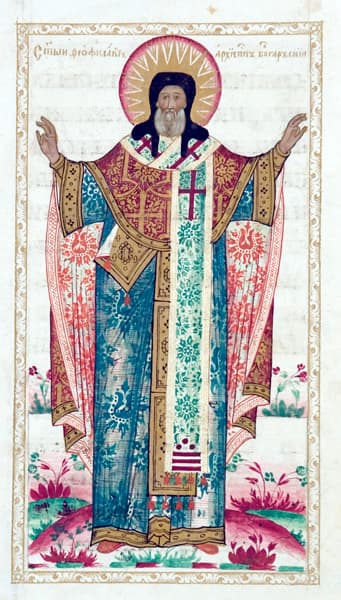
Blessed Theophylact of Ohrid — Hand-curated icon.
Life
Theophylact was born around 1055 on the Greek island of Euboea (modern Evia in central Greece), into a wealthy Byzantine Greek family of senior administrative rank. His father was a senior provincial bureaucrat of the Byzantine imperial system; the family had substantial estates on Euboea and political connections at the imperial court in Constantinople. He was educated at Euboea in the standard upper-class Byzantine curriculum, then sent to Constantinople for his higher studies under the great philosopher Michael Psellos — the leading classical scholar of mid-eleventh-century Byzantium. Theophylact emerged in his twenties as one of the most learned of the younger Byzantine intellectuals of his generation.
He was ordained deacon at the Patriarchate of Constantinople in his late twenties and was given a series of important diplomatic and administrative posts at the imperial court. He served as a tutor to the young prince Constantine — the eldest son of Emperor Michael VII Doukas — and produced for him an "Imperial Education" (a Greek mirror-of-princes treatise that has been preserved). He was a recognized commentator on the Greek classical poets through his Constantinople years.
In 1088 — at thirty-three — he was consecrated Archbishop of Ohrid, the senior bishopric of the recently-conquered Bulgarian provinces of the Byzantine Empire. The bishopric had been part of the autocephalous Bulgarian Church (founded a century earlier at the conversion of the Bulgarians by the brothers Cyril and Methodius) until the Byzantine reconquest of Bulgaria under Basil II in 1018. The Byzantines had then absorbed the autocephalous Bulgarian Church into the Byzantine imperial Church, with the bishop of Ohrid as the senior Greek hierarch of the former Bulgarian territories.
The appointment of Theophylact was politically significant. The Byzantine government wanted a senior Greek scholar at Ohrid both to consolidate Greek ecclesiastical control over the Bulgarian territories and to give the appearance of cultural prestige to the Greek presence there. Theophylact spent the rest of his life — about twenty years (1088-1107) — as the Archbishop of Ohrid, in what he often described in his letters as exile from the literary and cultural life of Constantinople.
His tenure at Ohrid was, by all the contemporary accounts, more difficult than he had anticipated. The Bulgarian population resented the Greek archbishop; the Byzantine provincial administration was corrupt and indifferent to ecclesiastical concerns; the Greek priests Theophylact had brought with him were too few for the size of the province; the surviving Bulgarian Slavic clergy were undertrained for the standards he wanted. He wrote a series of long letters back to Constantinople complaining of his treatment — letters that have been preserved as a major source for the social history of the late eleventh-century Byzantine Bulgarian provinces.
His distinctive work during the Ohrid years was the great series of biblical commentaries that have made his name. He wrote commentaries on all four Gospels (Matthew, Mark, Luke, John), on the Acts of the Apostles, on the Pauline letters (all of them), on the catholic epistles (James, Peter, John, Jude), and on the Old Testament minor prophets (Hosea, Habakkuk, Jonah, Nahum). The commentaries are not original works of Greek exegesis but careful compilations of the earlier Greek patristic commentaries — particularly John Chrysostom on the Pauline letters and Cyril of Alexandria on John — selecting, abbreviating, and re-organizing the patristic materials into a single accessible synthesis.
The format of the commentaries is what has given them their long influence. Theophylact gives each scriptural passage in its full text, then a continuous prose commentary that reads as a single explanation without interruption — selecting from the patristic sources what is most directly applicable, omitting digressions, smoothing the prose. The result is a commentary that can be read straight through as if by a single author, while at the same time preserving the substance of the standard Greek patristic exegesis. For a thousand years they have been one of the standard accessible introductions to the Eastern patristic reading of the Scriptures.
His distinctive theological position is conservative-orthodox in the standard sense. He was deeply committed to the Greek-Byzantine tradition as it had been received through the patristic Greek Fathers; he was wary of innovations; he had an evident dislike of the Western Latin Church (then in the early stages of the great schism of 1054 and the subsequent estrangement); and he was particularly hostile to what he saw as the Bulgarian-Slavic native traditions that he was attempting to assimilate to the Greek norm.
He reposed at Ohrid around 1107 or 1108, at perhaps fifty-three. He was buried at the cathedral of Ohrid. The medieval Ohrid cathedral has had a complex history — destroyed by the Ottomans, rebuilt, partially restored — but the tomb of Theophylact has been continuously preserved at the site. He was never formally canonized by the Greek Church (his theological position was orthodox but unremarkable; the title "Blessed" rather than "Saint" attached to him reflects his standing as a respected but not officially venerated figure); the Bulgarian Orthodox Church, which has reclaimed him as one of its medieval hierarchs, has given him a more formal local cult.
He is the patron of biblical commentators, of those who compile patristic materials for general readers, of unwilling provincial bishops, and of every Greek scholar who has been sent to administer a foreign province at the expense of his preferred metropolitan literary life. His feast is December 31.
Traditions
Topics
Works in library
Readings and commentaries
Explanation of the Holy Gospel According to John
A compact, readable synthesis of earlier Greek Fathers on the Johannine text.