saint
Most Holy The Most Holy Theotokos and Ever-Virgin Mary
Daughter of Joachim and Anna, dedicated as a child to the Temple, who at the angel's word became the Mother of God in the flesh. She stood at the foot of the Cross, was given to the apostle John, and was taken up in her dormition to her Son. The first and greatest of all the saints, named in every Orthodox prayer.
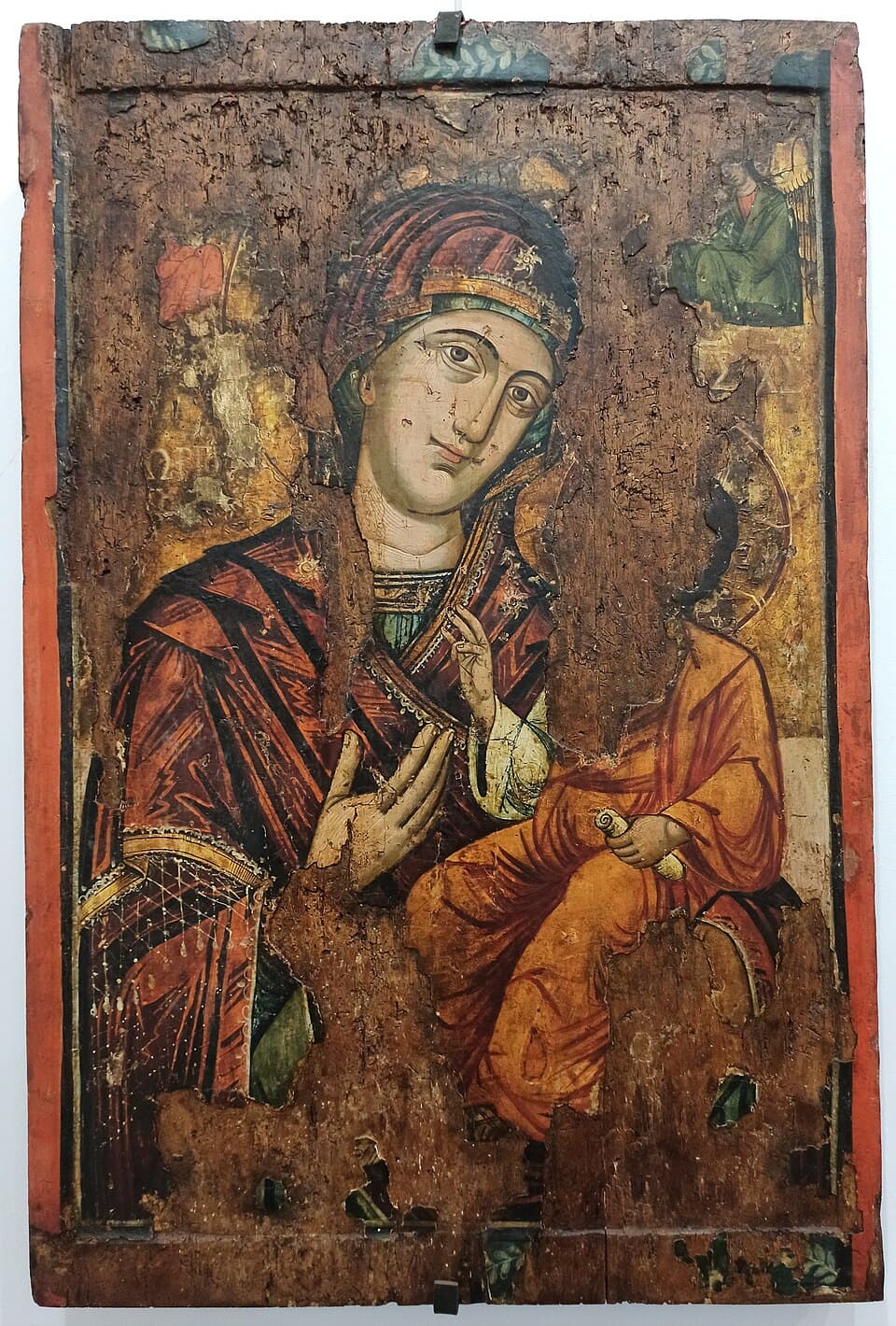
The Most Holy Theotokos — CC0. Spiritia. Via Wikimedia Commons.
Life
Mary was born in Jerusalem around the year 15 BC to Joachim, of the royal house of David, and Anna, of the priestly house of Aaron — both of them of advanced age and long childless. They had prayed for many years for a child and had vowed, if God should grant them one, to dedicate that child to the Temple. Tradition gives both the names of her parents and the festival of the Virgin's birth (September 8) on the strength of an early text known as the Protoevangelium of James.
At the age of three, in fulfillment of her parents' vow, she was brought up to the Temple in Jerusalem and given over to the keeping of the priest Zacharias (the father, years later, of John the Forerunner). The Feast of her Entry into the Temple (November 21) marks the day. She lived in the precincts of the Temple, learning Scripture and given daily bread by the hand of an angel, for about ten years.
When she was about fourteen the priests of the Temple, no longer able to keep an unmarried girl on the Temple grounds, chose Joseph, a widower of Nazareth and a kinsman of her family — already an old man with grown sons — to take her into his home as his betrothed wife but as a virgin under his protection. She lived in Joseph's house at Nazareth for some months before the visit of the archangel Gabriel — at the Annunciation (March 25, exactly nine months before the Nativity) — bringing her the word that she would conceive of the Holy Spirit and give birth to the Son of the Most High.
She gave her free consent — "Behold the handmaid of the Lord; be it unto me according to thy word" — and at that moment the Word was made flesh in her womb. Her cousin Elizabeth, also miraculously pregnant in old age, recognized the child of her cousin's womb when Mary came up into the hill country to visit her, and greeted her with the words the Church has prayed ever since: "Blessed art thou among women, and blessed is the fruit of thy womb." Mary answered with the Magnificat — "My soul doth magnify the Lord" — which the Church chants at every Orthros.
She bore the Lord in a cave at Bethlehem during the census of Caesar Augustus, presented Him in the Temple at forty days (where Simeon the God-Receiver took Him in his arms and Anna the Prophetess spoke of Him to all who looked for redemption), fled with Joseph into Egypt to escape Herod's slaughter of the innocents, and returned with the Holy Family to Nazareth after Herod's death, where the Lord grew. She was present at the wedding at Cana, where her quiet word — "Whatsoever He saith unto you, do it" — drew out His first miracle. She stood at the foot of the Cross on Friday, was committed by the dying Lord to the apostle John ("Behold thy son"; "Behold thy mother"), and from that day was kept in his household.
She received the Holy Spirit with the apostles at Pentecost in the upper room and lived on at Jerusalem under the care of John, and later (when persecution drove the household out) at Ephesus, where John served as bishop. Her dormition at Jerusalem is dated by old tradition to about the year 50, when she was about sixty-three. The apostles, scattered to their missions, were miraculously caught up and brought back to her bedside for her parting. When the apostle Thomas, late as before, arrived three days after her burial, the tomb was opened at his request and was found empty — for the Lord had taken her body to be where He is, and the assumption of His Mother into glory is celebrated by the Church on August 15.
The Third Ecumenical Council (Ephesus, 431) defined her formally as Theotokos — "the God-bearer," the one who bore in her womb the eternal Son. The Fourth (Chalcedon, 451) confirmed it. She is named in every Orthodox prayer, sung in every service, and honored above every other creature: "more honorable than the cherubim and beyond compare more glorious than the seraphim." There is no Christian people without her churches; there is no Orthodox family without her icon. Her feast is every day; her chief feasts are the four great festivals of her life (September 8, Nativity; November 21, Entry; March 25, Annunciation; August 15, Dormition), and the feast of her Protection (October 1), which celebrates her continual covering of the Christian people.
Traditions
Feast day
September 8, November 21, March 25, August 15, and every service
Topics
Works in library