saint
St. Tikhon, Patriarch and Confessor of Moscow
Elected patriarch of Moscow in 1917 at the restoration of the patriarchate, he led the Russian Church through the first persecutions of the Soviet state, anathematized the Bolsheviks for the blood they shed, and was placed under house arrest until his death in 1925.
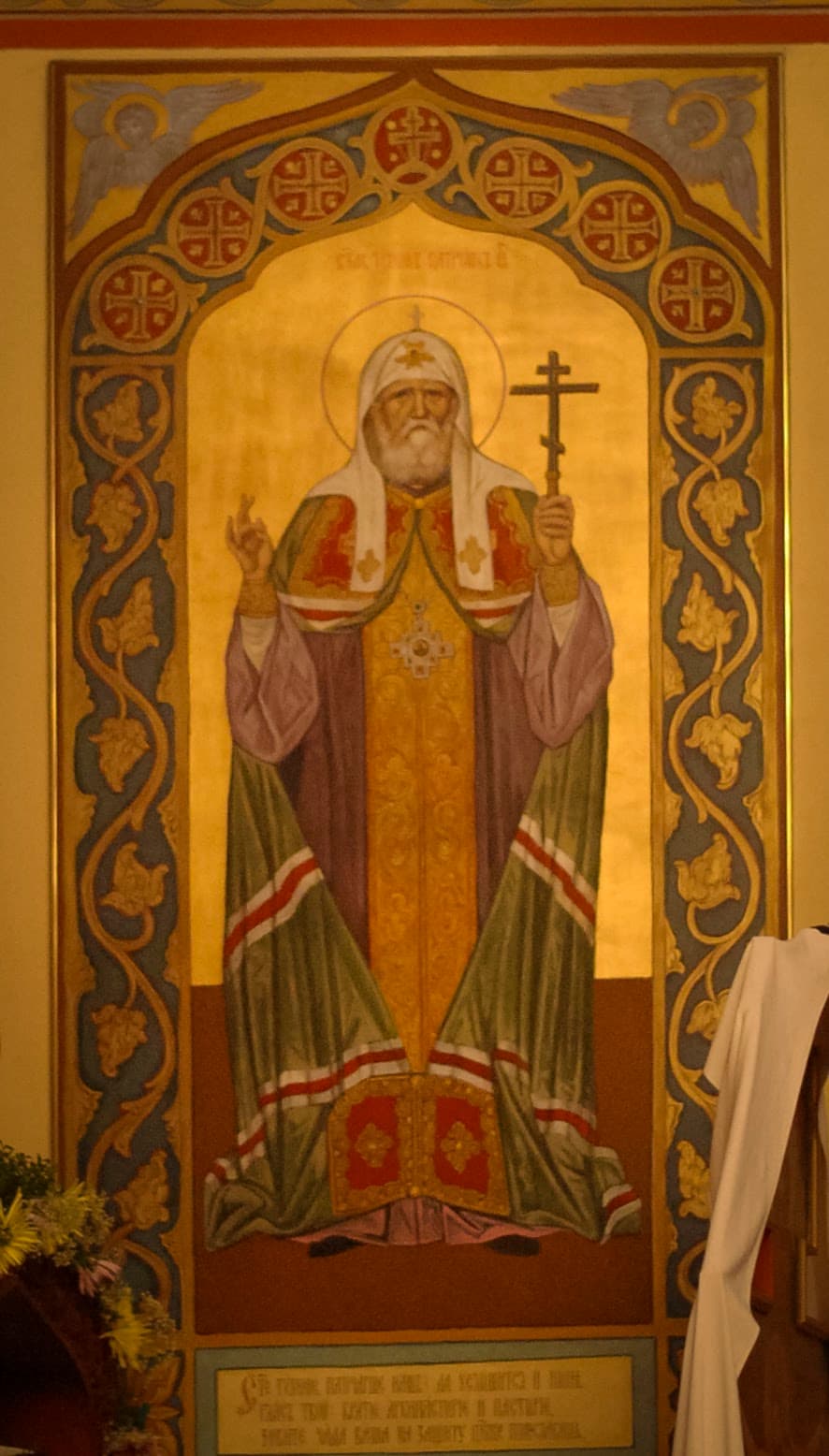
Saint Tikhon of Moscow — CC BY-SA 2.0. Via Wikimedia Commons.
Life
Vasili Ivanovich Bellavin was born on January 19, 1865, in the village of Klin, in the Pskov diocese of the Russian Empire — a son of a parish priest. As a seminarian his classmates called him "the bishop" and "patriarch" for his gentleness, his unbroken kindness, and the slightly otherworldly air with which he carried himself; the nicknames proved prophetic. After ordination as a teaching deacon, then as a monk with the name Tikhon, he served as a teacher at the Pskov seminary, then as rector of the Kholm seminary, and in 1897 — at thirty-two, exceptionally young — he was consecrated bishop.
He was sent in 1898 to America as bishop of the Aleutians and Alaska — Russia's North American mission. Over the next nine years he traveled the vast territory of the new diocese, learned English, integrated the Carpatho-Rusyn parishes that were joining the Russian Church in great numbers, founded the first American Orthodox seminary at Minneapolis, set up the see-city at New York (1905), and was raised to archbishop. He is responsible for shaping much of what became, in time, the Orthodox Church in America.
He was recalled to Russia in 1907 and given the see of Yaroslavl, then in 1913 the see of Vilnius (in what is now Lithuania). He was driven from Vilnius by the German advance in 1915 and was reassigned to Moscow as locum tenens. In the chaos of 1917, after the abdication of the Tsar, the All-Russian Local Council met in Moscow (August 1917 to September 1918) to restore the patriarchate — abolished by Peter the Great two centuries earlier. Three candidates for the office were chosen by the Council; the final choice was made by lot before the icon of the Vladimir Mother of God. The lot fell on Tikhon.
He was enthroned as Patriarch of Moscow and All Russia on November 21, 1917 — three weeks after the Bolshevik seizure of power. From his enthronement to his death seven and a half years later, his every act was framed by the persecution. In January 1918 he issued the famous "Anathema of the Bolsheviks," excommunicating those who shed the blood of the innocent and called the faithful to defend the Church. The decree of separation of Church and State in February 1918 began the wholesale seizure of churches, monasteries, and seminaries. In 1922 a famine in the Volga region became the pretext for the wholesale stripping of churches of their gold and silver; Tikhon allowed the giving of treasures not used in liturgy but resisted the seizure of vessels of the altar, and was arrested for it. He was held under house arrest for over a year, mostly at the Donskoy Monastery in Moscow, while the GPU built a case against him for the crime of having opposed the seizure.
In June 1923 he was released after issuing a partial declaration recognizing the legitimacy of the Soviet government and dissociating himself from anti-Soviet political activity. He never compromised on the Church's freedom in things of the spirit. The "Living Church" — a state-sponsored renovationist schism that tried to replace him — collapsed once he was free, as the parishes of Russia refused to recognize it.
His last years were spent under constant surveillance and constant pressure. He was poisoned twice; the second attempt, in late 1924, broke his health permanently. He died on April 7, 1925 — the feast of the Annunciation — at the Bakunin Hospital in Moscow, where he had gone for treatment of advanced heart disease. He was sixty.
He was glorified by the Russian Orthodox Church Outside Russia in 1981 and by the Moscow Patriarchate at the All-Russian Council of 1989. His relics were uncovered and translated to the Great Cathedral of the Donskoy Monastery in 1992, where they rest today. His feast is April 7 (repose) and October 9 (glorification).
Traditions
Feast day
April 7 (repose) and October 9 (glorification)
Topics
Works in library