saint
St. Tryphon of Lampsacus
A gentle Phrygian goose-herd who in his youth cast out a demon from a Roman princess and was later beheaded under Decius at the age of eighteen. The patron of fields, vineyards, and gardens, invoked against pests and the powers of the air.
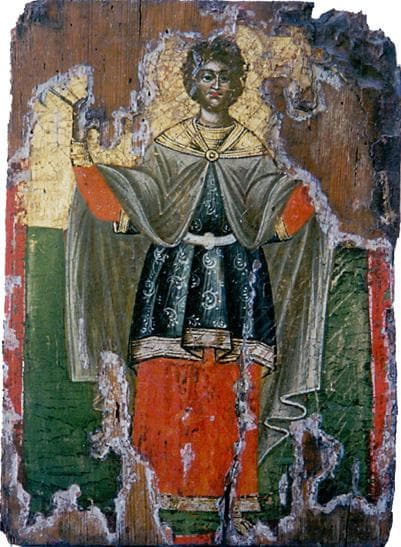
Tryphon of Lampsacus — Public domain. Via Wikimedia Commons.
Life
Tryphon was born around 232 in the small Phrygian village of Kampsade, near the Roman colony of Apamea in southwestern Asia Minor (modern Dinar in central Turkey), into a poor Christian family of free peasants. His father, by the surviving accounts, was a goose-herd of moderate means; Tryphon as a boy tended his father's geese. He grew up in the practice of the faith — at the standard country-village level of catechesis, no formal theology, but with the regular discipline of the Christian feasts and fasts and the public veneration of the martyrs of the previous generation.
He was about twelve when an event took place that fixed his name in the popular Christian imagination of the East. The young daughter of the Roman emperor Gordian III (238-244) — a girl of about fourteen named Gordiana, in the Greek sources — fell ill at the imperial palace at Rome with what the contemporary records describe as a violent demonic possession. The standard physicians of the imperial court were unable to help her. The girl herself, in her lucid moments, cried out that only one Tryphon, a goose-herd of a small Phrygian village, could heal her. The imperial bureaucracy, with some difficulty, located the boy at Kampsade and brought him to Rome.
Tryphon came to the imperial palace, prayed over the girl, and cast out the demon. The emperor was deeply impressed and offered him gold and an imperial appointment; Tryphon refused both and returned to his village. The story of his miraculous cure of an emperor's daughter spread across the eastern empire and made him a popular local healing-saint of his region.
He was about thirty-eight when the Decian persecution of 249-251 reached Phrygia. The local prefect Aquilinus was conducting the standard examinations of suspected Christians at Nicaea (where the regional assize court was held). Tryphon was reported by his neighbors and brought to Nicaea for trial.
Aquilinus knew Tryphon by reputation. He attempted to win him over with the standard offers — wealth, an imperial post, the freedom of the empire's territories. Tryphon refused. The standard tortures were applied: he was hung up by the feet, beaten with rods, his sides burned with torches, his feet driven through with nails. He continued to confess. Finally, in the middle of December 250, Aquilinus sentenced him to beheading.
The execution was scheduled for the next morning. Tryphon spent the night in prayer in his cell, and when the soldiers came for him in the dawn they found him already dead — he had given up his soul in the night, ahead of the executioner's sword. He was about thirty-eight or thirty-nine.
His body was recovered by the local Christian community of Nicaea and was eventually returned to his native village of Kampsade for burial. A church was built at the site; the cult of the martyr spread rapidly across Phrygia, then more broadly across the eastern empire, on the strength of the unusual combination of his healing acts in life and the miraculous death (the Christian sources read his anticipatory death as a final gift of the Lord, sparing him the executioner's blade).
The most distinctive feature of his cult is its agricultural focus. Because of his work as a goose-herd in his youth and the strong association of the Phrygian countryside with field crops, vineyards, and gardens, he was very early identified as the patron of agricultural labor. The standard prayers for the protection of fields from pests — locusts, mice, caterpillars, the various forms of crop disease — invoke him by name. His relics, or portions thereof, were eventually buried (in the standard medieval practice) under the corners of vineyards and grain-fields across the Greek-speaking world to ward off agricultural disasters.
Major portions of his relics rest at the Cathedral of Cattaro (Kotor) in Montenegro, where they have been since the late seventh century (the tradition is that they were translated there after the destruction of Kampsade in the Persian-Arab invasions of the period). Smaller portions are at the church of Saint Tryphon in Rome and at numerous Greek and Russian sites. He is the patron of farmers, gardeners, vineyard-keepers, herdsmen of geese and other birds, and of all who labor in the fields. His feast is February 1.
Traditions
Feast day
February 1
Topics
Works in library