saint
St. Holy Equal-to-the-Apostles Great Prince Vladimir of Kiev
Grandson of Olga, baptized at Cherson in 988 with the name Basil and called the Enlightener of the Rus' for bringing the whole nation into the Christian faith. After his baptism he abolished capital punishment and opened the storehouses of his treasury to the poor.
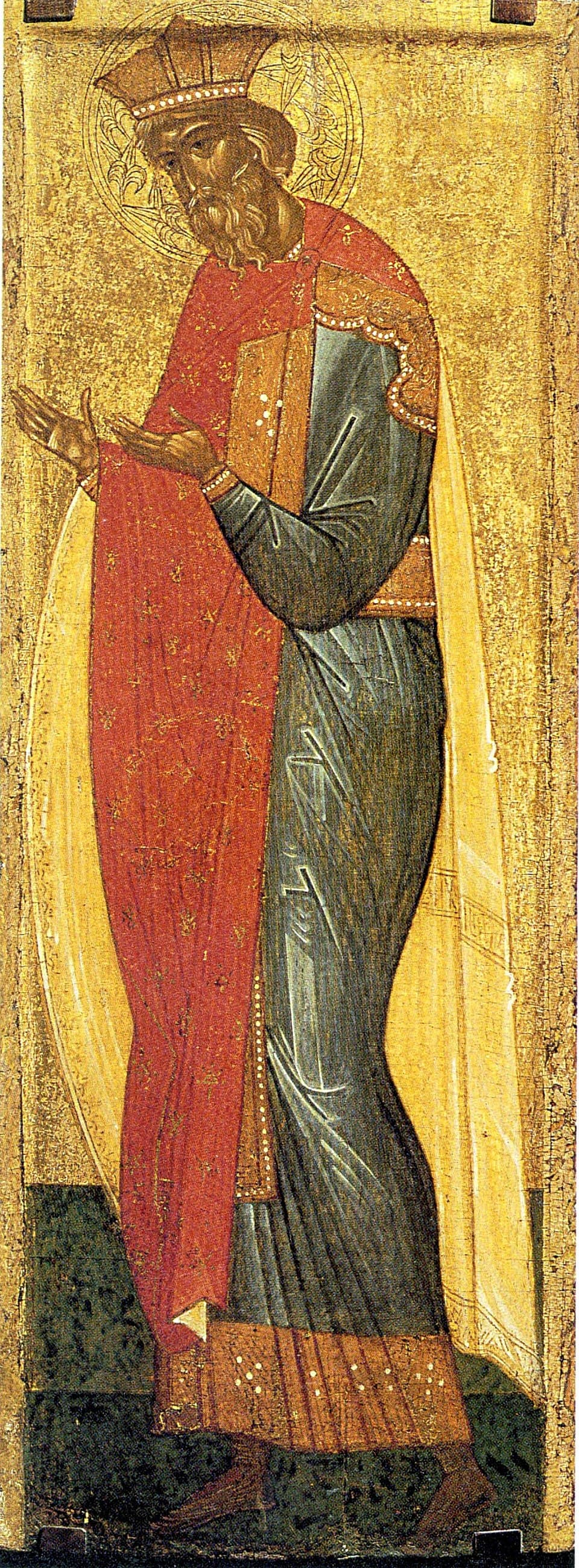
Saint Vladimir of Kiev — Public domain. Via Wikimedia Commons.
Life
Vladimir Sviatoslavich, born around 958, was a grandson of the holy Princess Olga and the youngest and least likely heir of the great Prince Sviatoslav of Kiev. After the murder of his elder brother Yaropolk in the civil war that followed his father's death, Vladimir emerged in 980 as the sole ruler of all the Rus'. His early reign was that of a vigorous and ruthless pagan: he set up wooden idols of Perun and the other Slavic gods on the heights above Kiev, kept many wives and concubines, and offered human sacrifice in his thanksgiving for victories.
Around 987 his great change began. The Primary Chronicle of the Kievan Caves records that, weighing the religions of the surrounding nations, he sent emissaries to inspect the worship of the Muslim Bulgars on the Volga, the Jewish Khazars, the Latin Germans, and the Greeks at Constantinople. From the Liturgy in the Great Church of Hagia Sophia his envoys returned bewildered: "We knew not whether we were in heaven or on earth, for surely there is no such splendor or beauty anywhere upon earth. We cannot describe it to you: only this we know, that God dwells there among men."
He was baptized in 988 — most likely at the Greek city of Cherson in the Crimea — taking the name Basil after his godfather, the emperor Basil II. He married the emperor's sister Anna, brought home Greek priests and Slavonic liturgical books prepared a century earlier by the disciples of Cyril and Methodius, and ordered the throwing down of the idols he himself had set up. Perun was scourged with whips and dragged to the Dnieper. On the appointed day Vladimir summoned all the people of Kiev — pain of his displeasure on those who would not come — to be baptized in the river. The whole nation was carried by his decision; the conversion of Russia had begun.
In the seventeen years between his baptism and his death he reigned by another spirit. He abolished capital punishment, hesitating even to execute murderers (the bishops at last had to beg him to take up the sword for the sake of order). He opened the storehouses of his treasury daily to the poor and the lame, and ordered carts of bread and meat to be driven through Kiev to feed those too sick to come to him. He built schools and churches across the land — the Church of the Tithe in Kiev among them. He sent missionaries north to Novgorod and east to the lands that would become Russia proper.
He reposed on July 15, 1015, at Berestove south of Kiev. Within a generation his grandchildren Boris and Gleb would become the first canonized saints of the Russian Church. The Church gave him the rare title Equal-to-the-Apostles — a title borne by only a handful of national converters across the Christian centuries: by Constantine for the Romans, Helen for the Holy Land, Nina for the Georgians, Cyril and Methodius for the Slavs, Olga for the Rus', and now Vladimir for the whole Russian world that would follow.
Traditions
Feast day
July 15
Topics
Works in library