saint
Blessed Xenia of St. Petersburg, Fool-for-Christ
Wife of a Russian colonel widowed young, who gave her wealth to the poor and took up the unkempt clothes and behavior of a fool-for-Christ, wandering St. Petersburg for forty-five years in voluntary poverty and unceasing prayer. The patroness of the homeless and of those who pray for their husbands.
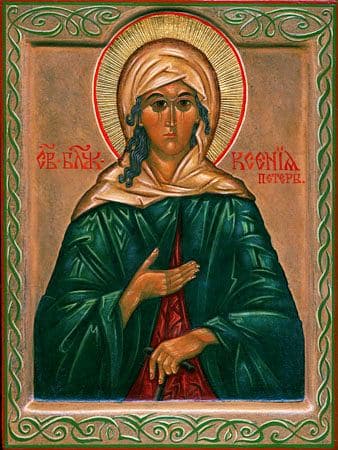
Blessed Xenia of Petersburg — Public domain. Via Wikimedia Commons.
Life
Xenia Grigorievna Petrova was born around 1731 in St. Petersburg to a well-off family of the imperial court. Around 1757 she married Colonel Andrei Fyodorovich Petrov, who served in the choir of the imperial chapel. The marriage lasted less than four years. The colonel died suddenly without confession or last rites — the worst possible death in the Russian understanding, his soul gone without the church's blessing.
Xenia, then about twenty-six, made an astonishing decision. She gave away her house to a friend, distributed her remaining money to the poor, put on her husband's old military uniform, and answered to his name and not her own. She lived for the next forty-five years as a fool-for-Christ, wandering the streets of St. Petersburg in his coat (eventually replaced when it fell apart with a red jacket and green skirt that became her recognized garb), refusing every gift of money, sleeping where she could.
When she lost the coat she went on praying — through the night in an open field outside the city, on her knees in the snow, in any weather. Construction workers building a new church on Smolensk Cemetery began to find every morning that the bricks they had stacked the night before had been carried by some unseen hand to the top of the rising walls; eventually they kept watch and found Xenia at midnight carrying brick after brick up the scaffolding. Carpenters at the church begged her to stop; she did not.
She had the gift of foresight. She would refuse to go to a house that she sensed was unsafe; she would urge an unknown woman to come at once to an address, where the woman would arrive in time to deliver a child whose mother had just died. Once in 1796 she told everyone she met in a single day to bake blini — and that night the empress Catherine II died and the whole country went into mourning, when blini are the customary fare.
She reposed at the end of the 1790s or the early 1800s — the exact date is unknown — and was buried at the Smolensk Cemetery. Pilgrims began at once to come to her grave, and the chapel built over it has never been empty since. The Soviets demolished the chapel in 1930; it was rebuilt and reopened in 1987. She was glorified by ROCOR in 1978 and by the Moscow Patriarchate in 1988.
She is the patroness of St. Petersburg, of the homeless and of widows, of those who pray for unfaithful husbands or for husbands gone without the Church's blessing, and of all wives who carry the burden of their husbands' souls. Russians visit her chapel by the thousands and leave written prayers at her grave; pilgrims come from all over the Orthodox world.
Traditions
Feast day
January 24 and February 6
Topics
Works in library