saint
Holy Zacharias the Priest
Husband of Elizabeth and father of John the Forerunner, who was struck dumb at the angel's announcement of his son's coming and sang the Benedictus when his speech was restored. Slain by Herod's men between the Temple and the altar for refusing to disclose where his son lay hidden.
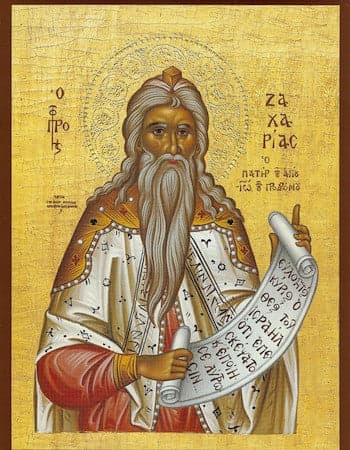
Saint Zachariah the Priest — Hand-curated icon.
Life
Zacharias was born around 60 BC in the territory of Judea, into the priestly family of the eighth division of the Mosaic priesthood — the division of Abijah (1 Chronicles 24:10). The Mosaic priesthood at the time of the second Temple was organized in twenty-four divisions, each serving at the Jerusalem Temple for a week at a time on a rotating basis; the division of Abijah was the eighth in the cycle, with two service-weeks per year (one in the spring and one in the autumn). Zacharias was the senior priest of the family in his generation and inherited the family's standing service at the Temple.
He was about thirty-five when he married Elizabeth, a daughter of another priestly family (probably of the family of Aaron in the senior line). Elizabeth was about fifteen at the marriage; the union was, in the priestly families of the period, a standard arrangement of marriage between the two senior branches of the priesthood. They settled at the family home in the Levitical village of Hebron in the Judean hill country (the standard residence of the priestly families during the long stretches of the year when they were not serving at Jerusalem).
Their marriage was childless. For nearly six decades — through Zacharias's prime priestly years and into his old age — they prayed in the Temple, at the family altars, and in their own private devotion for a child. They received no answer. Elizabeth was past the age of childbearing by the time the family's hopes had been exhausted; Zacharias was in his late seventies.
The decisive event of his life came around 6 BC. Zacharias's division of Abijah was serving at the Temple for its autumn week — late September in the Julian calendar, the standard week of the Feast of Tabernacles. The senior priestly duties of the week were assigned by lot; the lot fell on Zacharias to enter the inner sanctuary of the Temple to burn the incense at the daily afternoon sacrifice (Luke 1:9). The duty was one a priest of Zacharias's seniority would draw only once or twice in a lifetime — many senior priests served their entire careers without ever drawing the lot.
He went in alone. The standing of the priesthood at the time required that the priest performing the incense-offering be entirely alone in the sanctuary; the door was closed behind him; the people of Jerusalem who had assembled for the standard daily prayer waited outside in the outer court. Zacharias performed the prescribed gestures of the incense-offering at the small golden altar of incense (located in the sanctuary in front of the veil that separated the Holy Place from the Holy of Holies). He prayed at the altar — the standard priestly prayer for the people of Israel.
The archangel Gabriel appeared to him at the right side of the altar of incense — the place reserved in the standard priestly visualization for senior angelic visitations. He told Zacharias that his prayer (which had been silently uttered through six decades for a child of his own marriage, despite the priestly prayer he was at that moment officially offering for the people of Israel) was heard. Elizabeth would conceive a son. The son was to be named John; he would be filled with the Holy Spirit from his mother's womb; he would turn many of the children of Israel to the Lord their God; he would go before Him "in the spirit and power of Elijah" to prepare a people for the Lord.
Zacharias asked the angel for a sign — given that he and Elizabeth were both too old for natural childbearing. The angel — who identified himself by name: "I am Gabriel, that stand in the presence of God" — gave the sign of Zacharias's own dumbness. Zacharias would not speak again until the child was born and named.
He came out of the sanctuary into the outer court of the Temple. The waiting people, observing that he had taken longer than usual and that he could not now speak (he had to communicate by gestures), recognized that he had seen a vision in the sanctuary. He completed his week of priestly service in silence and returned to Hebron.
Elizabeth conceived within the year. She kept herself out of public view for the first six months of the pregnancy. In the sixth month came the Virgin Mary's Annunciation by the same angel Gabriel; Mary came up to Hebron almost immediately for the long visit with her cousin Elizabeth that included Mary's three-month stay until the birth of John.
The birth of the Forerunner took place around 5 BC, in the household at Hebron. At the eighth-day circumcision the neighbors and family had assumed that the child would be named after his father; Elizabeth said no, his name was to be John. The neighbors gestured to Zacharias to confirm; he wrote on a tablet "His name is John," and his speech was restored. He sang the Benedictus (Luke 1:67-79) — one of the great prophetic hymns of the New Testament, prophesying the coming of the Lord and the role of his son as forerunner.
Zacharias lived perhaps four more years after the birth of John. He served his standard rotation at the Temple through these years. The decisive event of his final years came at the time of Herod's slaughter of the innocents (around 1 BC). Herod's intelligence had picked up on the various unusual events of the previous six years (the visit of the wise men, the rumors of the Bethlehem birth, the Lord's family's flight to Egypt, the prophecy of Anna and Simeon at the Temple). The slaughter at Bethlehem extended in some traditions to the priestly families of Judea as well — Herod, suspecting that the "King of the Jews" might come from one of the priestly households as easily as from the Davidic line, sent his soldiers to inquire after the children of the senior priests.
Zacharias's son John, then about three years old, was hidden by his mother Elizabeth in the wilderness east of Hebron (the cleft in the rocks that has been venerated since antiquity as St. John the Hidden). Herod's soldiers came to Zacharias at the Temple, where he was performing his priestly duty for the year, and demanded that he tell them where his son was. Zacharias refused. They killed him on the spot — between the porch of the Temple and the bronze altar of the outer court, in the standard Christian reading of Matthew 23:35 ("Zacharias son of Berechiah, whom ye slew between the temple and the altar," which the early Christian tradition identifies with this Zacharias, father of John, rather than the Old Testament Zacharias son of Jehoiada).
His body was buried by his fellow priests near the Temple. The body's bloodstains on the pavement of the outer court of the Temple are said to have remained visible until the destruction of the Temple in 70 AD as a permanent reminder of the priest-martyr's death. His relics were sought and recovered after the building of the Constantinian basilica in the fourth century and were translated to Constantinople in the medieval period; major portions are at the Cathedral of San Zaccaria in Venice (where they were translated in the ninth century and have been continuously venerated). Portions are also at the Greek Orthodox monastery of Saint Zechariah in Jerusalem and at the small chapel of Zecharias at Hebron.
He is the patron of priests in their senior years (who pray for children either of their bodies or of their parishes), of those who pray patiently for a long-delayed gift, of fathers of more famous sons, and of every Christian who has been killed for refusing to disclose where his children are hidden. His feast is September 5.
Traditions
Feast day
September 5
Topics
Works in library