saint
St. James the Brother of the Lord
Son of Joseph the Betrothed by his earlier marriage, first bishop of Jerusalem, who presided over the apostolic council of Acts 15. Author of the catholic epistle bearing his name and of the most ancient eucharistic liturgy. Thrown from the pinnacle of the Temple and clubbed by a Jewish mob.
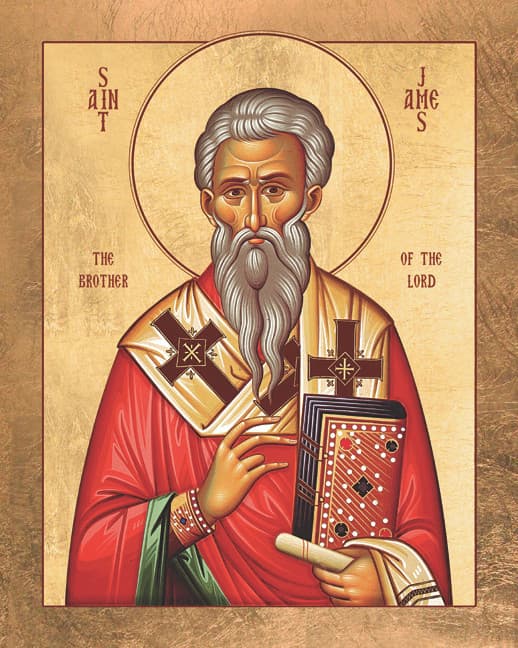
James the Brother of the Lord — Hand-curated icon.
Life
James, called by the early Church "the brother of the Lord" or "the just," was one of the sons of Joseph the Betrothed by his first marriage — an older man already a widower with four sons and several daughters when the priests of the Temple gave the young Virgin Mary into his keeping. He was thus the older half-brother (or in another tradition kinsman) of the Lord and grew up in the household at Nazareth from the time the Holy Family returned from Egypt.
During the Lord's earthly ministry, James and his brothers Joses, Simon, and Jude were not yet believers — the Gospel of John explicitly notes that "neither did his brethren believe in him" (John 7:5). They appear to have thought Him out of His mind and on at least one occasion went out with their mother (their stepmother in fact, the Theotokos) to bring Him home. The Lord's response is recorded — "Who is my mother, and who are my brethren?" — and the breach widened until the Resurrection.
The risen Lord appeared to James personally — one of the few private appearances recorded by Paul (1 Corinthians 15:7) — and from that moment James was a believer. He was at the upper room at Pentecost, was filled with the Spirit with the rest of the household, and was very quickly established as the senior elder of the Jerusalem Church. By the time Paul made his first visit to Jerusalem (around 37, three years after his own conversion), James was already the recognized head of the Jerusalem community — the place we today would call the bishop, though the title was not yet in use.
He presided at the Council of Jerusalem in about 49 — the council described in Acts 15 that ruled on the question of whether Gentile converts must be circumcised. James, the most respected of the Jerusalem elders among the Jewish-Christian party, took the side of Peter and Paul in releasing the Gentiles from the Mosaic Law except for four basic requirements (abstaining from meat offered to idols, from blood, from things strangled, from sexual immorality). His ruling was decisive for the future of the universal Church.
He led the Jerusalem Church for some thirty years from the Lord's repose to his own. By all the accounts he was ascetic in his personal life — he never drank wine, never ate meat, never cut his hair or beard, never washed his body with oil, never wore woolen clothes; his knees were said to be hard as a camel's from constant prayer in the Temple. Even non-Christian Jews of Jerusalem called him "the just" and recognized him as the protector of the city from divine wrath.
He was the author of the catholic epistle that bears his name in the New Testament — a short letter to the Jewish-Christian communities of the diaspora, full of practical exhortation on the relation between faith and works, on the proper use of speech, on the dangers of riches. He was also the author (or originator) of the most ancient of the eucharistic liturgies, the Liturgy of St. James, still celebrated by the Greek Orthodox in Jerusalem and on his feast day in other Greek lands.
In the year 62, during the interim between the death of the Roman procurator Festus and the arrival of his successor Albinus, the high priest Annas the Younger — a Sadducee — convened the Sanhedrin against James on charges of breaking the Law. James was brought to the pinnacle of the Temple at Passover and ordered to deny the divinity of Christ in the hearing of the assembled pilgrims. He instead confessed the Lord, was thrown down from the pinnacle, and survived the fall; the mob then clubbed him to death. A Rechabite priest standing by cried out in protest, and a fuller present finished James with a fuller's club. He was about ninety.
The judicious Jewish historian Josephus, who wrote within thirty years of the event, attributes the destruction of Jerusalem in 70 specifically to the violence done to James — "this most just man." His relics rest at the Cathedral of St. James in the Armenian quarter of Jerusalem, on what is traditionally the site of his martyrdom. His feast is October 23.
Traditions
Feast day
October 23
Topics
Works in library